Managing corporate transit across busy Indian metro cities is a challenging task for large companies. Running round-the-clock operations means dealing with shifting schedules, complex routes, and rising costs.
In fact, major Indian metro cities lose nearly 1.47 Lakh Crore INR every year due to severe traffic congestion, as per a report by The Hindu, directly hurting workforce productivity. To overcome this, progressive organisations are abandoning slow, manual spreadsheets and shifting toward specialised corporate mobility technology.
Understanding what employee transport management system software is is the first step toward building an efficient, transparent, and completely secure workplace commuting network.
Let’s dive deeper!
What Is an Employee Transport Management System?
Before diving into how an employee transport management system works, we must first address the complex logistical challenges modern enterprises face with corporate commutes.
Many organisations still depend on spreadsheets, transport coordinators, phone calls, and manual route planning to manage employee commutes. While this may work for smaller teams, it becomes inefficient when businesses handle hundreds or thousands of employees across multiple shifts.
Some of the common transportation problems faced by enterprises are:
- Delayed pickups and drop-offs
- Lack of route visibility
- High fuel and operational costs
- Poor vehicle utilisation
- Communication gaps
- Safety concerns for employees
- Difficulty managing multiple vendors
- Limited transport data and reporting
An employee transport management system helps businesses automate and centralise these operations.
The Operational Mechanics of an Enterprise Transport Management System
An enterprise transport management system uses intelligent automation as well as data analytics to replace manual tasks. The process begins when employee schedules are loaded or integrated directly from corporate HR platforms.
The software then processes this information to build optimised daily travel routes.
- Rostering and Shift Management: Employees can manage their weekly schedules or request changes through a mobile app before strict cut-off times. The software easily coordinates alternating shift patterns, fixed bus routes, and dynamic night-shift changes.
- Transparent Vendor Allocation: The system automatically assigns trips to transport vendors based on preset corporate rules, performance feedback, and vehicle availability. This creates an open digital record of every single trip.
- AI-Driven Route Optimisation: Rather than letting drivers choose their own paths, the platform calculates and helps decide the routes based on live traffic data. It groups employees by location to ensure high vehicle occupancy while reducing total travel time.
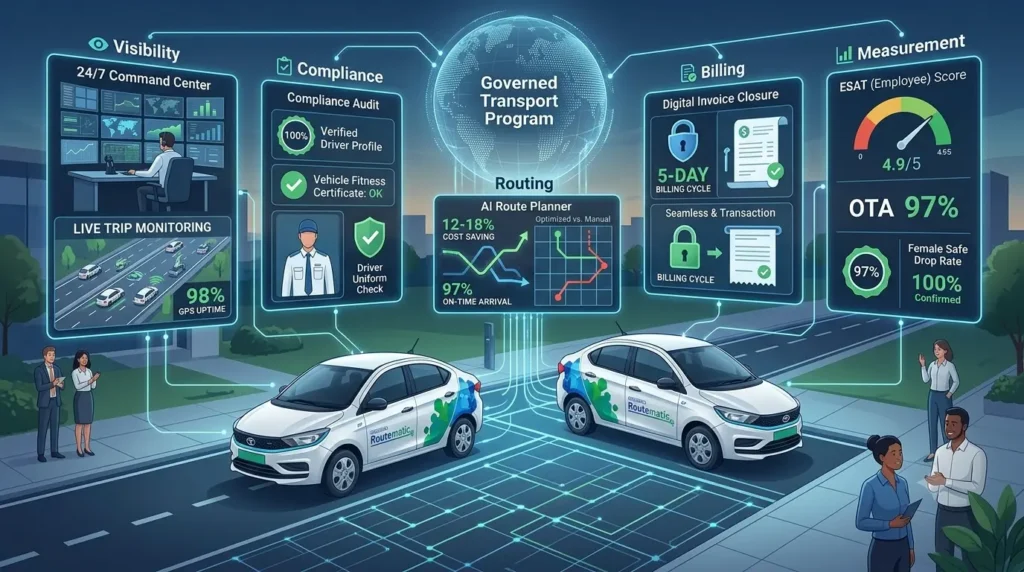
- Live Operations Control: A central web dashboard provides the administrative team with complete operational visibility. Transport teams can monitor active vehicle speeds, track exact routes, and get automated alerts if a vehicle goes off track or encounters a delay.
Key Features of a Modern Enterprise Transport Management System
When an enterprise evaluates transport solutions, they typically seek features that can help to enhance efficiency, scalability, safety, and automation. Understanding the key components of an employee transport management system can aid a business in choosing the right platform for its needs.
1. Automated Route Planning
One of the most important features of an enterprise transport management system is route optimisation. The software automatically creates efficient pickup and drop routes based on employee locations, traffic conditions, and shift timings.
This can significantly reduce travel time and operational costs while improving employee convenience.
2. Real-Time Vehicle Tracking
GPS-enabled tracking gives administrators and employees complete visibility into vehicle movement. Employees can check live cab locations and estimated arrival times, while transport teams can monitor route performance and delays in real time.
Real-time visibility also improves safety monitoring and emergency response management.
3. Driver and Vendor Management
Large enterprises often work with multiple transport vendors and drivers. Managing them manually becomes difficult as operations expand. An enterprise transport management system centralises:
- Driver records
- Allocation of the vendor
- Vehicle documentation
- Billing processes
- Compliance monitoring
- Performance evaluation
It can thus help to improve accountability and operational consistency across various transportation networks.
4. Safety and Emergency Features
Safety is a very important component of enterprise transportation. Modern systems include an array of safety-focused tools, such as SOS panic buttons, geofencing alerts, emergency escalation workflows, driver authentication, and trip-monitoring dashboards.
These capabilities help enterprises maintain safer travel environments for employees.
5. Reporting and Analytics
Advanced reporting dashboards allow businesses to measure transportation performance through actionable data. Some of the very common reports include daily trip reports, route efficiency tracking, fleet utilisation reports, cost analysis and vendor performance metrics.
Such insights are quite helpful as they can support smarter operational planning and continuous process improvement.
6. Mobile App Accessibility
Most modern transportation platforms offer mobile applications for employees, drivers, and administrators. Employees can without a problem:
- View trip schedules
- Track vehicles
- Receive notifications
- Raise support requests
- Submit feedback
Mobile accessibility improves communication and creates a more seamless commuting experience.
The Future of Enterprise Transport Management Systems
The future of enterprise transportation will be shaped by automation, artificial intelligence, sustainability, and smart mobility technologies.
Understanding what an enterprise transport management system is today also means understanding how enterprise transportation will evolve in the coming years. Artificial intelligence is already helping enterprises improve transportation planning through predictive analytics and intelligent route recommendations.
Future-ready enterprise transport management system platforms are required to include:
- AI-powered planning of the route
- Predictive traffic analysis
- Integration of electric vehicle
- Automated monitoring of compliance requirements
- Smart fleet management
- Advanced safety analytics
Electric mobility is also becoming an important focus area for enterprises aiming to reduce their environmental impact.
In fact, as per the Ministry of Heavy Industries, India continues to promote electric mobility, which can support sustainable transportation infrastructure. Also, hybrid work models are changing employee commuting patterns. Enterprises now require more flexible transportation systems that can adapt to changing office attendance schedules.
This makes intelligent and scalable transportation platforms even more important for modern businesses.
How Routematic Supports Enterprise Mobility?
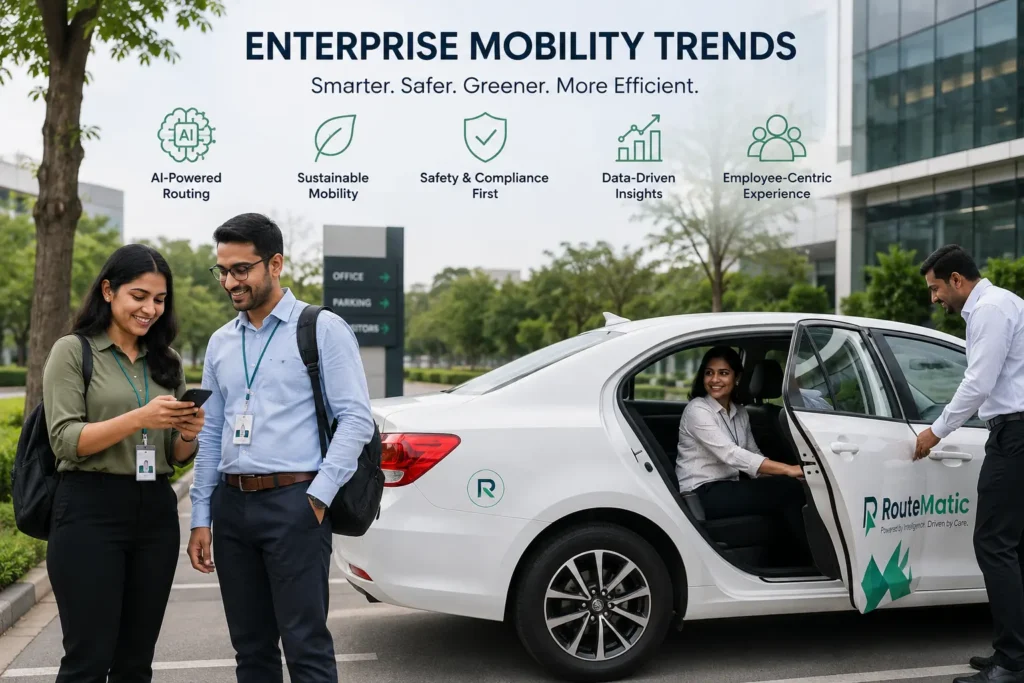
Routematic helps enterprises simplify and modernise employee transportation through smart, technology-driven mobility solutions. The platform is designed to manage large-scale workforce transportation efficiently while improving employee safety, operational visibility, and cost control.
Routematic uses automation and AI-powered route optimisation to reduce travel time, improve vehicle utilisation, and lower transportation costs. Its real-time tracking system enables employees and transport teams to monitor trips in real time, improving transparency and smoother coordination.
The platform also prioritises employee safety through features such as SOS alerts, geo-fencing, verified drivers, and trip monitoring. These capabilities are especially useful for enterprises managing late-night shifts and large employee movement across multiple office locations.
Conclusion
Understanding how an employee transport management system works is essential for enterprises looking to improve workforce mobility, safety, and operational efficiency. As businesses expand and adopt flexible work models, managing employee commutes manually quickly becomes complex, expensive, and unreliable.
A modern enterprise transport management system helps organisations automate daily transport operations, optimise routes, improve vehicle utilisation, and ensure safer employee commutes through real-time tracking and smart scheduling.
As enterprise mobility continues to evolve in India, businesses need scalable and technology-driven transportation solutions. They also need platforms like Routematic, which help organisations build smarter, safer, and more efficient employee transport ecosystems.
Frequently Asked Questions
What is an employee transport management system in enterprises?
An employee transport management system is a technology-based solution that helps enterprises manage employee pickup and drop-off operations through automated scheduling, route optimisation, live tracking, safety monitoring, and transport analytics.
Why do enterprises need an employee transport management system?
Enterprises need an employee transport management system to improve employee safety, reduce transportation costs, automate operations, manage large-scale workforce mobility, and improve overall transport efficiency.
How does employee transport software improve employee safety?
Employee transport software aims to improve safety through GPS tracking, SOS alerts, geofencing, verified drivers, emergency escalation systems, as well as real-time trip monitoring, thereby considerably enhancing travel security.
Should enterprises replace manual transport operations with automated systems?
Yes, enterprises that have large workforces need to consider automated systems because manual transport operations often lead to higher costs, operational inefficiencies, and limited scalability.
Is investing in employee transport management software worth it for growing enterprises?
Yes, small as well as medium enterprises can greatly benefit from improved efficiency, reduced operational costs, greater employee satisfaction, and stronger transportation control, making the investment highly valuable in the long term.