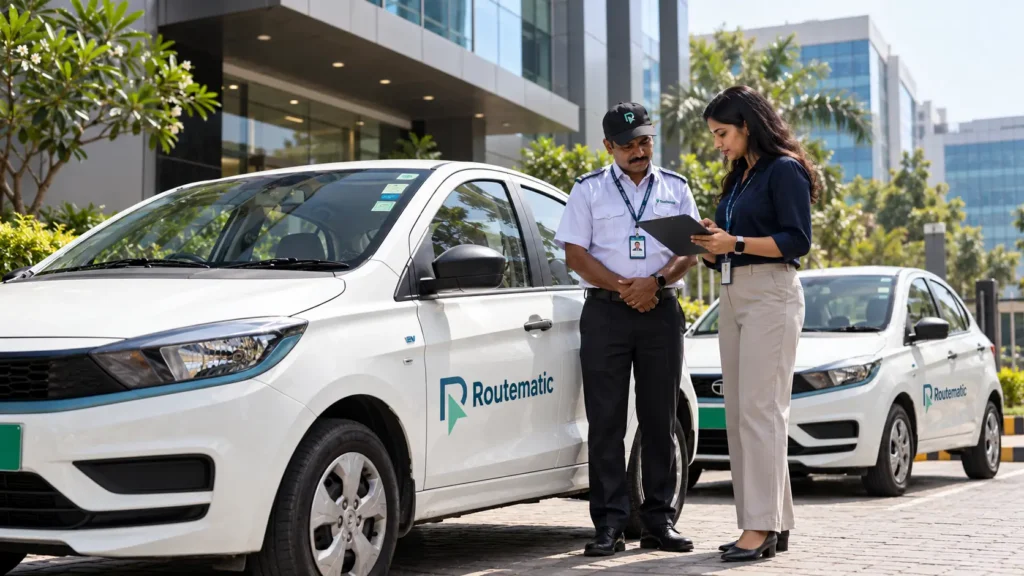
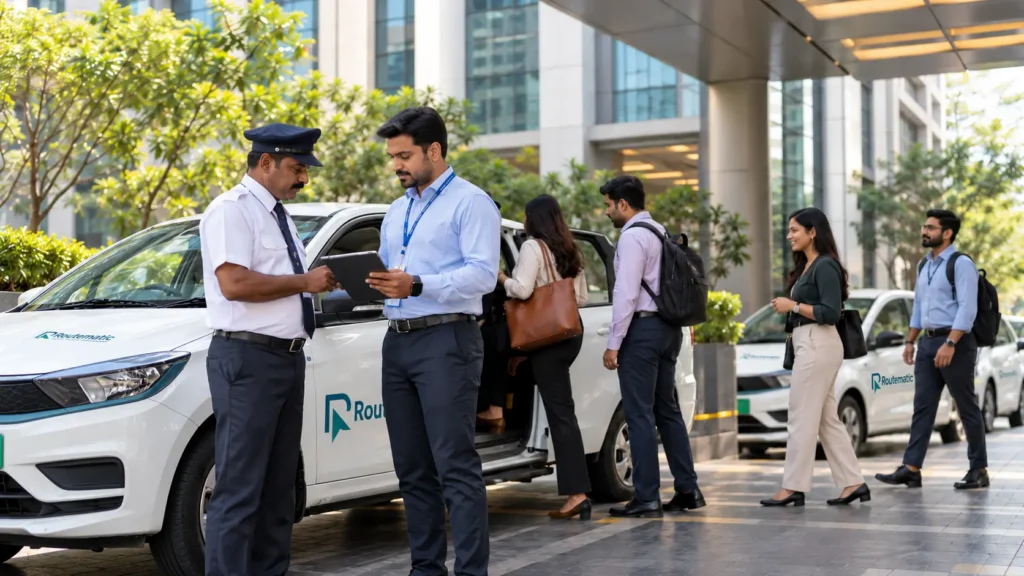
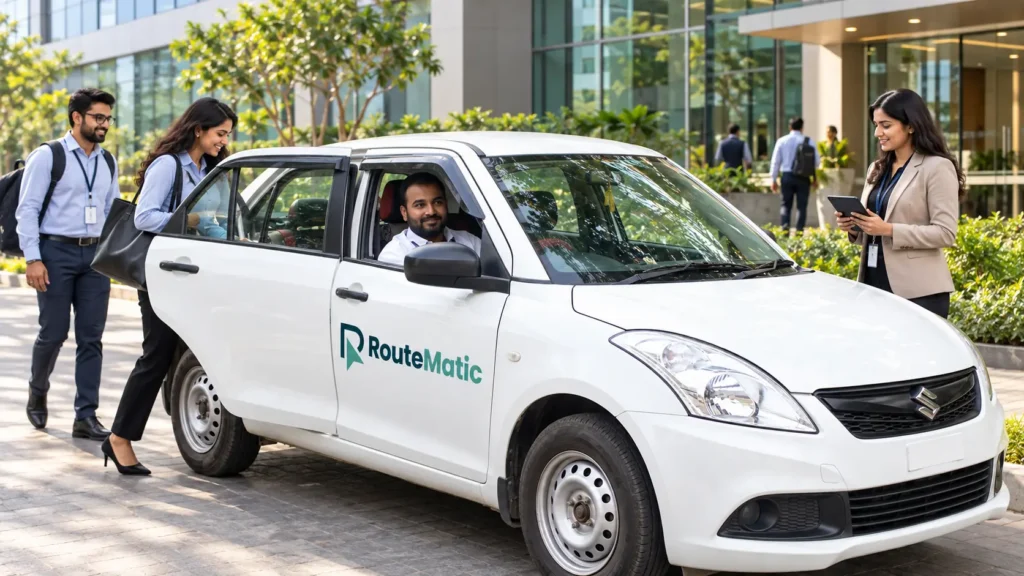
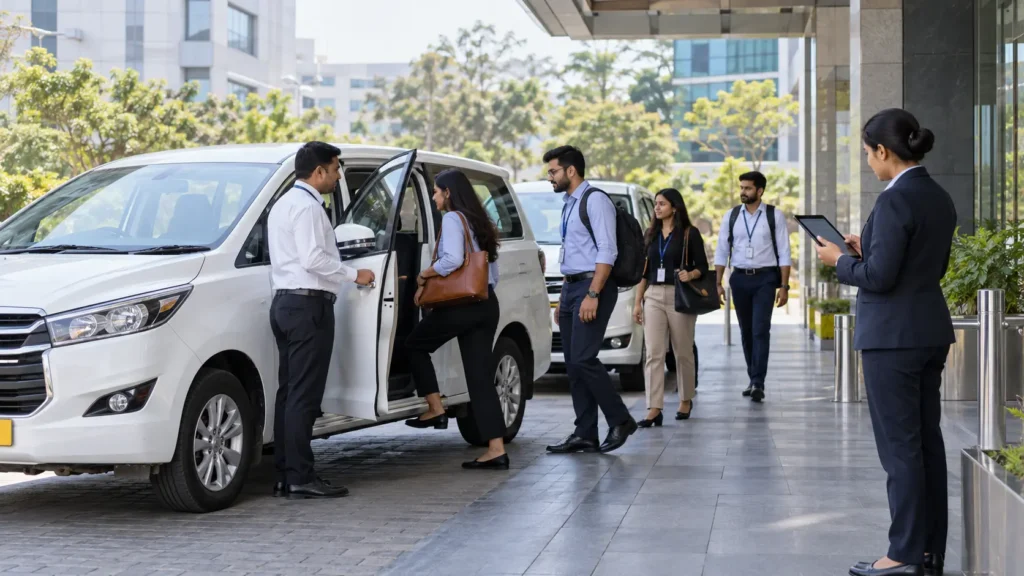
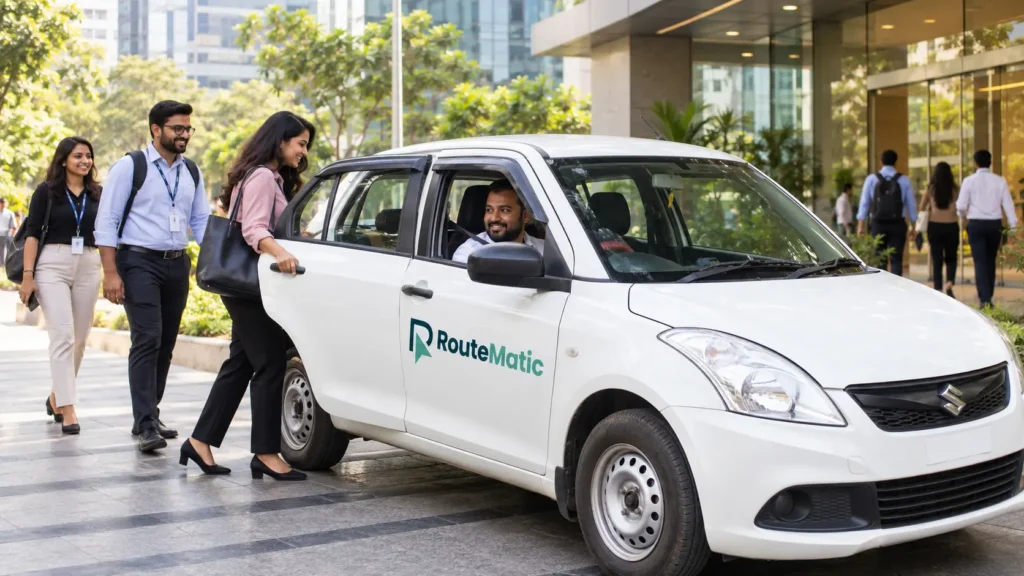
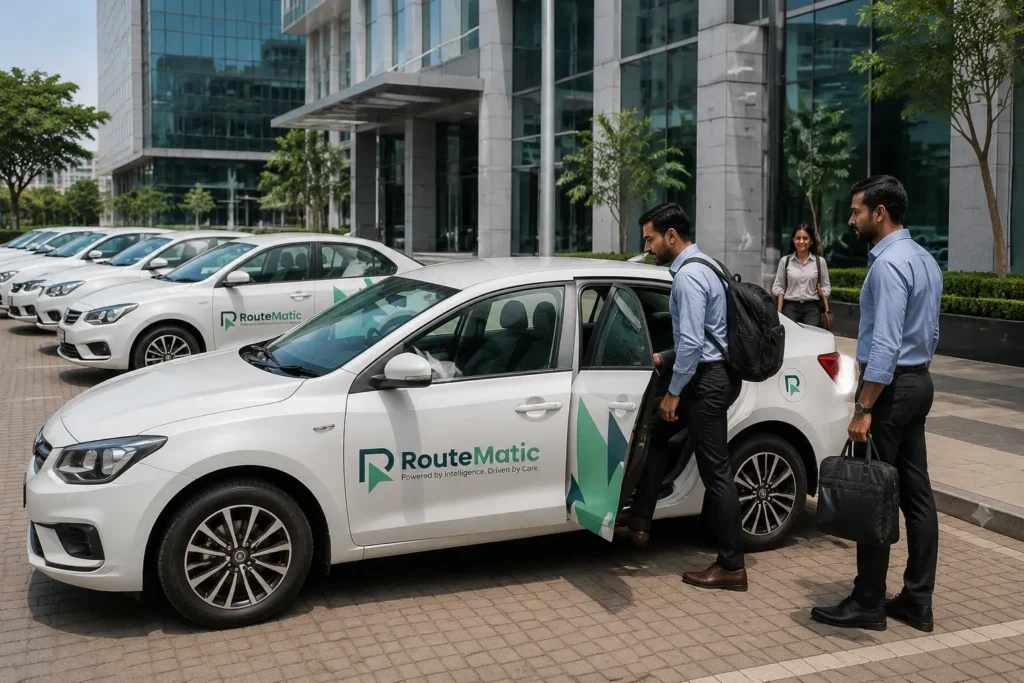
Corporate mobility refers to the structured, employer-managed movement of employees between their homes and workplaces, and across business locations. In the enterprise context, it covers the full system: fleet operations, route planning, driver compliance, safety protocols, billing, and real-time monitoring.
For large organisations especially in India’s rapidly growing GCC and IT services sectors corporate mobility is not a logistics convenience; it is a governance function that directly controls cost, safety, liability, and workforce productivity.
What Is Corporate Mobility?
Corporate mobility is the employer-organized system for moving employees to, from, and between work locations, encompassing fleet operations, route planning, driver compliance, safety protocols, billing, and real-time monitoring. In India, corporate mobility refers specifically to structured employee commute and inter-office transport programs managed by enterprises to ensure safety, cost control, and operational accountability. The term covers every element involved: the fleet of vehicles, the routes they follow, the drivers who operate them, the technology that monitors trips, the compliance checks applied to vehicles and personnel, and the billing systems that account for every rupee spent.
At its most basic level, corporate mobility is how an organisation answers the question: how do our people get to work safely, on time, and at a controllable cost?
At its most sophisticated, which is where large enterprises, GCCs, and high-compliance industries operate, corporate mobility is a governance system. It produces audit trails. It enforces safety protocols. It generates financial data that Finance and Procurement teams can act on. It produces ESG disclosures that boards and investors review.
The confusion between these two levels is common and expensive. Organisations that treat corporate mobility as a basic logistics function tend to underinvest in it until a safety incident, a billing audit, or a compliance failure forces the issue.
For enterprises running more than 100 vehicles daily across multiple cities, the model chosen is not a procurement decision. It determines whether the organisation has real control over its transport operations, or the appearance of it. Learn how employee transport management software enables this control, and explore best practices for sustainable commuting incentives.
What Are Corporate Mobility Solutions?
Corporate mobility solutions also called corporate mobility services are the platforms, services, and operational models that enterprises use to manage employee transportation at scale. They include SaaS dashboards, aggregator networks, managed transport services, and integrated Transport-as-a-Service (TaaS) models. They range widely in what they provide.
Technology-only platforms (SaaS) give transport managers a dashboard for booking, routing, and tracking. The organisation still manages its own vendors, drivers, and compliance checks. The technology creates visibility, but does not guarantee that what it makes visible is compliant or under control.
Aggregator models connect enterprises to ride-hailing pools or third-party cab vendors. These models offer flexibility and no fixed fleet costs. They trade off consistency: driver quality, vehicle standards, safety protocols, and billing accuracy vary across vendors and cities.
Managed transport services outsource operations to a provider that takes accountability for the fleet, drivers, and outcomes. The quality of a managed service depends entirely on whether the provider has its own operational infrastructure or is simply coordinating other vendors.
Hybrid TaaS (Transport-as-a-Service) models combine all three layers. The provider operates an owned, standardised fleet, integrates AI-driven routing and compliance technology, and maintains 24/7 command centre operations to monitor and respond to every trip in real time. This model is the only one that delivers quantified SLAs across safety, cost, and reliability simultaneously.
For enterprises running more than 100 vehicles daily across multiple cities, the model chosen is not a procurement decision. It determines whether the organisation has real control over its transport operations, or the appearance of it.
The 5 Measurable Benefits of Structured Corporate Mobility
1. Cost Control and Leakage Prevention
Poorly governed transport is a source of consistent financial loss. Ghost trips, overbilling, low vehicle occupancy, route duplication, and the absence of automated billing validation all compound over time into material spend that organisations cannot account for. A large enterprise running 500 vehicles daily without centralised billing automation can accumulate billing discrepancies across monthly invoices without any mechanism to detect them.
Structured corporate mobility addresses this at the process level. AI-driven demand forecasting matches vehicle deployment to actual employee needs. Occupancy optimisation reduces the number of vehicles dispatched with fewer than half their seats filled. Automated billing validates every trip against route data, eliminating manual entry errors and vendor-inflated claims.
RouteMatic consistently delivers 12–18% cost savings for enterprise clients, achievable within the first year of structured operations. This is not achieved through renegotiating vendor rates. It is achieved by removing the structural inefficiencies that unmanaged transport accumulates.
2. Safety Accountability and Audit Readiness
Employee safety during commutes carries direct liability for the employer. This liability is highest during late-night and early-morning shifts, and highest of all for female employees travelling alone.
Structured corporate mobility solutions address this through layered controls: driver background verification, vehicle fitness documentation, GPS-based real-time trip monitoring, automated Safe Drop confirmation, and command centre escalation protocols for any deviation from the expected route or schedule.
The audit dimension is equally important. When a safety incident occurs, the first question from leadership, legal, and regulators is: what records exist? A mobility system with centralised, digital audit trails can answer that question. A fragmented vendor ecosystem with no standardised documentation cannot.
3. On-Time Performance and Workforce Productivity
Commute experience directly affects workforce performance. Research published in ScienceDirect in 2024, drawing on survey data from 550 white-collar employees, found a measurable link between longer, more stressful commutes and declines in self-reported job performance, with the effects compounding over time rather than being absorbed.
A 2023 study by the Indian Institute of Management Bangalore found that employees in Bengaluru and Hyderabad lose an average of 1.5 hours daily to commute delays, directly impacting work readiness and first-hour productivity. On-time arrival at the first pickup point (measured as FOTA, First-point On-Time Arrival) is the single most visible indicator of transport quality from the employee perspective. When the cab is late to the first stop, every subsequent stop runs late, and employees arrive stressed and not prepared.
RouteMatic maintains 97% OTA/OTD (On-Time Arrival and Departure) and 97% FOTA (Flight On-Time Arrival) rates across its operations. This is the result of AI-powered route planning that accounts for real-time traffic, historical patterns, and dynamic shift changes.
4. Employee Experience and Retention
For enterprises competing for skilled talent in cities like Bengaluru, Hyderabad, Pune, and Gurugram, where commute times are long and traffic is dense, employer-provided transport is a meaningful differentiator in the hiring decision. It is also a retention lever that costs far less than replacing a departing employee.
An ESAT (Employee Satisfaction) score of 4.9/5 across RouteMatic’s client base indicates that structured, reliable, safe transport shapes how employees perceive their employer’s investment in their daily experience.
5. ESG Performance and Reporting
According to Autocar Professional, sustainable transportation is no longer part of a corporate social responsibility programme; it is a necessity linked to ESG performance, brand reputation, and the long-term viability of an organisation.
India’s SEBI BRSR (July 2023) (Business Responsibility and Sustainability Reporting) framework now requires listed companies to disclose Scope 3 emissions, including employee commuting. This turns transport from an operational cost centre into an ESG disclosure item that investors and regulators will scrutinise.
Structured corporate mobility addresses this directly. Shared routes reduce per-employee emissions. EV integration reduces fleet-level carbon output. Occupancy optimisation cuts the number of vehicles on the road. Every trip generates data that feeds the sustainability dashboard.
How to Build a Corporate Mobility Strategy
A corporate mobility strategy is the documented framework that defines how an organisation will manage employee transportation: which service models to deploy, which vendors to engage, which technology platforms to use, and which performance metrics to track. It aligns transport operations with broader business goals cost control, safety, ESG commitments, and workforce productivity.
Building a strategy starts with three questions: What is the current state of our transport operations? What are the measurable gaps (cost leakage, safety incidents, compliance failures)? And what outcomes do we need to achieve in the next 12-24 months? The answers determine whether the organisation needs a SaaS platform, a managed service, or a full TaaS model.
What Triggers an Enterprise to Formalise Its Mobility Strategy?
Three scenarios consistently drive enterprises to move from informal or fragmented transport management to a structured corporate mobility solution.
Rapid Headcount Growth or Geographic Expansion
Rapid headcount growth or geographic expansion. A GCC opening a second delivery centre in Pune while running operations in Hyderabad cannot manage two separate vendor ecosystems with the same approach. Standardisation breaks down. Costs diverge. Safety monitoring becomes inconsistent across sites.
Audit Observation or Leadership Escalation
When internal audit teams or senior leadership review transport operations and find billing discrepancies, missing compliance documentation, or unresolved safety incidents with no audit trail, the pressure to restructure is immediate. The question shifts from ‘can we improve’ to ‘how quickly can we fix this?’
Financial Pressure from Rising Transport Spend
When transport costs exceed budget without a clear explanation, when Finance cannot reconcile billed trips with rosters, or when per-seat costs vary dramatically across cities, the decision to centralise governance becomes a financial imperative, not a preference.
India’s GCC ecosystem, which stood at 1,550 centres in 2023, is projected to reach 2,400 by 2030, according to EY’s Future of GCCs in India: A Vision 2030 report. This growth rate makes the scalability question urgent for every GCC currently managing transport through informal vendor relationships.
Corporate Mobility and ESG: The Connection Most Enterprises Miss
Most ESG conversations about transport focus on EVs. This is a useful starting point, but sustainable corporate mobility requires a broader frame.
The full ESG contribution of a structured corporate mobility programme is broader:
Scope 3 emission reduction. Employee commutes are a Scope 3 emission source. Every shared vehicle that replaces multiple private cars reduces the carbon intensity of the commute. Every route optimised to reduce idle time and unnecessary kilometres lowers the total fuel burn. Every EV deployed reduces tailpipe emissions to near zero.
Social governance. Women’s safety protocols, driver verification, night-shift compliance, and accessible escalation mechanisms are social governance outcomes.
Operational transparency. Automated billing, digital audit trails, and real-time performance dashboards produce the governance transparency that the G in ESG demands.
As Scope 3 emissions gain prominence in ESG reporting, companies are recognising that employee travel, especially in cities such as Bengaluru, Delhi NCR, Hyderabad, Mumbai, and Pune, constitutes a significant carbon footprint.
RouteMatic currently operates a fleet with 10% EV penetration and is expanding its electric capacity in line with enterprise ESG commitments. The platform’s sustainability dashboard generates verifiable CO₂ reduction data that feeds directly into client ESG disclosures.
How RouteMatic Delivers Measurable Corporate Mobility Outcomes
RouteMatic is India’s most trusted employee transport partner, serving 400+ enterprises across 24 cities, including 125 GCCs and 38 Fortune 500 companies. It is the only platform in this space that combines an owned fleet with integrated AI technology and 24/7 command centre operations under a single accountability model.
RouteMatic delivers corporate mobility solutions in Bengaluru, Hyderabad, Pune, Mumbai, Delhi NCR, and 19 other cities across India, ensuring consistent service quality and compliance standards nationwide. This matters because the gap between a technology provider and a transport partner is where most corporate mobility failures occur. A SaaS platform tells you what is happening. RouteMatic tells you what is happening and is operationally accountable for what happens next.
Proof from the Asset Catalogue
A BFSI client with billing leakage. RouteMatic’s AI billing forensics identified and resolved hidden transport costs across a large financial services organisation. The case study documents ₹12 Cr in hidden transport costs uncovered through automated billing validation, costs that had been accumulating without detection under the previous vendor-led model. Read the full case study →
An IT services company with EV utilisation challenges. AI-driven vehicle deployment raised EV utilisation from a low baseline to 78% for a leading IT services organisation, demonstrating that an EV transition without intelligent deployment optimisation results in underutilised, expensive assets. Read the full case study →
A global consulting firm with a broken commute system. RouteMatic transformed operations for a global consulting firm experiencing consistent SLA failures across its employee commute programme, replacing a fragmented vendor ecosystem with a single, standardised operation. Read the full case study →
Thermofisher Scientific (enterprise manufacturing and life sciences): “RouteMatic’s technology-integrated fleet helps us drive safety and compliance. Real-time feeds help us address queries immediately, enhancing employee satisfaction.”, Manager Facilities, South East India
HCL Technologies (global IT services): “Engaging with RouteMatic has been a transformative experience. Aligned technology in transport helped us run operations more efficiently with transparency and accuracy.”, Associate General Manager (GWS), HCL Tech
Sagility (healthcare BPO): “RouteMatic has helped enhance our employee transport experience, optimising routes and maximising vehicle occupancy to reduce fuel consumption and emissions.”, Senior VP, Global Head of Real Estate, Sagility
Performance Benchmarks
| Metric | RouteMatic Performance |
| Cost savings delivered | 12–18% |
| On-Time Arrival / Departure (OTA/OTD) | 97% |
| First point: On-Time Arrival (FOTA) | 97% |
| Female Safe Drop compliance | 100% |
| Driver and vehicle compliance | 100% |
| Employee Satisfaction Score (ESAT) | 4.9 / 5 |
| No-show rate | ≤ 5% |
| Billing closure | < 5 days |
| Automated Female Safe Drop confirmation | 98% |
These are operational outcomes, not product claims. They are delivered at a scale of 75,000 daily trips and 5 million monthly rides across 24 Indian cities.
FAQs
What does corporate mobility mean?
Corporate mobility means the employer-managed system for transporting employees between home, office, and business locations. In India, it refers to structured employee commute programs that include fleet management, route optimization, driver verification, real-time tracking, billing automation, and safety compliance ensuring cost control, workforce productivity, and regulatory accountability for enterprises.
What are corporate mobility solutions used for?
Corporate mobility solutions are used to manage employee commute operations at scale. Specifically, they handle route planning and vehicle deployment, driver and vehicle compliance tracking, real-time trip monitoring, employee booking and roster integration, automated billing and audit trails, and sustainability reporting.
What is corporate mobility management?
Corporate mobility management is the end-to-end governance of employee transport operations, covering policy design, vendor selection, fleet deployment, compliance monitoring, cost tracking, and performance reporting. Effective management requires centralized technology platforms, real-time data analytics, automated billing validation, and 24/7 operational oversight to ensure safety, cost efficiency, and audit readiness across all employee commute programs.
No. Structured corporate mobility becomes relevant when an organisation operates more than 50 vehicles daily, runs across multiple shifts, or has compliance obligations regarding employee safety, particularly for female employees during late-night operations. Companies with 500+ employees in cities with long commutes benefit measurably from structured corporate mobility, whether they are mid-sized enterprises or large multinationals.
Three things: owned or directly managed fleet (not just a vendor coordination layer), integrated technology with real-time monitoring and automated billing, and 24/7 operational accountability through a command centre. The combination of all three is what separates a transport partner from a transport vendor. Ask specifically: who is accountable when a driver does not arrive? Who escalates a safety incident at 2 AM? Who validates billing against actual trips? The answers reveal the model.
For enterprises ready to move from fragmented vendor management to a structured, measurable transport operation, explore RouteMatic’s TaaS model or review client outcomes.