Night shift employee transportation is not just about getting people from point A to point B after dark. It is a legal compliance obligation, a safety protocol, and an operational risk layer that your company owns, not your vendor. For IT, BPO, BFSI, and GCC organizations in India running 24/7 operations, getting night shift transportation wrong is one audit observation away from becoming a board-level conversation.
Key Takeaways
- Under India’s Occupational Safety, Health and Working Conditions Code (enforced in late 2024 and 2025), safe night-shift transportation for female employees working between 7 PM and 6 AM is a legally binding employer obligation, not a vendor’s responsibility.
- Compliance cannot be ensured solely by technology. Transportation systems have flaws that software can’t fix until there is a standardized fleet, vetted drivers, and a command center that’s open all the time.
- Overbilling, ghost trips, and low vehicle occupancy are examples of financial leaks in unmanaged night-shift transport. These types of expenses don’t always appear clearly on a P&L but can quickly accumulate.
- With an AI-driven routing system in place for the night shift, transportation expenses can be cut by 12–18% without sacrificing punctuality, all while keeping arrival rates at 97%.
- Confirmation of a female employee’s safe arrival home, known as Female Safe Drop, is no longer an optional perk but rather an essential operational need.
So, Your Company Runs Night Shifts. Who’s Actually Responsible for how People get Home?
If something happens to a woman employee traveling home at 2 AM in a cab your vendor arranged, who is legally accountable?
Spoiler: It is your company.
The Occupational Safety, Health, and Working Conditions Code of India makes this very evident as it is gradually enforced across all states from 2024 to 2025. Female night-shift employees have a right to safe, recorded transportation provided by their employers. This includes door-to-door service, emergency escalation procedures, and transport records.
Going a step further, government circulars issued in March 2025 specifically included safe mobility as a need for employers. Night shift taxis are now required by several states to deploy security guards, install CCTV cameras in their vehicles, and keep transit records. One such state is Haryana.
What Does Unmanaged Night Shift Transport Actually Look Like on the Ground?
You have probably seen this play out. A coordinator manages five vendors over WhatsApp. Drivers call employees directly when they are running late. No one really knows which cab is where at 3 AM. A female employee’s safe drop is “confirmed” by the driver telling the coordinator he dropped her, no digital record, no callback, no audit trail.
That is the version of night shift transportation solutions most companies are still running. And the problems are predictable:
Safety gaps that are one incident away from a crisis. Your night shift fleet is basically running on trust if there isn’t standardized driver verification, consistent background checks, and real-time trip monitoring. Nearly all women (91%) report feeling unsafe while utilizing public transportation, particularly at late hours, according to the Ola Mobility Institute. Your company’s reputation takes a hit long before any legal ramifications arise when your fleet begins to resemble that event.
Financial leakages you cannot see. Fragmented vendor models often result in “ghost trips,” in which a taxi is charged for a trip that never occurred. There are several reasons your real cost per seat may exceed your transport budget. These include route duplication, poor vehicle occupancy, and overbilling without a digital audit trail. Due to sloppy tracking, some of this spending does not add up to a tidy sum.
Compliance exposure that scales with headcount. Your compliance surface becomes more complex as your night shift staff grows. Having five different suppliers in three cities, with inconsistent driver documentation, is not an issue for the transport administrator. This finding is from an audit.
Why “We Have an App” is not the Same as Having a System
Many companies think they have solved their late-night commute problem for employees by deploying a tracking app or a transport management tool. And look, technology helps. A lot. But here is the thing: software can tell you where a cab is. It cannot ensure the driver is verified, the vehicle passed a safety check this morning, or that someone at a command center actually picked up the phone when the cab went off-route at midnight.
This is the gap that most pure-SaaS transport solutions leave open. You get visibility. You do not necessarily get accountability.
Transportation for night shift employees entails more than simply getting them from A to B in the dark. All three of these things, legal compliance, safety protocol, and operational risk layer, are your company’s responsibility, not the vendor’s. Companies in India’s IT, BPO, BFSI, and GCC industries that operate around the clock are just one audit observation away from a board-level discussion about night-shift transportation gone awry.
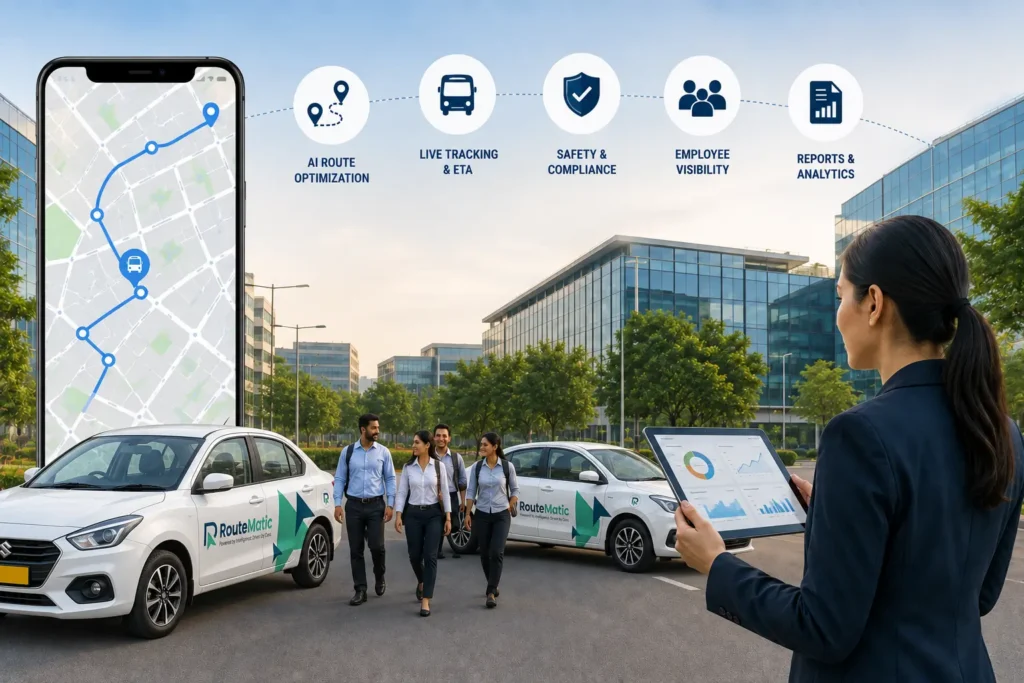
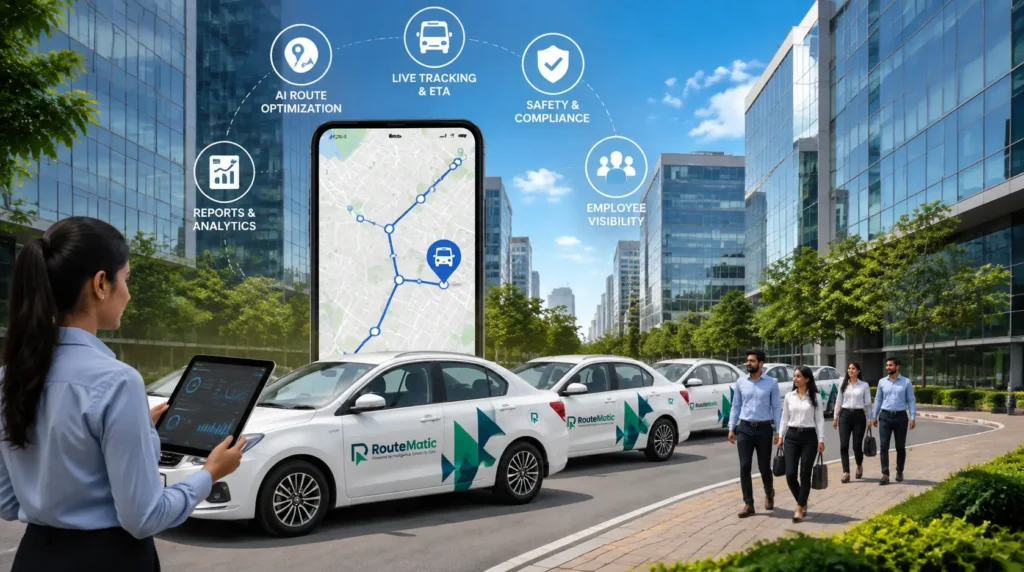
That is exactly the model RouteMatic runs. As India’s most trusted employee transport partner, serving 400+ enterprises, including 125 GCCs and 38 Fortune 500 companies across 24 cities, RouteMatic operates 4,500 owned vehicles with integrated technology. Not a SaaS layer on top of someone else’s cabs. An actual hybrid model where the fleet, the technology, and the operational accountability sit under one roof.
The output from that structure is quantifiable. With a punctuality rate of 97%. Complete safe-drop compliance for females. Complete record-keeping for drivers and vehicles. Billing will be closed in less than a week. Instead of aspirational benchmarks, your procurement and finance teams can use these stated SLA outcomes in contracts.
What Good Night Shift Transport Compliance Looks Like, Specifically
If you are evaluating your current employee transport solutions for night shifts, here is a practical checklist worth running through:
Driver and vehicle compliance. It is imperative that all drivers possess up-to-date documentation of their license, background check, and vehicle fitness certificate; documents older than 6 months are not acceptable. Every vehicle and driver is kept up to date through RouteMatic’s platform, which runs automated compliance alerts.
Female Safe Drop confirmation. This is the one that matters most legally and operationally. 98% of RouteMatic’s safe drop confirmations are automated, with a digital, timestamped record confirming that a female employee was safely home. The remaining 2% are followed up with a manual callback. That is the audit trail your compliance team needs.
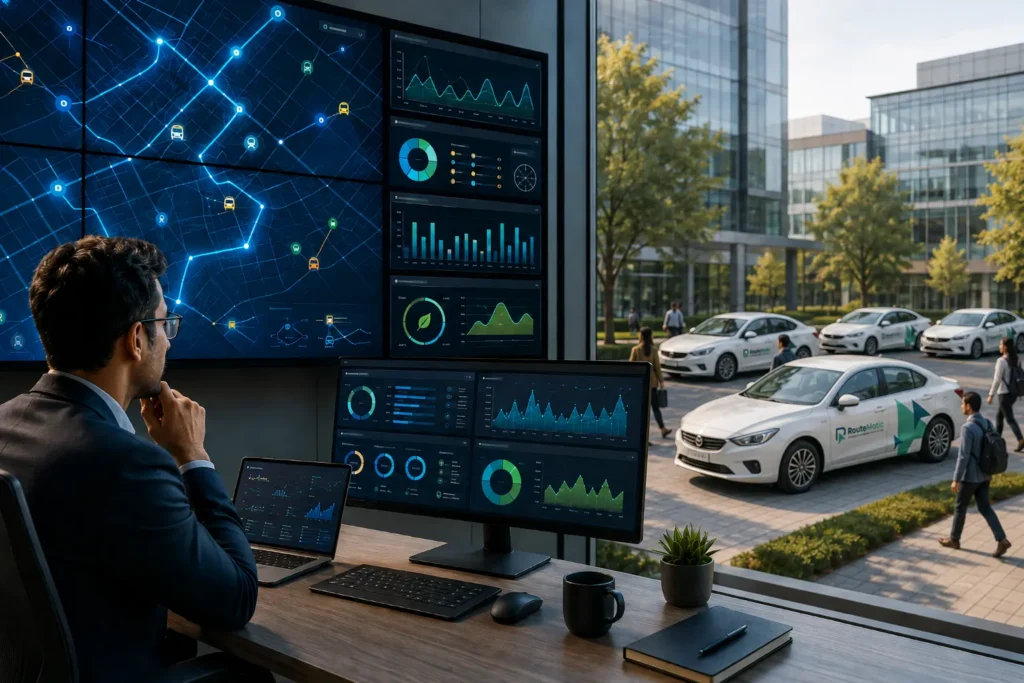
Real-time trip monitoring with deviation alerts. If a cab goes off the approved route at 1 AM, someone needs to know in real time, not the next morning. A 24/7 command center with 15+ active safety alerts during trips is what this looks like in practice.
Panic workflow. Employees need a clear, instant escalation path, not a “call HR” instruction. An in-app SOS that routes to a command center that is actually staffed through the night is the standard.
The Cost Side of the Conversation
Night shift transport tends to get ring-fenced in most transport budgets as a “necessary cost,” and that framing stops people from questioning whether it is being managed well. Here is what AI-driven night shift employee transportation actually does to that cost line.
Using historical boarding data and current cancellations, AI-driven demand forecasting determines the optimal number of vehicles for a given shift. By optimizing occupancy, seats are filled before midnight, when cabs are only half full. The human back-and-forth with vendors that extends billing cycles to 30 days or more and generates disputed bills can be eliminated with automated billing reconciliation.
The result was a 4.9/5.0 employee satisfaction rating, a 12-18% reduction in no-show rates compared to conventional transportation methods, and a cost savings of 5% overall. Such proportions are substantial for a major corporation that conducts 75,000 daily travels.
FAQs
What is Female Safe Drop and why does it matter for compliance?
Female Safe Drop is a documented, auditable confirmation that a female employee was safely dropped at her home after a night shift. It requires a digital record, a manual confirmation from a driver does not satisfy compliance requirements. RouteMatic achieves 98% automated safe drop confirmation, with manual callbacks for the remaining 2%.
How is AI used in night shift employee transport solutions?
Several applications of AI include demand forecasting, route optimization, real-time deviation alerts, automated billing validation, and the elimination of manual reconciliation errors. These technologies help with tasks such as predicting the number of vehicles needed per shift, minimizing dead kilometres, and maximising seat occupancy. All of these things work together to make flights more punctual and cheaper per passenger.
What financial leakages should I look for in our current night shift transport model?
The most common ones are ghost trips (billed trips that did not happen), route duplication across multiple vendors, low vehicle occupancy on late-night routes, and billing disputes caused by the absence of a digital audit trail. If your billing closure is taking more than 10 days, that is usually a signal that documentation is fragmented.
Can a single transport platform manage both day and night shift operations across multiple cities?
Yes. A platform like RouteMatic’s Transport SuperApp handles dynamic shift-based transport, fixed routes, and multi-city standardisation from a single command centre. The same compliance standards, billing model, and safety protocols apply regardless of shift timing or geography, which is specifically what enterprises running GCCs across Bengaluru, Hyderabad, Pune, and other cities need.
About the author

Kavitha Ramachandragowda
Co-Founder & Executive Director, RouteMatic
As Co-Founder and Executive Director of RouteMatic, Kavitha Ramachandragowda is passionate about shaping the future of employee transportation through innovation and customer-centric solutions. She shares about workplace experience, women's safety, sustainability, enterprise mobility, and the leadership strategies that enable organizations to build smarter commuting programs.