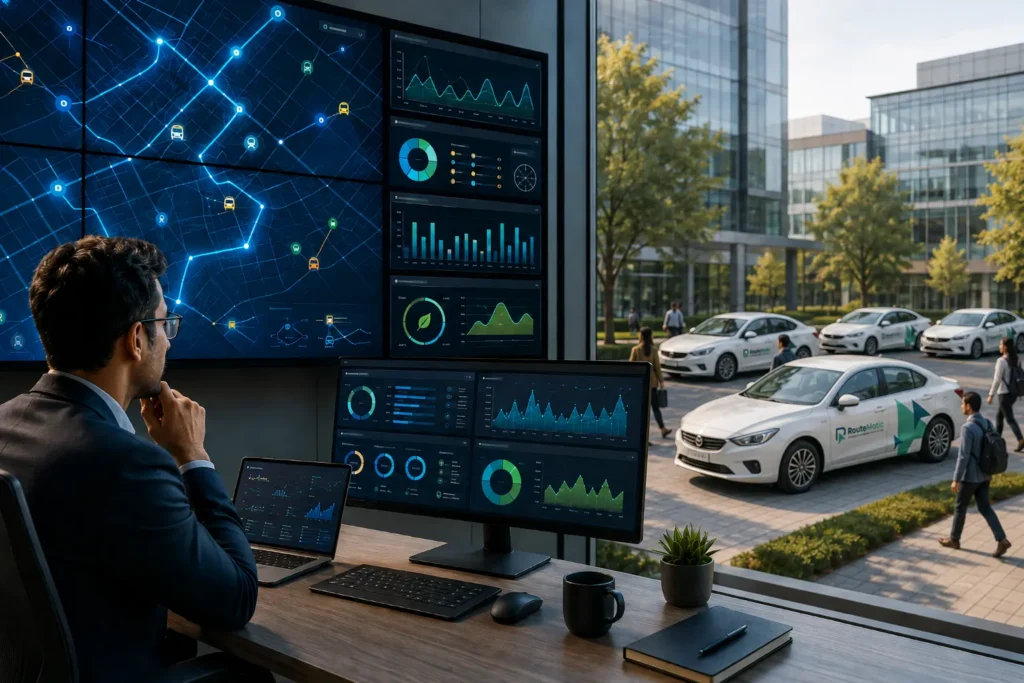
When it comes to moving thousands of employees, it is no longer a logistics task. It is a big deal for large companies and Global Capability Centers (GCCs), as it involves various factors, including safety, law, and finance.
The traditional transportation methods no longer work, as there is no transparency. Hence, using modern employee transportation management software is now essential for even large-scale organisations.
By taking advantage of employee transport management software benefits, businesses can move away from messy paperwork to an efficient and smart AI-driven system. In fact, companies that adopt data-driven operations can improve efficiency by up to 20%.
In this article, we examine seven key benefits of employee transport management software and how they help transform enterprise mobility into a strategic advantage.
TL;DR
- Employee transport management software replaces manual processes with AI-driven systems that improve safety, efficiency, and cost control.
- It helps enterprises optimise routes, automate billing, track compliance, and improve employee commute experiences.
- Real-time data and analytics enable better decisions, scalability across locations, and stronger ESG performance.
- A complete transport solution combines technology and operations to reduce risks and drive long-term business value.
What Are the Benefits of Using Employee Transport Management Software?
Employee transport management software helps organisations move from manual, error-prone systems to a structured, data-driven approach, improving cost control, safety, efficiency, and overall employee commute experience.
Let us look at the seven benefits of employee transportation software:
1. Enhanced Safety and Automated Compliance
Safety is meant to be the top priority for any corporate transport operation. In an unmanaged model, a single lapse in driver verification or vehicle fitness can lead to severe legal and reputational risks. One of the primary benefits of employee transport management software is that it builds safety into the system.
- 100% Compliance Architecture: Every vehicle, as well as driver on the platform, is required to pass strict digital checks. If a driver’s license or a vehicle’s insurance expires, the system automatically blocks them from the roster.
- 24/7 Command Centre Oversight: All trips are monitored in real-time. If a vehicle deviates from its path or stops unexpectedly, an alert is triggered in the command centre for immediate action.
- Special Protection for Night Shifts: For employees working late hours, the software enforces “safe-drop” protocols. This includes the automated female safe-drop confirmation, ensuring that a female employee is never the last person in the cab.
According to global fleet data, companies using AI-powered monitoring see a 75% reduction in speeding incidents, directly leading to fewer accidents and a safer journey for staff.
2. Significant Cost Savings and Financial Transparency
For Finance and Procurement heads, uncontrolled transport spend is a constant worry. Without a digital audit trail, ghost trips, which are rides that are billed but never taken, and route duplication go unnoticed.
Using smart employee transport management software helps eliminate these leakages.
- AI-Driven Route Optimisation: The software doesn’t just map a path; it also uses demand forecasting to group employees, ensuring high vehicle occupancy.
- Automated Billing Validation: Every trip leaves a digital footprint. Invoices are generated based on actual GPS data, which reduces billing closure time to less than 5 days.
- Eliminating Route Duplication: AI ensures that two cabs aren’t sent to the same area when one larger vehicle could suffice.
Reports from the World Economic Forum explain that digital route optimisation can, in fact, reduce total mileage by up to 10%, which will directly help to save fuel and also lower operational costs.
3. Supporting ESG and Sustainability Targets
Sustainability is a major goal for the modern enterprise. Employee commuting is one of the largest sources of Scope 3 emissions. One of the benefits of using employee transport software is the ability to track and reduce your carbon footprint.
By optimising routes and increasing vehicle occupancy, it is easy to naturally reduce the number of cars on the road. Furthermore, RouteMatic helps companies transition to greener fleets. It is easy to get accurate data for ESG reporting, showing exactly how many tons of CO2 were saved through efficient planning and EV usage.
4. Operational Scalability and Multi-City Control
When a business scales up and has offices in a new city or adds a new shift, the transport admin team often feels the strain. Employee transport management software provides a standardised way to manage operations, whether you are in Bengaluru, Pune, or Noida.
As a trusted partner for over 400 enterprises, including many Fortune 500 companies, RouteMatic offers a “plug-and-play” solution. The software automates the most time-consuming tasks:
- Roster Management: The system automatically schedules cabs based on shift times and employee locations, reducing the Admin team’s workload by nearly 40%.
- SLA Tracking: You get real-time data on First Point On-Time Arrival (FOTA) and overall On-Time Arrival (OTA).
5. Superior Employee Experience and Satisfaction
The quality of the commute directly impacts how employees feel about their workplace. Unreliable cabs and long wait times lead to frustration and burnout. Enterprise mobility software benefits employees by providing transparency and control through a simple mobile app.
- Real-Time ETAs: Employees can see exactly where their cab is, so they don’t have to wait on the street.
- Emergency Features: A dedicated SOS button in the app provides peace of mind, knowing that help is just a click away.
- Personalised Comfort: Clean cars, polite and professional drivers in uniform, and easy communication via the app lead to higher employee satisfaction (ESAT) scores.
6. Mitigation of Regulatory and Audit Risks
For GCCs and large companies, it is very important to be audit-ready. Manual systems often lack the digital trail needed to prove compliance during inspections. Employee transport management software will help to maintain a complete history of every trip, driver verification, and safety checks.
This digital archive protects the company from regulatory risks and ensures that, when an incident happens, all necessary data is ready within seconds. Whether it’s night-shift compliance or state-specific transport regulations, there is absolute certainty your business stays on the right side of the law.
7. Data-Driven Decision Making
The final benefit is the shift from “gut feeling” to “hard data.” The platform provides detailed analytics on:
- Vehicle Utilisation: Are you paying for 7-seaters when 4-seaters would work?
- No-Show Trends: How many employees booked a cab but didn’t show up? Reducing this to 5% or less saves significant money.
- Vendor Performance: If you use multiple vendors, the software tells you exactly which one is performing best based on real data, not just anecdotes.
Conclusion
Employee transport is not just an everyday task. It has an impact on cost, safety, employee satisfaction, and, more importantly, business performance. Companies that still depend on manual systems often face hidden costs, safety risks and operational inefficiencies.
From cost savings and safety to better employee experience and scalability, the actual benefits of using employee transport software are clear and practical. However, just having the software will not suffice. It is equally important for companies to have a complete system that combines technology with real operations.
For growing enterprises, it is necessary to invest in the right transport solution, which is no longer optional. It is a smart step towards better efficiency, lower risk, and long-term success.
Frequently Asked Questions
What are the primary benefits of employee transport management software for large enterprises?
The main benefits are complete automated compliance, significant cost savings (typically 12-18%), and enhanced employee safety. It helps to replace manual, error-prone processes with AI-driven precision as well as real-time oversight.
How does the system ensure the safety of female employees during night shifts?
The software enforces “female safe-drop” protocols, making sure that a woman is never the last person in a vehicle. It also includes real-time tracking, an SOS button in the app, and automated calls to confirm she has reached home safely.
How long does it take to implement employee transport software?
While basic software is simple and can be set up quickly, a full implementation, including data cleanup (addresses and shifts) and hardware installation, usually takes a few weeks to ensure a smooth, disruption-free transition.
How can a company transition from an existing employee transport management software to a better solution?
Companies can transition smoothly by choosing a provider that offers onboarding support, data migration, and phased implementation. A structured approach reduces disruption and ensures continuity in daily transport operations, safety, and compliance.
How do you choose the right employee transport management software for your business?
Choose a solution that offers end-to-end control, not just technology. Look for features like real-time tracking, AI-based routing, compliance management, audit-ready billing, and scalability. Platforms such as RouteMatic combine software with fleet and operations. This is helpful to reduce vendor dependency and ensure better cost, safety, and performance outcomes.
About the author

Kavitha Ramachandragowda
Co-Founder & Executive Director, RouteMatic
As Co-Founder and Executive Director of RouteMatic, Kavitha Ramachandragowda is passionate about shaping the future of employee transportation through innovation and customer-centric solutions. She shares about workplace experience, women's safety, sustainability, enterprise mobility, and the leadership strategies that enable organizations to build smarter commuting programs.