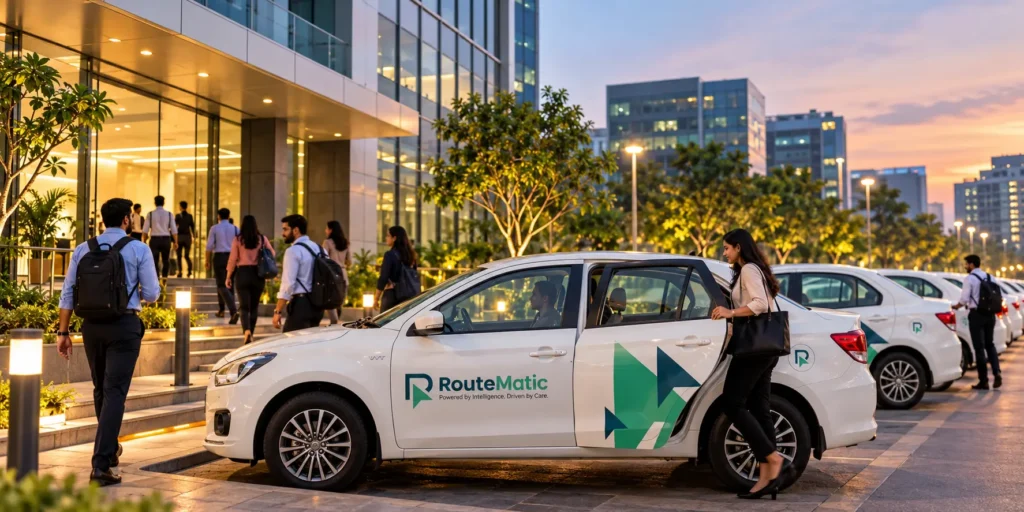
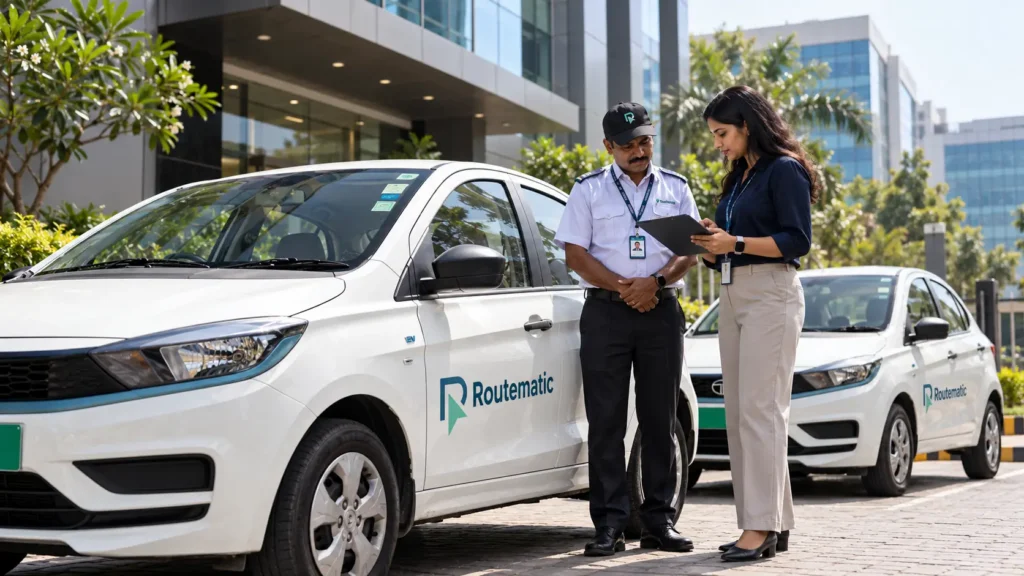
Planning employee transport routes also means accounting for pickup locations, safe seating limits, and how long employees can reasonably spend on the road.
A route is the sequence of stops a vehicle follows to pick up employees and take them to the office, or drop them home after a shift. While seat capacity gives you a starting point, travel time can change how many vehicles you need, particularly in congested cities such as Bengaluru.
This guide walks through a practical example involving 240 employees on a single night shift in India. You’ll learn how to calculate routes, choose a suitable vehicle mix, and measure seat occupancy, with a final result of 33 routes you can compare with your own transport requirements.
If you want to automate this process, Routematic’s employee transportation service and employee transport management solution help manage routing, tracking, and billing through a central platform.
What Is Employee Transport Route Calculation and Why Does It Matter?
Employee transport route calculation is the process of determining how many routes a shift needs so every employee gets a seat, arrives on time, and no vehicle runs mostly empty. Too few routes mean long rides and late logins, while too many mean idle seats and extra cost.
The TomTom Traffic Index 2025 puts the average time for 10 km in Bengaluru at 36 minutes 9 seconds, rising to 45 minutes 27 seconds in the evening rush. Those are daytime figures, and night roads move faster, so you should measure your own shift times before you plan.
Four terms appear throughout the calculation:
- Usable seats: the vehicle’s passenger seats minus the seat taken by an escort guard.
- Planned load: the riders you assign to a route, kept below usable seats so late changes still fit.
- Dwell time: the minutes each pickup adds, including the stop and a small detour.
- Ride time limit: the longest time any employee should spend in the vehicle.
How Do You Calculate Employee Transport Routes Step by Step?
Group riders by zone, determine how many riders one route can take, and divide. The same five steps work for any city and any vehicle mix.
- Group riders by zone. Use the roster for that shift and group employees by area or PIN code.
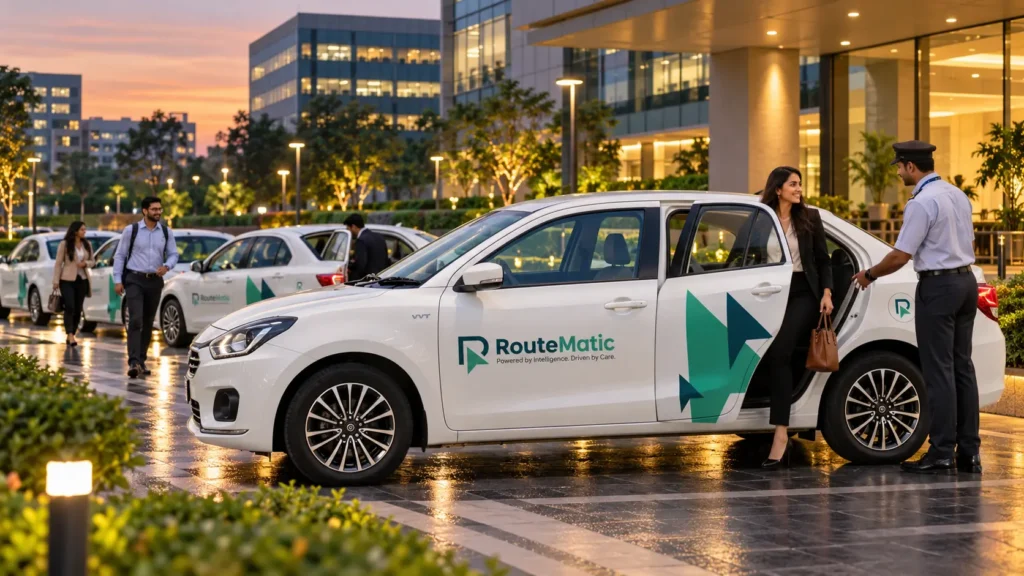
- Find usable seats. Subtract the escort guard’s seat from the vehicle’s passenger seats. The Ministry of Labour’s OSH Code FAQ lists adequate safety, transport, and security arrangements for women on night shifts, with their consent, so many employers send a guard on these routes.
- Set the planned load. Multiply usable seats by a fill factor such as 90% and round down.
- Set the stop limit. Stops allowed = (ride time limit minus drive time) divided by dwell time.
- Divide. Riders per route is the smaller of steps 3 and 4, and routes per zone = riders in the zone divided by riders per route, rounded up.
How to Calculate Transport Routes: A Worked Example for 240 Employees
This example uses a Bengaluru office with one pickup run for a 10 PM login. The numbers are illustrative, so replace them with your own GPS data.
- 240 riders, including 60 women, and a guard on every route
- Four zones at different distances from the office
- 12-seat vehicles, with seat counts excluding the driver
- 90% fill factor, 25 km/h night planning speed, 3 minutes dwell per pickup, and an 80-minute ride limit
Step 1: What Is the Planned Load Per Route?
A 12-seat vehicle has 11 usable seats once the guard sits in one. At a 90% fill factor, the planned load is 9 riders (11 × 0.9 = 9.9, rounded down), which leaves 2 seats for roster changes.
Step 2: How Far Can Each Route Go Within the Time Limit?
At 25 km/h, each kilometre takes 2.4 minutes. Drive time is distance times 2.4, and stops allowed are (80 minus drive time) divided by 3, rounded down.
| Zone | Riders | Distance | Drive time | Stops allowed | Riders per route | Routes |
| A | 70 | 8 km | 19 min | 20 | 9 | 8 |
| B | 60 | 12 km | 29 min | 17 | 9 | 7 |
| C | 50 | 18 km | 43 min | 12 | 9 | 6 |
| D | 60 | 26 km | 62 min | 5 | 5 | 12 |
| Total | 240 | 33 |
Seats set the limit in zones A, B, and C, while the time limit sets it in zone D. A Zone D route that picks up 5 riders takes 62 minutes of driving plus 15 minutes of stops, for 77 minutes, which is within the 80-minute limit.
Seat capacity alone would give 240 ÷ 9 = 26.7, or 27 routes. The time limit adds six routes, and all of them come from the farthest zone.
Step 3: How Do You Convert Routes Into Vehicles?
Employee fleet route calculation turns routes into vehicles, and the vehicle size matters as much as the route count. Sending 12-seaters to Zone D leaves each one with 5 riders, so the fleet offers 33 × 12 = 396 seats and occupancy is 240 ÷ 396, or 61%.
Using 7-seat vehicles for Zone D changes that. The fleet then offers 21 × 12 + 12 × 7 = 336 seats, and occupancy rises to 240 ÷ 336, or 71%. Each 7-seater has 6 usable seats and a planned load of 5, so one seat stays free for changes.
Vehicles can also serve two trips. If 9 of the 33 routes can follow a drop trip from the outgoing shift, which ends near the zone where the pickup starts, you need 33 minus 9, or 24 vehicles. This only works when the drop finishes before the pickup begins.
How Do You Plan Return Trips and Daily Changes?
You plan return trips separately, because they are not mirror images of the morning routes. Riders leave at different times, and drop order and stop counts change, so route calculation for employee transportation needs its own run for each direction.
A Routematic and Research NXT benchmark found that 36% of organizations face fluctuating commute demand because of hybrid work. A roster cut-off time helps here, because the plan can be calculated once the list is final and late requests can use the spare seats.
How Can You Check That Your Route Count Is Right?
You check it with a few numbers from the first week of live trips. If any of these miss your assumptions, adjust the fill factor, speed, or dwell time, then recalculate.
- Seat occupancy per route, compared with your planned load
- The longest ride time on each route, compared with the limit
- On-time arrival at the office for the shift
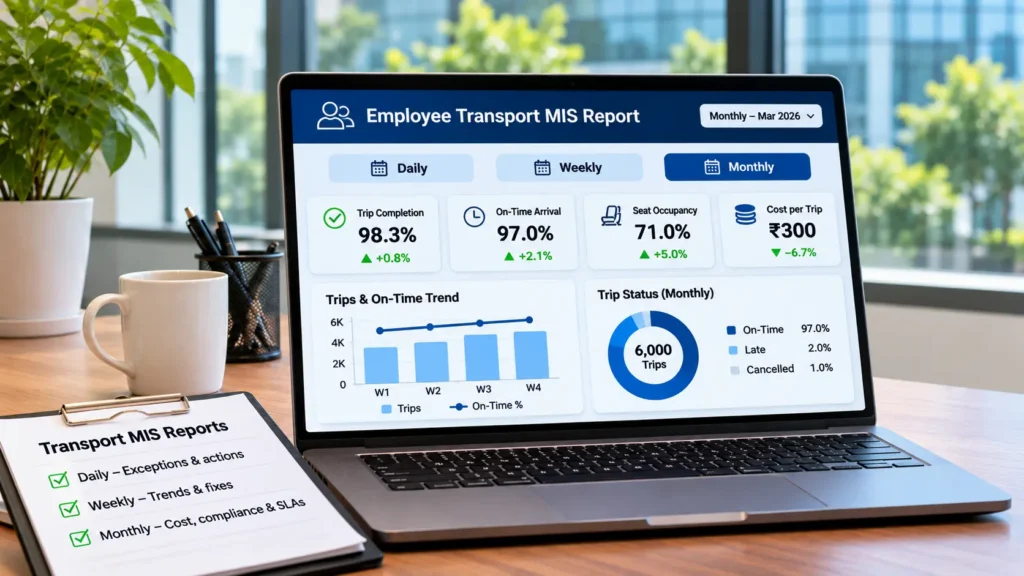
- Invoices that match GPS trips, since automated billing uncovered ₹12 crore in hidden transport costs in one Routematic case study
- Safe drop confirmation for every woman, as covered in this guide to women’s safety in corporate transportation
You need trip-level data to run these checks, and the Supreme Court’s 13 May 2026 order notes that fewer than 1% of transport vehicles in India have a vehicle location tracking device. So insist on GPS logs from every vendor before you trust any route count.
In one AI routing case study, a Bengaluru mortgage firm with over 1,000 employees saw monthly trips fall by 8.7% and trips per vehicle rise by 20%, while vendors, schedules, and fleet size stayed the same. Costs dropped by about 12% in 30 days.
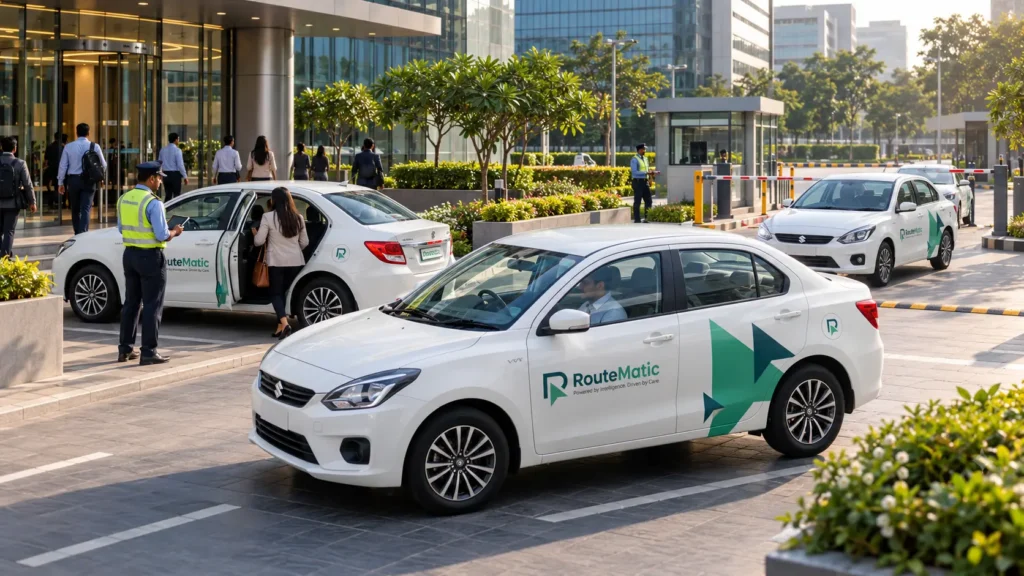
Across its clients, Routematic reports 97% on-time arrival and 12 to 18% cost savings. It serves 400+ enterprises in 24 cities, including 125 GCCs, and you can see how it plans shifts for them on the GCC employee transportation page.
Want your own route count checked? Talk to Routematic for a review of your current shifts.
FAQs
How often should we recalculate routes?
Recalculate daily from the final roster, and review the fill factor, speed, and dwell assumptions every month. A new office, a new shift, or a change in vehicle mix should trigger a fresh calculation.
What seat occupancy should we aim for?
No single target fits every site, because it depends on shift timing, zone spread, and your ride time limit. Measure your current occupancy first, then set a target from a pilot, as the example moved from 61% to 71% with better vehicle sizing.
Can small sites use fixed shuttle routes instead?
Yes, when riders cluster around a few stops, fixed routes with seat reservations are simpler than door-to-door pickups. Routematic offers fixed route shuttles with seat reservations and waitlist management alongside dynamic shift cabs.
How should we handle employees who miss the cab?
Set a waiting rule and a fallback, such as a standby vehicle or a reimbursed cab. Routematic reports that it has brought no-shows down to 5%.
What employee data does a vendor need for route planning?
Usually, the pickup area or PIN code, shift time, and contact number are enough to plan routes, and full address details can be shared only for confirmed riders. Ask the vendor how it protects this data and who can access it.
About the author

Kavitha Ramachandragowda
Co-Founder & Executive Director, RouteMatic
As Co-Founder and Executive Director of RouteMatic, Kavitha Ramachandragowda is passionate about shaping the future of employee transportation through innovation and customer-centric solutions. She shares about workplace experience, women's safety, sustainability, enterprise mobility, and the leadership strategies that enable organizations to build smarter commuting programs.