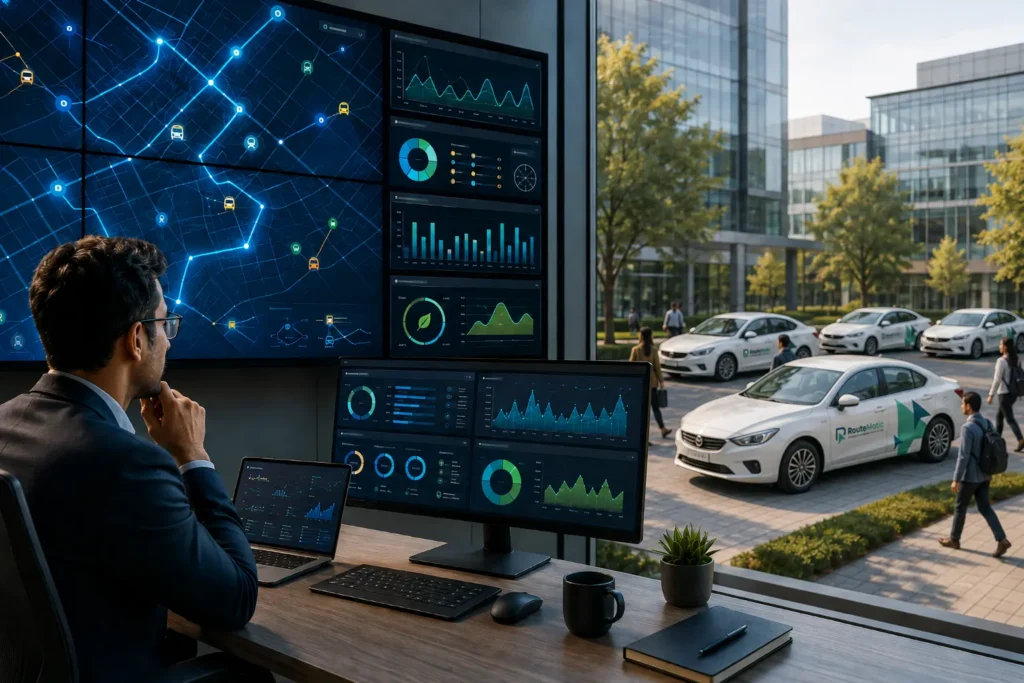
Indian enterprises are re-evaluating employee commute operations with a stronger focus on cost control, workforce safety, operational visibility, and employee experience. The right employee transport management system turns fragmented operations into a single, verifiable flow from planning to billing.
For businesses searching for how employee transport management software reduces costs, the answer lies in automating route planning, vehicle usage, attendance, billing, and commute visibility across the entire transportation cycle.
When automation is applied across routing, vehicle deployment, and shift management, corporate transportation becomes predictable, auditable, and materially cheaper. or enterprises evaluating a complete solution, RouteMatic’s employee transport management solution helps centralize commute planning, tracking, safety, and billing workflows.
Cost-cutting mechanisms that actually move the needle
Reducing cost starts with disciplined planning and automated execution.
Intelligent routing clusters riders by locality and shift windows, which improves pooling while protecting ETAs. Vehicle optimisation reduces dead kilometres through nearest-vehicle assignment, staging zones, and back-to-back trip stitching. Shift-aware rostering minimises idle time and prevents partial-load dispatches. Together, these controls cut fuel burn, lower fleet hours, and shrink admin effort.
The impact compounds when the employee transport management system enforces pooling thresholds before dispatch and triggers rebalancing on no-shows. Cost per seat drops without compromising punctuality or safety.
How automation reduces fuel, fleet hours, and admin overheads?
Automation eliminates manual intervention from high-frequency transportation decisions. Dynamic route generation accounts for traffic, rider density, and service windows. Auto-assignment ensures the right vehicle type serves the right corridor at the right time.
Digitised attendance, check-ins, and OTPs eliminate phone trees and manual logs. Billing pulls from verified trip events rather than spreadsheets.
For corporate transportation teams, this means fewer back-and-forth calls, faster month-end closure, and lower reconciliation effort. For finance, it means fewer disputes and cleaner cost allocation to cost centres and projects.
This is where employee commute software becomes important. It connects trip planning, employee check-ins, live vehicle tracking, exception alerts, and billing data in one place, so transport teams can reduce manual dependency and make faster decisions.
Enhanced employee experience that boosts adoption
Commutes work when they are reliable and transparent. Real-time tracking reduces uncertainty in congested corridors. Reliable pickups lift punctuality and lower stress before shifts begin. Predictable ETAs help managers plan handovers, especially in late and early hours. Safety features such as verified drivers, route geofencing, SOS readiness, and women’s safe drop with call-back confirmation build confidence across shifts.
Simple in-app check-ins and proactive notifications keep everyone informed. When the daily ride is smooth, adoption rises, absenteeism falls, and the data powering the employee transport management software becomes even more accurate.
Safety and compliance that stand up to audits
Safety is a workflow, not a poster. Embed verification of drivers and vehicles, document checks, geofenced routes, and incident playbooks as defaults. Record every trip event, from check-in to drop, as an immutable trail. Tie exceptions to defined escalation paths and measurable SLAs.
This approach reduces incident response time and simplifies investigations. It also provides the assurance that auditors, legal teams, and leadership require. In regulated verticals and for late-shift operations, such controls are essential to protect people and brand trust.
Technology is at the core of modern transport programs
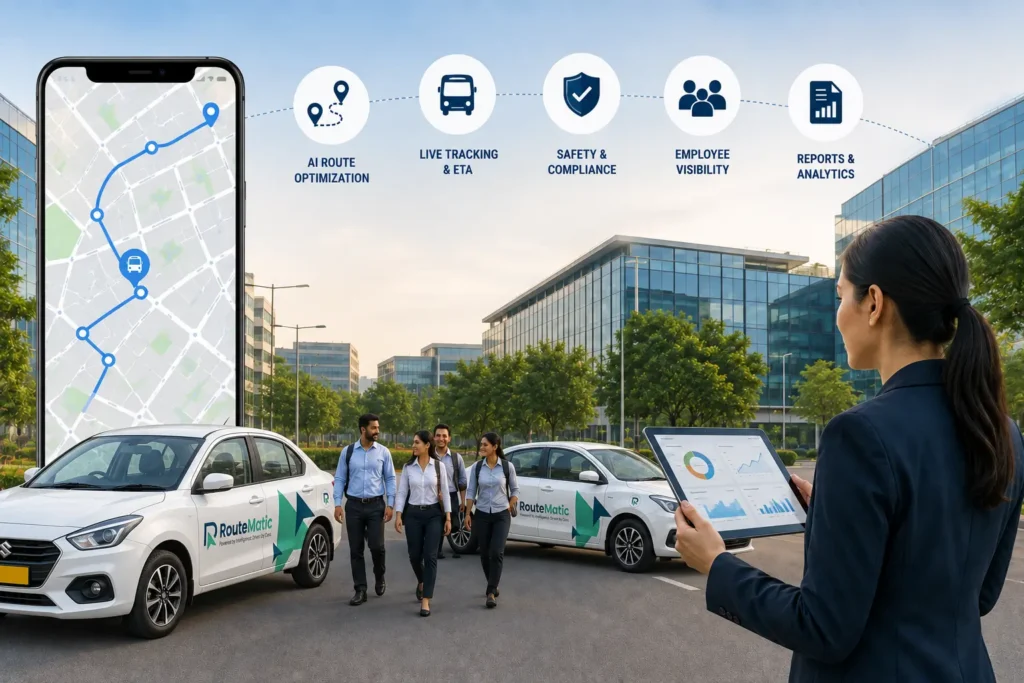
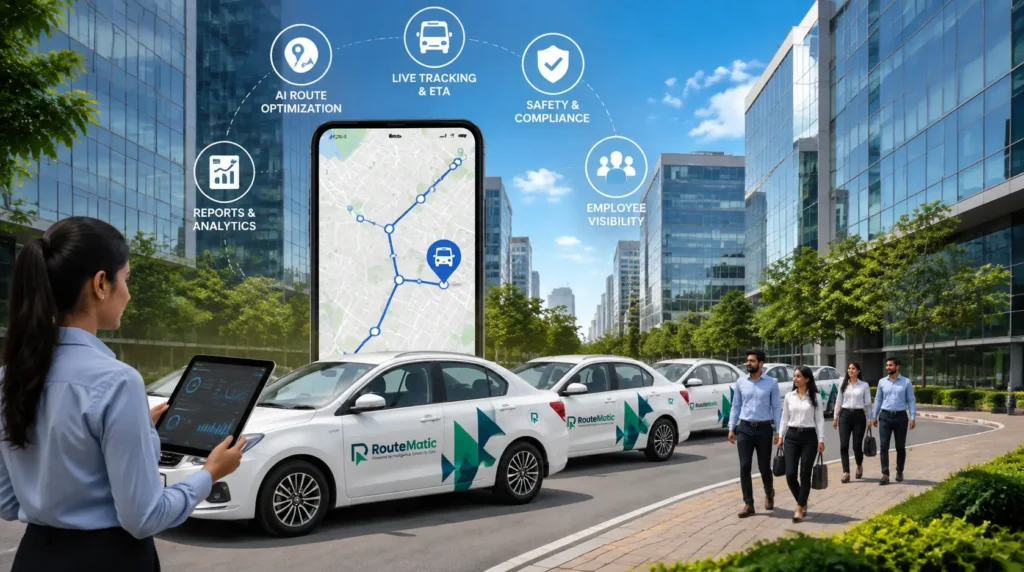
Strong software is a force multiplier. AI-based routing stabilises ETAs while lifting occupancy. Automated deployment coordinates rosters, trip formation, and vehicle assignment in one flow. Live tracking and in-trip alerts surface risks before they become SLA breaches. Analytics dashboards expose cost per seat, dead-kilometre ratios, vendor performance, and route-level variance.
Event-led billing attaches GPS traces, OTPs, and check-ins to each line item, enabling precise chargebacks. The result is a corporate transportation setup where planning, operations, and finance all see the same truth.
Business impact that leaders can measure
When costs fall and commutes improve, productivity follows. Shorter routes and higher occupancy reduce spend per rider. Stable ETAs and safer trips improve morale and punctuality. Clean, auditable billing shortens the month-end cycle and reduces provisions. Sustainability gains from route optimisation and EV adoption lower CO2 per rider while maintaining service quality.
The business case is clear. Better control. Happier employees. Stronger compliance. Measurable ESG progress. An employee transport management system makes these outcomes repeatable at scale.
How to build the ROI case in two steps?
- Establish the baseline: cost per employee per day, occupancy by shift, ETA variance, dead-kilometre ratio, dispute volume, and days to close.
- Set targets tied to platform features: occupancy lift through pooling rules, dead-kilometre reduction via routing intelligence, and one-cycle faster reconciliation via event-led billing.
With base, conservative, and stretch scenarios, decision-makers can see causality between feature adoption and financial outcomes.
To make the ROI case stronger, enterprises should compare current manual transport costs with the savings possible through automated employee commute software, including reduced dead kilometres, improved vehicle utilization, and faster invoice reconciliation.
Why Corporate Car Rental Companies Are Redefining Employee Commute
Why companies are moving beyond owned fleets and regular cabs
- Owned fleets and ad hoc cabs struggle with utilisation, scale, and auditability. Peak periods create shortages, off-peak times leave vehicles idle, and manual coordination generates disputes.
- Corporate car rental models, when powered by transport software, convert fixed costs to predictable operating costs and deliver the scale and control that multi-site enterprises need.
- For enterprises with fluctuating transportation demand across shifts, locations, and seasonal peaks, managed transportation models offer greater flexibility and operational efficiency than owned fleets.
Cost and efficiency advantages that matter to finance
- Corporate rental models deliver predictable pricing and reduce overheads through shared utilisation across corridors and time bands. Optimised usage means fewer vehicles can serve more riders.
- Flexible scalability ensures capacity rises for projects, events, and seasonal peaks without stranded costs later.
- When rental fleets integrate with an employee transport management system, each kilometre is accounted for, each exception is flagged, and each invoice line is backed by evidence. Finance teams gain transparency, while operations gain agility.
Employee-centric benefits that improve daily commutes
- Employees value certainty, safety, and comfort. App-based bookings, clear ETAs, and reliable pickups reduce pre-shift stress. Verified drivers, route geofencing, SOS support, and women’s safe drop protocols build trust in late and early hours.
- Comfortable vehicles and consistent routing improve the day-to-day experience. Higher satisfaction raises adoption and attendance, which in turn feeds richer data for route planning and pooling rules
Technology and sustainability are shaping the future.
- Tech-enabled rentals use apps, tracking, and analytics to stabilise service quality at scale. Live fleet visibility helps pre-position vehicles where demand is rising. Battery-aware routing schedules charging windows within shift gaps, not service hours.
- EV adoption reduces fuel spend and emissions, while occupancy targets and route optimisation lower CO2 per rider even for ICE vehicles. For corporate transportation teams, these tools make sustainability measurable without sacrificing punctuality.
Putting it together for Indian enterprises
- Start with a pilot at one large site to validate pooling thresholds, routing rules, and event-led billing.
- Measure cost per seat, ETA variance, dead-kilometre ratio, safety incidents, and dispute volume over one billing cycle.
- Scale to multi-site with unified policies, vendor scorecards, and SLA governance visible on a single dashboard.
Conclusion
Cost and experience are two sides of the same operational coin. The right employee transport management system applies automation, analytics, and auditable billing to reduce spend while improving the daily ride. Corporate transportation models that leverage tech-enabled rentals add predictable pricing and flexible scale, with safety and sustainability built into workflows.
For Indian enterprises, AI-powered employee transport management software delivers measurable cost savings, improved employee commute experiences, stronger compliance, and long-term sustainability benefits.
In short, employee transport management software reduces costs by improving route planning, vehicle utilization, billing accuracy, safety compliance, and commute visibility across the organization.
FAQs
1. How does employee transport management software reduce transportation costs?
Employee transport management software reduces costs through AI-based route optimization, automated trip scheduling, improved seat utilization, and reduced dead kilometres.
2. What are the benefits of automated employee transportation management?
Automated transportation management improves operational efficiency, reduces manual coordination, enhances employee safety, and provides real-time visibility into transportation operations.
3. How does AI-powered routing improve employee commute efficiency?
AI-powered routing analyzes traffic, shift schedules, and occupancy patterns to create optimized routes that reduce delays, fuel consumption, and travel time.
4. Why is real-time tracking important in corporate transportation?
Real-time tracking improves commute transparency, helps employees monitor vehicle arrivals, and enables transport teams to respond quickly to delays or disruptions.
5. What is employee commute software?
Employee commute software is a digital platform that helps companies manage employee transportation through route planning, vehicle allocation, live tracking, attendance, safety workflows, and billing automation.