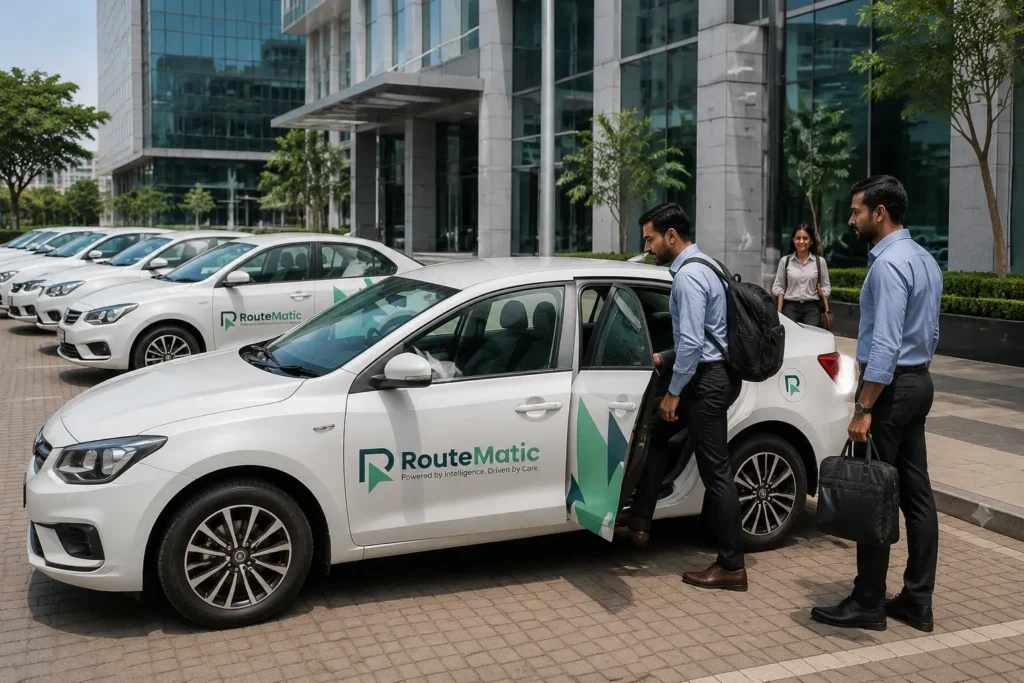
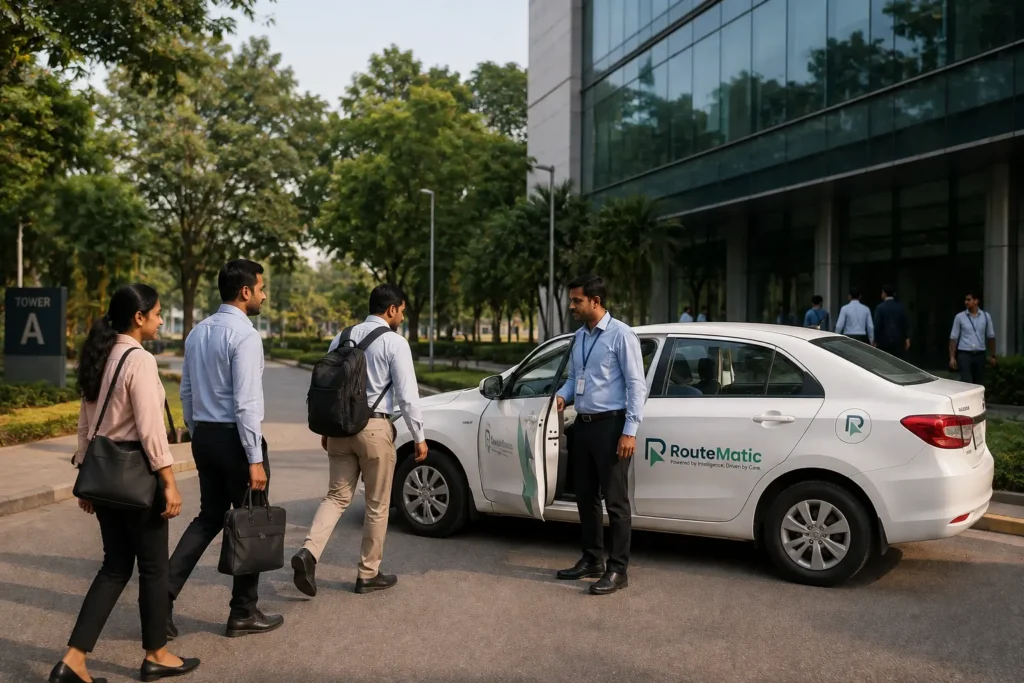
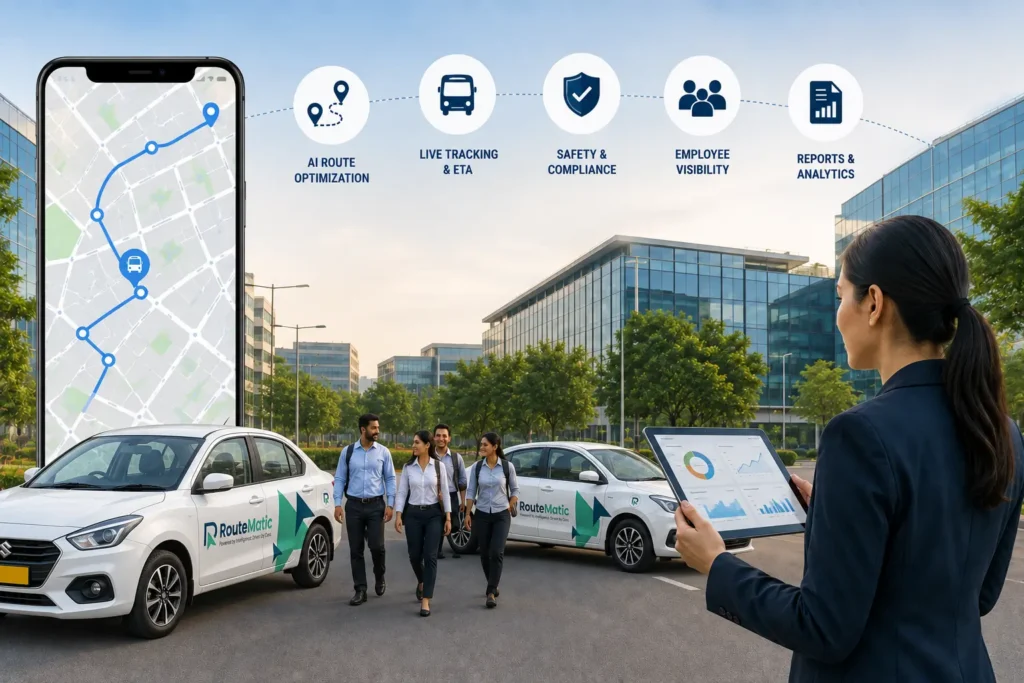
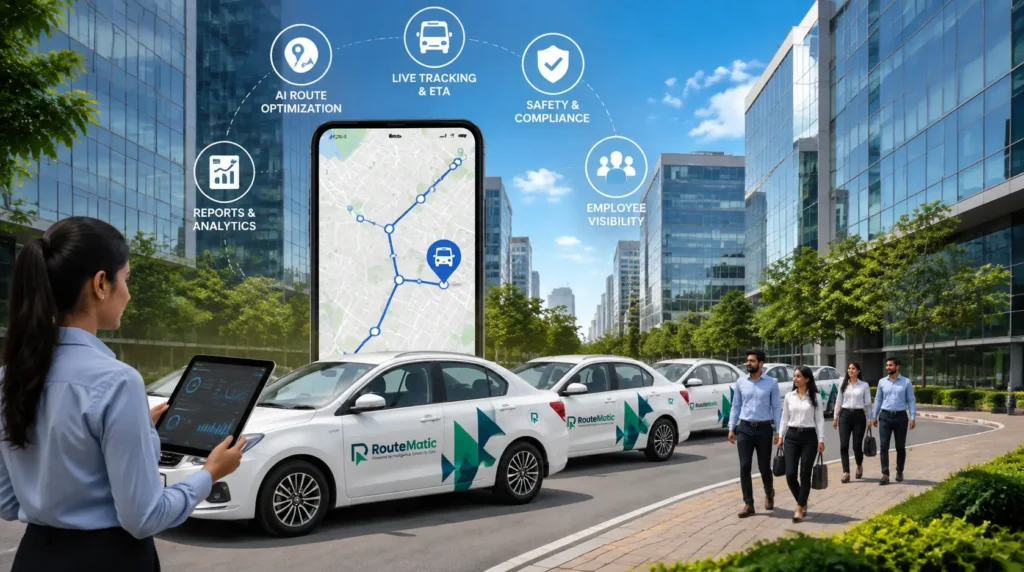
Your transport admin team juggles three vendor invoices, two compliance trackers, and a WhatsApp group for escalations. Somehow, a night-shift cab still shows up without a verified driver. Employee transportation optimization fixes this at the root, not with another dashboard. It starts with one accountable partner instead of a patchwork of vendors, and RouteMatic’s employee transport management software shows what that looks like in practice.
Employee transportation optimization means using AI routing, fleet compliance, and command-center monitoring to cut costs and ensure secure commutes. It works through demand forecasting, trip tracking, billing checks, and EV deployment. Together, these replace scattered vendors with a single system.
These five strategies come from real enterprise transport audits. They cover routing gaps, compliance exposure, billing leakage, and multi-city scale. Each one is checked against several finance, safety, or operations metrics already tracked by leadership, not against feature novelty.
Key Takeaways
- Employee transportation optimization starts with predictive routing. RouteMatic maintains 97% on-time arrival and departure performance across its owned fleet, even as Bengaluru lost 168 traffic hours per commuter in 2025, according to the TomTom Traffic Index.
- Owned fleet control closes compliance gaps left by vendor-only models. RouteMatic confirms 100% driver and vehicle compliance and 98% automated Female Safe Drop verification.
- A 24/7 command center matters more each year. India’s GCC count has grown by 32% since FY2021, and multi-city enterprises need a single escalation point rather than a fragmented vendor chain.
- Billing validation is where most transport savings hide. RouteMatic ties this discipline to a 12 to 18% cost reduction, with billing cycles closing inside five days.
- Employee transportation optimization now includes EV integration. RouteMatic’s EV fleet has grown past 400 vehicles, saving roughly 65,400 liters of fuel every 15 days as of March 2026.
1. Predictive Route Planning and Demand Forecasting
Predictive route planning forecasts shift-level demand before a vehicle leaves the yard, cutting empty-seat miles before they happen. RouteMatic runs this model across its owned fleet of 4,500 vehicles, maintaining 97% on-time arrival and departure performance even as Bengaluru lost 168 traffic hours per commuter in 2025, according to the TomTom Traffic Index 2025. RouteMatic’s live webinar on how AI is reshaping every layer of employee mobility breaks down how this kind of forecasting model actually gets built, layer by layer.

Picture a 600-employee GCC running three shifts from a Bengaluru tech park. Manual rostering assigns cabs based on headcount rather than pickup density. Two vehicles idle half-empty while a third gets overloaded near shift-end. Predictive forecasting fixes the assignment before the shift starts, not after complaints reach HR.
The forecasting model weighs:
- Historical shift-timing and attendance patterns
- Real-time traffic and congestion data
- Pickup-point density across zones
- Vehicle availability and battery status for EV routes
RouteMatic checks every manually edited route against these factors before dispatch (RouteMatic, 2026).
2. Owned Fleet Control for Driver and Vehicle Compliance
Owned fleet control gives enterprises 100% verified driver and vehicle compliance, something a patchwork of vendor-supplied cars can’t match. RouteMatic pairs this control with automated Female Safe Drop confirmation on its employee transport management solution, closing a gap most vendor-only models leave open.
A woman analyst finishing a 2 a.m. shift needs her drop confirmed the moment she’s home. She should not wait for a spreadsheet entry the next morning. RouteMatic automates that confirmation for 98% of trips. The remaining 2% close through a manual call, not silence.
Compliance checks applied per trip:
- Verified driver onboarding and background checks
- Vehicle inspection before every shift
- Real-time trip tracking against the assigned route
- Automated Female Safe Drop confirmation
RouteMatic reports 100% driver and vehicle compliance and 98% automated safe-drop confirmation across its fleet (2% safe-drop manual confirmation).
3. Centralized Command Center Monitoring for Multi-City Scale
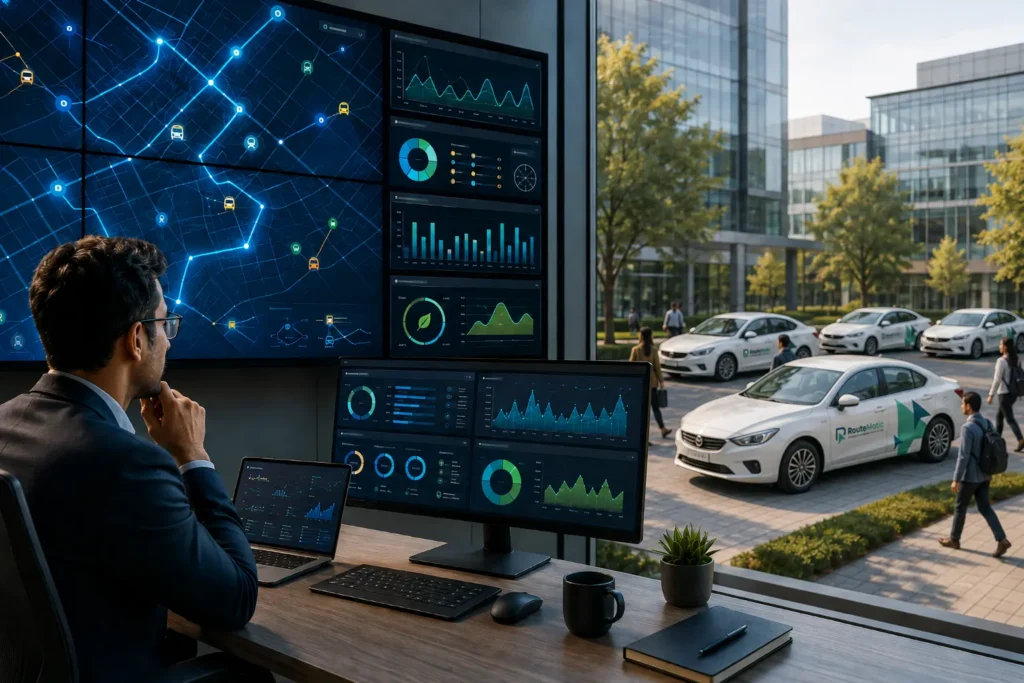
A centralized command center replaces city-by-city escalation chains with one 24/7 control point that monitors every trip from a single screen. RouteMatic runs this as enterprises expand their GCC footprint, and India’s GCC count grew 32% since FY2021 to 2,117 centers, per the Nasscom-Zinnov GCC Landscape Report 2026.
A GCC opening its second Pune campus doesn’t need a new vendor contract for every city. One command center absorbs the new routes, drivers, and compliance checks. No parallel escalation chain lands on the facilities team, a pattern visible across RouteMatic’s client case studies.
A command center actually monitors:
- Live trip tracking across every city
- Panic alert workflows during active trips
- Escalation management for delays or incidents
- Employee query resolution in real time
RouteMatic’s command center tracks every active trip across its 24-city network from one control point (RouteMatic, 2026).
4. Automated Billing Validation to Close Cost Leakage
Automated billing validation catches ghost trips and route duplication before they reach the invoicing stage, something manual vendor billing routinely hides. RouteMatic ties this validation to its billing workflow and delivers transport cost reductions of 12% to 18%, closing billing cycles in under five days.
A finance controller reconciling 40 vendor invoices a month can’t check every trip by hand. Automated validation flags a duplicate route or an unbilled cancellation before approval. It does not wait three months for an audit to catch it.
| Leakage type | What automated validation catches |
| Ghost trips | Trips billed with no matching GPS log |
| Overbilling | Fare mismatches against the agreed rate card |
| Route duplication | Two vehicles billed for one overlapping route |
| Low occupancy | Vehicles dispatched below the planned seat capacity |
Each flag traces back to a single trip log, so finance approves based on evidence, not a vendor’s word.
RouteMatic closes billing cycles in under five days against a validated trip log (RouteMatic, 2026).
5. EV Integration and Shared Mobility for Sustainable Commutes
EV integration turns fleet electrification into a measurable, current outcome, not a line in an ESG report. RouteMatic’s EV fleet has grown past 400 vehicles as of March 2026, saving roughly 65,400 liters of fuel every 15 days across its network.
An enterprise chasing a Scope 3 target can’t wait for a slow, city-wide EV rollout. Routing EV-eligible trips first, based on battery level and charging access, moves the number now. No vehicle gets stranded mid-shift due to range anxiety.
| Sustainability metric | Result |
| Electric fleet size | 400+ vehicles |
| Fuel saved | ~65,400 liters every 15 days |
RouteMatic optimizes EV deployment against battery level and charging access before dispatch (RouteMatic, 2026).
RouteMatic: The Employee Transportation Optimization Partner Built for Enterprise Compliance
HCL Technologies runs its employee commute operations on RouteMatic’s hybrid model. It replaced fragmented vendor management with one owned fleet and one command center. Across its 24-city network, RouteMatic holds 100% driver and vehicle compliance and 97% on-time arrival and departure performance. RouteMatic builds for enterprises that need audit-ready compliance records, not just a routing app.
Conclusion
The real cost of unmanaged employee transport isn’t the fuel bill. It’s the audit finding nobody saw coming. Each strategy above works because it moves a number that leadership already tracks. The real question isn’t whether your transport operation needs this discipline. It’s whether RouteMatic builds it with you before the next escalation reaches your CEO’s desk or after it does.
Get a Quick Demo for Your Employee Transportation Requirements
Get a quick demo built around your ETS requirements, not a generic product walkthrough. See how RouteMatic’s hybrid model stacks up against a SaaS-only or vendor-led setup before you sign your next contract. Already comparing providers? RouteMatic’s breakdown of RouteMatic versus MoveInSync is a useful starting point.
Frequently Asked Questions
What is transportation optimization?
Transportation optimization means using route forecasting, live tracking, and compliance checks to move employees at a low, predictable cost. RouteMatic runs this through AI-based routing and a 24/7 command center. Its owned fleet holds 97% on-time arrival and departure performance across all shifts.
How does employee transportation optimization reduce enterprise transport costs?
Employee transportation optimization cuts costs mainly through billing checks, not route efficiency alone. RouteMatic integrates routing, fleet usage, and billing checks. That reduces transport costs by 12 to 18%, with billing closed in under five days instead of the typical 30-day lag.
Why do employees struggle with unpredictable commutes in cities like Bengaluru?
Bengaluru commuters lost 168 hours to rush-hour traffic in 2025. Static routes can’t adjust once the day begins. Employee transportation optimization fixes this through live traffic data and dynamic rerouting. Reliability still depends on how well the fleet behind that engine is managed.
How is employee transportation optimization different from a SaaS-only routing tool?
A SaaS-only routing tool optimizes the route on a map. It doesn’t own the vehicle, the driver, or the compliance record behind that route. Employee transportation optimization through RouteMatic’s hybrid model combines AI routing with an owned fleet. One platform plans, drives, and verifies every trip.
What should an enterprise check before switching employee transport providers?
Ask for the compliance audit trail and the tech stack behind it: verified driver onboarding, vehicle inspection records, trip logs, and real-time routing or billing validation data. A provider without an owned fleet and integrated tech often can’t produce both, a gap enterprises discover only after the switch is underway.
About the author

Sriram Kannan
Chief Executive Officer, RouteMatic
As CEO of RouteMatic, Sriram Kannan is driving the future of enterprise mobility through technology and innovation. He shares key knowledge about AI, digital transformation, workplace mobility, and the evolving role of intelligent transportation in helping organizations improve operational efficiency, employee experience, and sustainable growth.