For a small company, employee transport can genuinely be managed with a spreadsheet, a few calls and a coordinator who knows the routine. The shared file gets updated, the vendor is informed and, most days, the trips happen. That simplicity does not last forever. Add a few hundred employees, overlapping shifts or another office, and the cracks begin to show: pickups run late, invoices are questioned, safety checks get missed and problems often surface only after something has already gone wrong.
That is the practical problem employee transport management software is meant to solve. It is less about adding another piece of technology and more about making a complicated daily operation manageable. Rostering, route planning, live tracking, compliance checks and billing can all sit in one place, giving a relatively small transport team the ability to handle enterprise-scale operations. Below, we look at how the software works, where it is most useful and the operational and financial difference it can make when implemented well.
When Does Manual Transport Management Stop Working?
No company deliberately designs a messy transport operation. It usually happens bit by bit. One workaround becomes three, another spreadsheet appears, more calls are added to the process, and eventually the coordinator spends most of the day dealing with exceptions instead of managing transport properly.
In practice, five situations tend to expose the limits of a manual setup particularly quickly.
Rapid headcount growth
Growth changes the transport equation surprisingly fast. A business moving from 200 to 800 employees in a year is not simply dealing with a bigger roster. New pickup zones appear, vehicle requirements keep shifting and routes need frequent reworking. With manual planning, that becomes difficult to keep on top of. Some vehicles end up crowded while others run half-empty, and routes designed six months earlier may bear little resemblance to where employees now live.
Multiple shifts running simultaneously
For IT, BPO, manufacturing and healthcare teams, transport rarely follows one neat timetable. Vehicles may be needed early in the morning, again in the afternoon and late at night. Every shift brings its own passenger list, pickup areas and compliance requirements. Keeping all of those moving parts aligned manually makes avoidable errors far more likely.
Night-shift compliance requirements
Night transport also comes with a higher compliance burden. India’s Occupational Safety, Health and Working Conditions Code, in force since November 2025, requires documented safe transport for women employees working night shifts. An ordinary spreadsheet is not designed to create the timestamped audit trail auditors may ask for, and relying on people to make every safe-drop follow-up call becomes increasingly unreliable as volumes grow.
Multi-city operations
Consider a GCC or large enterprise with teams in Bengaluru, Hyderabad and Pune. If each city has its own vendor relationship, billing process and compliance record, getting a clear view across the operation is difficult. Those disconnected processes are also where unnecessary costs can slip through and safety issues can fail to reach the central team.
Rising and uncontrollable transport costs
Transport costs become especially hard to control when overbilling, ghost trips, poor vehicle occupancy and duplicated routes cannot be checked against a reliable trip record. Without that record, Finance is left comparing invoices with incomplete operational information. Month-end reconciliation can then feel more like a negotiation than an audit. Employee transportation management software gives teams the evidence needed to close that gap.
What Does Employee Transportation Management Software Actually Do?
It is easy to mistake employee transportation management software for a more sophisticated GPS tracker, but its role is much broader. A good platform connects the day-to-day pieces of the commute operation instead of leaving teams to jump between spreadsheets, WhatsApp groups and calls with vendors.
A capable platform will usually cover the following core functions:
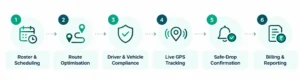
Roster and scheduling management
Employees can share their availability through an app or web portal, rather than sending changes through multiple channels. The system brings those inputs together, applies the relevant shift rules and prepares the roster for routing. Cut-off times can be enforced automatically, while genuine last-minute additions are treated as exceptions instead of forcing the team to rebuild the entire plan.
AI-driven route optimisation
Once the roster is finalised, AI-driven route optimisation can work through pickup locations, shift timings, vehicle capacity and live traffic data to build more practical routes. It can also respond when headcount changes, a driver becomes unavailable or road conditions shift. Compared with routes planned manually, the gains are tangible: vehicles are used more efficiently, empty return journeys fall and the cost per seat comes down.
Driver and vehicle compliance automation
Driver and vehicle compliance automation takes repetitive checks out of the admin team’s hands. Before a trip is assigned, the platform can verify driver documents, vehicle fitness certificates and insurance records. Blacklisted drivers are excluded automatically, while pre-departure alcohol checks can be recorded with a timestamp rather than tracked separately.
Real-time GPS tracking and live monitoring
With real-time GPS tracking and live monitoring, the transport desk does not have to wait for a complaint to learn that something is wrong. Delays, route deviations and no-shows can trigger alerts while there is still time to respond. Employees also get live ETA updates, which means less uncertainty at the pickup point.
Safe-drop confirmation
Safe-drop confirmation is another area where automation matters. At the end of a trip, the system can ask the employee to confirm that they have reached home safely. For night shifts, this is a legal requirement. Routematic’s employee transport management software, for example, achieves 98% automated safe-drop confirmation; the remaining 2% is closed through a direct follow-up call.
Automated billing and reconciliation
Automated billing and reconciliation gives Finance something concrete to work with. Trip data can be matched against GPS-validated kilometres and vendor records before an invoice is approved. Ghost trips or unusual mileage are flagged early, and disputes that once dragged on for three weeks can be closed in under five days.
Which Companies Need Employee Transport Management Software Most?
The case for employee transportation management software is not equally strong for every business. It becomes most compelling when manual coordination is already struggling, or when the scale and nature of the operation make those problems increasingly likely.
IT and GCC companies
Large IT campuses and Global Capability Centres may have hundreds of vehicles moving through three or more shift windows every day. Compliance expectations are high, and commute quality can feed directly into ESAT scores. For multi-city GCCs, running a different vendor model in every location also makes standardisation difficult. This is why employee transportation management software often has an immediate impact in these environments.
BPO and KPO operations
BPO and KPO operations add another layer of complexity because transport may run around the clock, with large numbers of employees travelling at night. Women’s safety compliance, safe-drop confirmation and driver verification cannot be treated as optional checks. Automating them means the process no longer depends on an individual coordinator remembering every step on every shift.
Healthcare and pharmaceutical companies
In healthcare and pharmaceutical settings, a late or missed pickup can have consequences beyond one employee arriving late. Shift handovers may be time-sensitive, and disruption can affect patient care or the continuity of an operation. That makes dependable transport, backed by a verifiable record, particularly important.
BFSI enterprises
For BFSI enterprises, transport can also fall within the scope of internal audits. Teams may be asked for driver verification records, vehicle fitness documents and trip logs, sometimes at short notice. Paper files and manually maintained records make that much harder than it needs to be.
Any company above 300 employees with shift-based transport
There is no universal employee count at which manual transport suddenly stops working. Even so, a pattern appears once roughly 300 employees depend on company-managed transport: the coordination itself starts consuming more time than a small transport team can realistically give it, and operational gaps become harder to avoid.
Key Benefits of Employee Transport Management Software
The value of employee transportation management software should show up in operating numbers, not just in a product presentation. Enterprises moving away from manual or vendor-only models typically see changes across cost, punctuality, safety, billing and employee experience.
| Benefit Area | What Changes | Typical Outcome |
| Cost control | AI routing, occupancy optimisation, billing validation | 12 to 18% reduction in transport spend |
| On-time performance | Automated dispatch, AI delay prediction, live monitoring | 97% first-point on-time arrival |
| Safety and compliance | Automated driver checks, safe-drop confirmation, audit logs | 100% driver and vehicle compliance |
| Billing accuracy | GPS-validated trip records, automated reconciliation | Billing closure in under 5 days |
| Employee satisfaction | Predictable pickups, live ETAs, accessible helpdesk | ESAT scores of 4.9 out of 5 |
| No-show management | Real-time alerts, automated notifications to employees | No-show rate reduced to 5% |
Cost savings that are actually provable
Transport budgets often contain more assumptions than Finance would like. A platform replaces some of that guesswork with a record of kilometres driven, occupancy on each trip, idle time and billing checked against GPS data. Review those records consistently and savings start to come from fixing waste in the operation itself, rather than simply pushing vendors for a lower rate.
Compliance that does not depend on memory
Manual compliance has a very human weakness: somebody has to remember every check, every time. A driver’s licence may expire unnoticed until an audit. A safe-drop call may be missed because the same coordinator is dealing with a vehicle breakdown. Automated workflows make those checks part of the process instead of part of someone’s memory.
Visibility that HR and Finance can actually use
Useful transport data should not live only with the transport desk. A central platform can present it in ways Finance can reconcile, HR can report on and operations can use to make decisions. That shared visibility turns transport from a vaguely understood cost centre into a governed function with measurable KPIs. Routematic’s employee transport management solution shows how these pieces can be brought together in practice.
What to Look for When Choosing Employee Transport Management Software
A polished demo can make almost any platform look capable. What it cannot prove is how the system behaves under pressure: whether compliance standards hold in a newly launched city, for instance, or whether on-time performance survives a sudden 40% rise in headcount. Those are the questions that matter after implementation.
A few practical questions help separate software that works in the real world from software that simply demos well.
Does it own the operation or only the software layer?
First, understand what the provider actually owns. Some SaaS platforms sit above your existing vendor network; others combine the technology with an owned fleet and managed operations. If the provider has no direct control over vehicle quality or driver compliance, it may be able to report a problem without necessarily being able to prevent it.
How does it handle compliance?
Do not settle for a general claim that the platform ‘handles compliance’. Ask how driver verification, vehicle fitness certificates and women’s safe-drop confirmation work in practice. Are checks automated and logged by the system, or does somebody still complete a checklist manually? That distinction tells you whether compliance is built into the workflow or merely added around it.
Can it scale to multiple cities with consistent standards?
Multi-city scale is another useful test. A system performing well in Bengaluru does not automatically guarantee the same operating standard in Pune or Hyderabad. Consistency across cities usually needs centralised oversight and processes, not simply the same software licence installed at each location.
What does the billing and audit trail look like?
Before choosing a platform, ask for an actual sample billing report. Look for GPS-validated kilometres, driver IDs, boarding confirmations and trip-level exceptions. If the final report still depends mainly on figures submitted by the vendor, the underlying cause of billing disputes has not really disappeared.
For a closer look at the evaluation criteria, Routematic’s employee transport management software page sets out the full feature set and explains which operational problem each capability is intended to address.
Conclusion
Choosing employee transport management software is ultimately an operational decision, even though the solution itself is technology-led. A slick interface matters far less than whether the system fixes the problems a transport team sees every day: routes that no longer match reality, vendors that are difficult to hold accountable, missing compliance records and invoices that cannot be properly verified.
Beyond a certain scale, manual transport management becomes more than an efficiency problem. The weaknesses eventually appear elsewhere: in audit observations, safety incidents, recurring billing disputes or ESAT scores that are difficult to explain. Employee transportation management software gives the function clearer ownership, measurable performance and a digital record that can stand up to scrutiny, instead of leaving the team to react to one issue after another.
If transport is now creating almost as much work as it is solving, it may be time to look at what a purpose-built platform changes in practice. Routematic’s employee transport management software is one example of how that model works.
FAQs about Employee Transport Management Software
What is employee transport management software?
Employee transport management software brings the main parts of the workforce commuting into one system. Organisations can use it for roster collection, route planning, vehicle dispatch, live tracking, compliance checks, safe-drop confirmation and billing, rather than managing each activity separately.
How is employee transportation management software different from a basic GPS tracking tool?
A basic GPS tool answers one question: where is the vehicle? Employee transportation management software goes much further. It can show who should be travelling in that vehicle, whether the required compliance checks were completed, whether a safe arrival was confirmed and whether the eventual invoice matches the trip. GPS tracking is therefore one part of the workflow, not the whole system.
Which industries benefit most from employee transportation management software?
IT companies, GCCs, BPO and KPO operations, healthcare organisations and BFSI enterprises are among the strongest use cases. Although the sectors are different, their transport challenges are similar: shift-based work, large employee volumes, demanding compliance requirements and, often, operations spread across several cities.
What is the difference between a SaaS transport platform and an end-to-end solution?
With a SaaS transport platform, your team receives the software layer and continues to manage much of the operation around it. An end-to-end solution also brings in elements such as an owned fleet, trained drivers and operational support. That difference becomes important when the expectation is to deliver compliance, rather than simply report on it. Routematic uses a hybrid model, combining AI-driven software with an owned fleet and 24/7 command centre operations.
How long does it take to implement employee transport management software?
For many enterprise deployments, a structured platform such as Routematic can be live within 30 days. That implementation period typically covers roster migration, address data ingestion, shift mapping and driver compliance checks.
About the author

Sandeep Padhi
Chief Operating Officer, RouteMatic
As COO of RouteMatic, Sandeep Padhi brings extensive expertise in transport operations, fleet management, and enterprise mobility. He shares practical insights on scaling transportation programs, operational excellence, compliance, driver ecosystems, and building reliable mobility solutions for modern enterprises.