Your shuttle costs keep climbing. Employees still complain about being late. Buying more vehicles rarely fixes either problem.
Employee transportation efficiency means moving staff to work with fewer delays and lower per-trip costs. It also means a full audit trail, not just more vehicles on the road. Companies get there by automating dispatch and billing checks. They standardize driver and vehicle compliance. They track every trip against a real SLA instead of a vendor’s word.
These seven fixes target the failure points that hit most transport programs: wasted seats, unverified billing, and weak compliance. Each one closes a cost or audit gap, ranked by how directly it does that. Ease of setup comes second.
Key Takeaways
- Bengaluru commuters lost 168 hours to rush-hour traffic in 2025. That’s 12 hours more than the year before, per TomTom’s Traffic Index. Every one of those hours sits on a company’s payroll, too.
- Employee transportation efficiency improves fastest when billing gets checked on its own, without a person reconciling it by hand. Manual invoices from vendor-run fleets rarely catch duplicate trips or empty runs.
- See the Hyderabad EV rollout below for the number and what drove it.
- Over-speeding accounted for 70.3% of India’s road fatalities in 2024, according to the Ministry of Road Transport and Highways. Driver compliance checks need to come before any routing upgrade, not after.
- Automated dispatch, billing validation, and standardized compliance checks close the three biggest leaks in unmanaged corporate transportation efficiency programs. Those three are wasted seats, unverified spend, and inconsistent safety records.
1. Automate Route Planning and Dispatch
Route automation software recalculates the fastest path in real time using live traffic data. It’s one of the fastest ways to improve employee transportation efficiency, and it reduces empty-seat miles left by manual rostering. Bengaluru commuters lost 168 hours to rush-hour traffic in 2025 alone, and TomTom’s Traffic Index shows that number climbing every year.
A transport admin running 40 shuttle routes across two shifts can’t manually recalculate paths every time a road closes. A passenger cancellation changes the math too. Automated software does both in seconds. It reassigns seats and updates driver apps before the shuttle leaves the yard.
- Cuts empty-seat miles by matching live occupancy to route capacity
- Recalculates paths automatically when traffic, cancellations, or closures shift mid-route
- Updates driver and passenger apps in real time, not after the fact
Bengaluru’s average rush-hour congestion level hit 74.4% in 2025. That made it the world’s second-most congested city, according to TomTom’s Traffic Index that year.
2. Fix Billing Leakage With Automated Validation
RouteMatic’s automated billing validation checks every trip against GPS timestamps and driver logs, one of the more overlooked levers behind corporate transportation efficiency. It catches gaps before an invoice gets approved, not after. Ghost trips, duplicate billing, and unverified mileage are the three leaks that eat most transport budgets. None of them show up on a plain PDF invoice. RouteMatic’s webinar on how transport leaders control costs by unifying fragmented systems walks through this exact problem in more detail, for teams still reconciling multiple vendor invoices by hand.

A finance team reviewing vendor invoices has no way to confirm a trip actually happened. They can’t confirm it ran its full distance or carried the billed passenger count. Automated validation flags the mismatch before payment goes out, not three months later during an audit.
- Matches billed trips against GPS-logged start and end points
- Flags duplicate trips and empty runs before payment, not after
- Cuts matching time from weeks to days once checks run on their own
RouteMatic reports billing closure inside five days per cycle once checks run on their own, a self-published number worth confirming before repeating elsewhere.
3. Standardize Driver and Vehicle Compliance
Standardized compliance checks verify every driver’s license, background check, and vehicle fitness against a single checklist. That single standard protects both safety and employee transportation efficiency, and it beats running five different vendor checklists side by side. Over-speeding caused 70.3% of India’s road fatalities in 2024, according to the Ministry of Road Transport and Highways. Most of that risk sits with drivers a company has never personally vetted.
A facility manager overseeing three vendors gets three different verification standards. Each vendor runs its own renewal schedule, and there’s no single audit trail for incidents. One checklist across every driver and vehicle closes that gap early. It’s ready before an insurer or auditor asks for it.
- Verifies license, background check, and vehicle fitness against one standard, not per vendor.
- Tracks renewal dates centrally instead of chasing them manually across contracts.
- Audit trail ready before a regulator or client compliance team requests it.
Helmet non-use contributed to over 54,000 road deaths in India in 2024. Seatbelt non-use added over 14,000 more, per the Ministry of Road Transport and Highways.
4. Add Real-Time Trip Monitoring and Safety Alerts
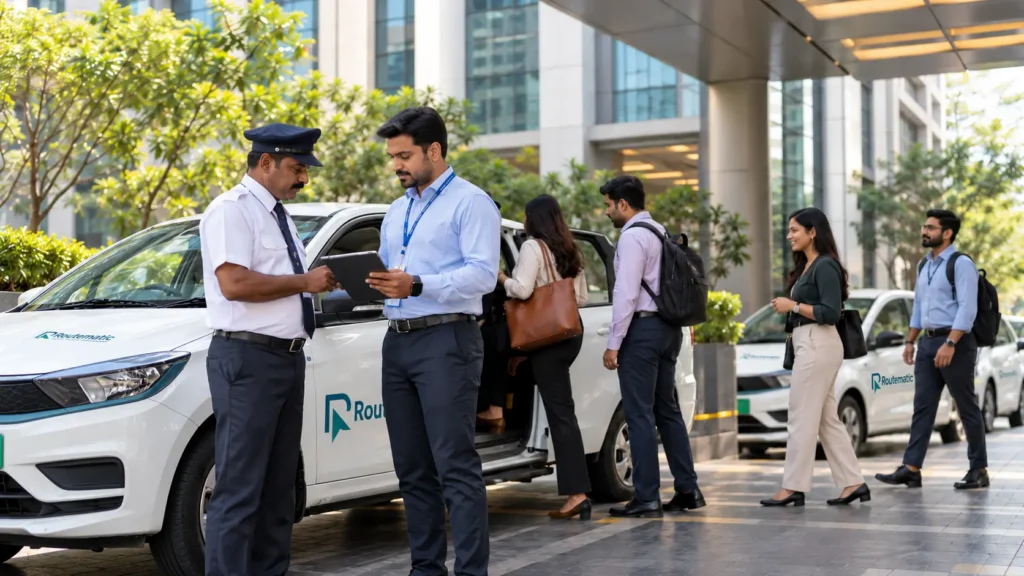
Live GPS tracking paired with SOS alerts lets a command center see every vehicle’s position at once. That closes a real safety gap in employee transportation efficiency, and it can respond within minutes instead of hours. Night-shift employees at IT and BPO campuses in cities like Bengaluru and Hyderabad carry the highest exposure. Their commute windows fall outside regular traffic and staffing patterns.
A woman finishing a shift at 2 a.m. needs her pickup confirmed and her route tracked. She also needs a way to raise an alarm that reaches someone right away. A help desk ticket queued for the morning won’t do. Check-in and check-out confirmation with a live SOS trigger closes that window.
- Live vehicle location is visible to a command center at all times
- SOS trigger reaches a live responder, not a ticketing queue
- Logs check-in and check-out confirmation automatically for every trip
Evening hours between 6 and 9 p.m. see the highest share of road accidents nationwide, per Ministry of Road Transport and Highways data. That’s the exact window many shift commutes fall into.
5. Shift Underused Capacity to EVs
Switching underused shuttle capacity to electric vehicles cuts per-kilometer fuel cost right away. It can also pull in incentives under India’s FAME II scheme for eligible fleets. Fuel and maintenance account for the highest recurring costs in most transport budgets. That’s exactly where an EV swap shows the fastest results.
A transport head comparing a 15-vehicle diesel fleet against the same fleet in EVs sees the fuel line drop first, usually within the first full billing cycle. Maintenance and ESG reporting savings show up later. The charging setup needs to match the actual shift timing, not general office hours.
- Fuel cost per kilometer drops first and shows up fastest in reporting
- FAME II incentives apply to eligible commercial EV fleets, cutting upfront costs
- Charging schedules need to match shift timing, not general office hours
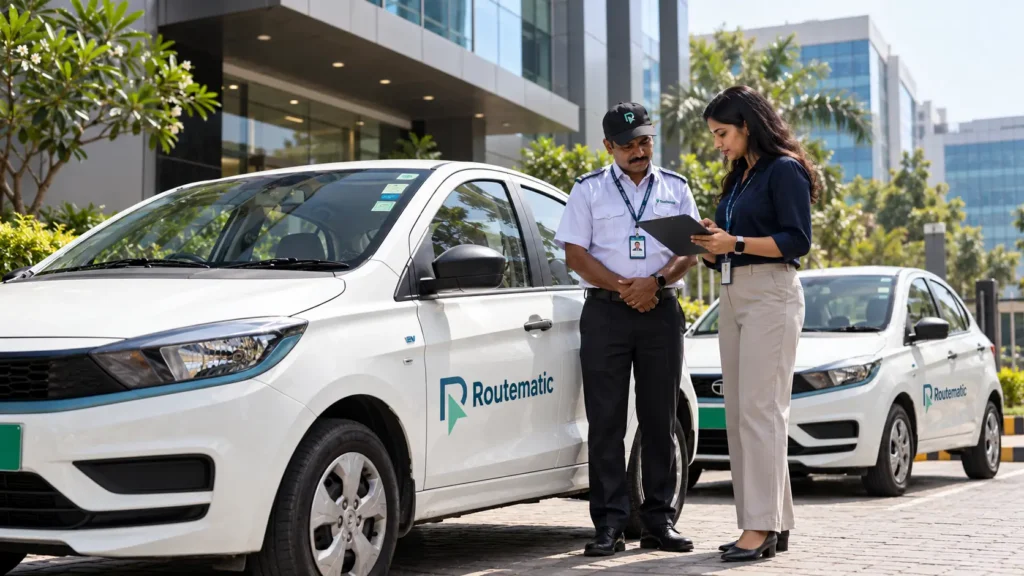
About 10% of RouteMatic’s own 4,500-vehicle fleet already runs electric. That’s a self-reported figure the company publishes on its own site.
6. Consolidate Multi-Vendor Operations Into One Command Center
A single command center from a provider like RouteMatic replaces the fragmented, vendor-by-vendor tracking that most transport programs run on. It’s one of the biggest levers for corporate transportation efficiency. A single team gains visibility into every route, driver, and vehicle at once. RouteMatic’s own GCC transport benchmarking data found that 60% of GCCs in India still manage transport without an integrated system.
A procurement lead juggling four regional vendors gets four different reporting formats. There’s no single number for total spend or SLA performance across them. One command center collapses that into a single dashboard. It gives the program one point of accountability.
- One dashboard replaces separate vendor reports and spreadsheets
- Tracks SLA performance against one standard across every city and vendor
- Escalations route to one team instead of bouncing between vendor contacts
RouteMatic’s benchmarking study covered over 100 GCCs. It analyzed more than 1 million employee commutes across India.
7. Run Recurring Transport Audits Against SLA Data
RouteMatic runs recurring audits through a metric it calls FOTA, short for first-attempt on-time arrival. The audits compare actual trip data against agreed SLA targets like on-time arrival and safe-drop confirmation. Skipping this step is the most common way employee transportation efficiency quietly erodes over a year. RouteMatic reports it at 97% across its own operations, a self-published figure worth checking against a client’s own trip logs.
A transport head who reviews performance once a year finds problems months late. By then, they’ve already cost money or created safety gaps. Monthly or quarterly audits against the same SLA metrics catch a slipping on-time rate early. They catch a rising no-show count while it’s still a small fix.
- Tracks on-time arrival, no-show rate, and safe-drop confirmation against SLA targets.
- Reviews run monthly or quarterly instead of once a year
- Drift caught early, before it shows up as a client or employee complaint
Bengaluru’s rush-hour congestion level rose from 72.7% in 2024 to 74.4% in 2025, per TomTom’s Traffic Index. A program built on last year’s routes needs checking rather than assuming.
RouteMatic’s Fleet-Plus-Technology Model in Practice
One enterprise client’s Hyderabad transport program pushed EV assignment to nearly 90% of that location’s fleet volume after moving to RouteMatic’s combined fleet-and-technology model, per the client’s own account published on RouteMatic’s site. The change came from pairing owned, compliance-checked vehicles with routing and monitoring in one system. It didn’t come from adding a tracking app to an existing vendor fleet.
RouteMatic also reports billing closure inside five days per cycle. That’s a claim about its own operations, not an independently audited figure, and it’s worth checking before repeating elsewhere.
The seven fixes above work best together. Automating dispatch without fixing billing validation just moves the same leak from routes to invoices. Bengaluru’s congestion kept getting worse every year in TomTom’s data. A transport program still running on manual rosters and vendor-reported numbers falls further behind each cycle it stays that way.
The real question isn’t which of these seven to try first. It’s whether the current setup could survive an audit tomorrow, or whether it’s held together mostly by a vendor’s word.
A smarter commute design usually starts by fixing the weakest of these seven first, not all of them at once. RouteMatic’s full breakdown of what to automate first covers the same ground in more depth.
See Where Your Transport Program Is Leaking Money
A billing review usually yields the fastest win, since it requires no new vehicles or vendor contracts to fix. See how these five common transport problems get solved with the same automation approach covered here.
Frequently Asked Questions
What is employee transportation?
Employee transportation is any structured system a company uses to move staff between home and work. It usually runs through shuttles, contracted cabs, or a managed fleet. It covers routing, driver and vehicle compliance, safety monitoring, and billing, not just the vehicles themselves.
What are the main types of employee transportation?
Most companies use a mix of company-owned shuttles, contracted vendor fleets, ridesharing partnerships, and individual reimbursements. Larger enterprises and GCCs increasingly combine their owned fleets with routing technology into a single system. That beats running each type through a separate vendor with separate billing.
How do you improve employee transportation efficiency?
Employee transportation efficiency improves fastest by automating route planning and validating billing against GPS data. Standardizing driver and vehicle compliance across every vendor helps, too.
What is a good employee efficiency rate?
There’s no single benchmark, since it depends on shift patterns, city, and fleet type. On-time arrival above 95% and no-show rates under 5% are common enterprise SLA targets in India’s transport contracts. RouteMatic reports a 97% first-attempt on-time arrival across its own operations, a self-published figure.
What is employee efficiency?
Employee efficiency generally measures output against time or resources. Specifically tied to transportation, it usually refers to how much productive time a commute preserves. Weigh that against the costs of delays, fuel, and compliance risk. A 90-minute one-way commute erodes that number no matter how efficiently the office itself runs. See how much a RouteMatic demo could recover for your program.
About the author

Sandeep Padhi
Chief Operating Officer, RouteMatic
As COO of RouteMatic, Sandeep Padhi brings extensive expertise in transport operations, fleet management, and enterprise mobility. He shares practical insights on scaling transportation programs, operational excellence, compliance, driver ecosystems, and building reliable mobility solutions for modern enterprises.