The biggest enterprise mobility trends in 2026 are AI-led routing and demand forecasting; the shift from fragmented vendors to managed Transport-as-a-Service; EV fleet adoption driven by Scope 3 reporting rules; women’s safety and night-shift compliance becoming a legal baseline; and transport moving from an admin task to a governed financial and risk function. The common thread is control. Companies want transport that is measurable, auditable, and accountable, not just available.
Key Takeaways
- Scope 3 emissions, which include employee commuting, typically make up around three-quarters of a company’s total carbon footprint, making commute decarbonization central to ESG reporting in 2026.
- Under SEBI’s BRSR Core framework, India’s top 250 listed companies must disclose Scope 3 emissions from FY 2025-26 on a comply-or-explain basis, pulling employee commute data directly into mandatory reporting.
- India’s OSH Code, in force from 21 November 2025, legally requires employers to provide safe transport for women working between 7 PM and 6 AM.
- Indian EV passenger car sales rose 51% year-on-year in January 2026, and the Indian EV market is projected to reach USD 23.52 billion by 2030 at a 28.52% CAGR.
- A structured, AI-driven transport operation delivers 12-18% cost savings compared with fragmented vendor models, according to Routematic’s data from 400+ enterprise clients.
What Is Actually Changing in Enterprise Mobility This Year?
For years, employee transport was something companies arranged and then stopped thinking about. A few vendors, some cabs, a coordinator with a spreadsheet. That model is quietly falling apart, and 2026 is the year the cracks became impossible to ignore.
Three forces are driving it. Regulation got teeth, with safety and emissions rules that now carry real compliance weight. Technology matured, so AI routing and real-time monitoring stopped being pitch-deck promises and became an operational reality. And finance teams started asking harder questions about where transport money actually goes.
The result is a clear direction across all the enterprise mobility trends worth tracking: transport is shifting from a support function to a governed system. Let’s go through the specific trends shaping that shift.
Why Is AI Now the Core of Corporate Mobility Trends?
Because it solves the problems that broke the old model. The most important corporate mobility trend in 2026 is AI moving from optional to foundational.
The old way of planning transport was manual rosters and static routes. That results in low vehicle occupancy, empty seat miles, and routes that do not adapt when shift patterns change. AI fixes this in a few specific ways:
- Demand forecasting predicts how many vehicles a shift actually needs, based on historical boarding patterns and live cancellations, rather than relying on worst-case guesses.
- Dynamic routing rebalances vehicles in real time in response to traffic and roster changes, protecting on-time arrival rates.
- Occupancy optimization fills seats before dispatching, which is where the real cost savings live.
- Automated billing validation matches every charge to an actual trip, closing the leakage that manual reconciliation misses.
This is also where a common misconception needs to be corrected. Technology alone does not deliver safety, compliance, or cost control. AI surfacing a dashboard over third-party vendors cannot enforce driver standards or guarantee what shows up on a route at 11 PM. The AI has to sit atop an operation that can actually act on it. That combination of intelligence and operational control is what separates a transport partner from a transport vendor.
How Is Sustainability Reshaping Smart Mobility Trends in Enterprises?
Sustainability stopped being a branding exercise and became a reporting obligation. This is one of the most consequential smart mobility trends in enterprises this year, and it is driven by hard regulation, not goodwill.
Here is the mechanism. Scope 3 emissions, the indirect emissions across a company’s value chain, account for around three-quarters of total corporate emissions on average, and employee commuting sits squarely inside Scope 3. So when reporting rules tightened, employee transport became a number that had to be measured and disclosed.
And the rules keep tightening. Under SEBI’s BRSR Core framework, India’s largest listed companies now report ESG data across their value chains, with Scope 3 emissions, including employee commuting, increasingly pulled into the disclosure cycle. Employee commute is becoming a factor that many companies have to measure.
This is fuelling EV fleet adoption. Per Vahan portal registration data, electric four-wheeler registrations in India nearly doubled in FY26, rising 91.3% year-on-year to 193,633 units. For enterprises, EVs in the commute fleet do double duty: they cut emissions and generate the verifiable CO2 data that ESG disclosures now reward.
Why Has Safety Compliance Become a Defining Trend, Not a Feature?
Because the legal floor moved. For years, women’s safety in transport was marketed as a premium feature. In 2026, it is a baseline legal obligation, and that reframing is one of the defining enterprise mobility trends of the year.
Since 21 November 2025, India’s Occupational Safety, Health and Working Conditions Code legally requires employers to provide safe transport for women working between 7 PM and 6 AM. This is an employer obligation, not a vendor’s, and it comes with documentation requirements: transport registers, consent records, and provable safe-drop confirmation.
The business case reinforces the legal one. The Ola Mobility Institute’s survey of 9,935 women across 11 Indian cities found fewer than 10% felt safe traveling on public transport. If your transport does not prioritize safety, you lose women from your workforce before they even join, which directly collides with the diversity goals most enterprises are also reporting on.
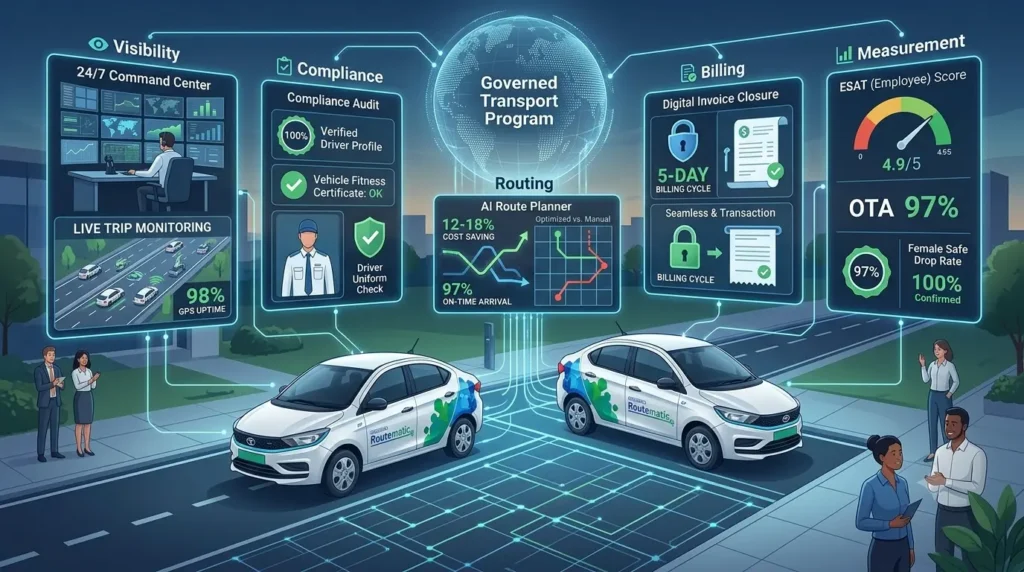
In practice, this trend looks like a shift toward provable safety: real-time trip monitoring, in-app SOS routed to a staffed command center, and automated, timestamped Female Safe Drop confirmation rather than a driver’s verbal say-so. The standard worth holding any provider to is automation. Routematic’s women’s safety framework automates safe-drop confirmation on 98% of trips, with a manual follow-up call on the rest.
What Does the Shift to Managed Transport-as-a-Service Mean for You?
It means the fragmented vendor model is being replaced by accountable, single-platform operations. This is the trend that ties all the others together.
The reason is simple. AI, EV reporting, and safety compliance all require operational control that a loose web of vendors cannot provide. You cannot enforce 100% driver compliance, generate audit-ready ESG data, or guarantee a safe drop at 2 AM when responsibility is spread across five vendors with no central visibility.
| Fragmented vendor model | Managed TaaS model |
| No central visibility, SLA breaches | Single platform, measurable SLAs |
| Manual billing, leakage | Automated validation, billing closed in under 5 days |
| Inconsistent safety checks | 100% driver and vehicle compliance |
| No audit trail | Queryable trip-level records |
| Experience varies by city | Standardized across cities |
This is why the corporate mobility trends point toward consolidation. Routematic operates this hybrid model with its own fleet of 4,500 vehicles and integrated technology, serving 400+ enterprises, including 125 GCCs and 38 Fortune 500 companies across 24 cities, delivering 12 to 18% cost savings and a 4.9 out of 5 employee satisfaction score. The market is moving this way because the alternative no longer holds up to an audit, an ESG disclosure, or a finance review.
FAQs
Are autonomous vehicles a realistic enterprise mobility trend in India for 2026?
Not yet for the daily commute for employees at scale. Autonomous shuttles are being piloted in controlled environments globally, but India’s road conditions, regulatory framework, and liability questions make near-term enterprise deployment unlikely. The practical 2026 trend is AI-assisted human-driven fleets: dynamic routing, driver monitoring, and predictive maintenance, rather than driverless cars on the morning route.
How should a mid-sized company without a huge budget approach these trends?
Start with the trend that carries legal and financial weight rather than the flashiest one. For most, that means tightening safety compliance and switching from manual billing to validated, auditable billing, since both reduce immediate risk and recover leaked spend. Structured transport typically becomes worthwhile once an organization runs more than roughly 50 vehicles daily or operates across multiple shifts, so the threshold is lower than many assume.
Does adopting EVs actually help with ESG reporting, or is it mostly optics?
It helps measurably, but only if the data is captured properly. The reporting value comes from verifiable, trip-level CO2 figures that feed directly into BRSR or other disclosures, not from simply owning EVs. A managed platform with a sustainability dashboard produces auditable emissions data; an EV running through an untracked vendor arrangement produces a nice photo and an unverifiable claim.
Which industries are moving fastest on these mobility trends?
IT, BPO, KPO, BFSI, and GCCs are ahead because they combine night and rotational shifts, large multi-city workforces, competitive talent markets, and frequent exposure to ESG and safety audits. Healthcare and consulting are following closely. These are the sectors where the cost of getting transport wrong, in attrition, compliance exposure, or audit findings, is highest.
If your transport operation is still running on fragmented vendors and manual oversight, the 2026 trends are not optional upgrades. They are the new baseline for compliance and cost control. Talk to Routematic to see how a governed, AI-first, owned-fleet model maps to every trend above.