Employee transportation challenges for GCCs grow from three pressures that arrive together: more cities, more shifts, and more scrutiny. Each new site adds vendors, rosters, and compliance checks that manual setups can’t track.
India had 2,117 GCCs, 3,728 GCC units, and 2.36 million GCC professionals in FY26E, according to the Nasscom-Zinnov India GCC Landscape Report 2026.
Every one of those units needs people to reach work on time, often across shifts that run late into the night. A March 2026 Routematic and Research NXT benchmark found that about 60% of GCCs lack a fully integrated transport management system.
This guide covers the employee transportation challenges that hurt GCCs most as shifts scale, and how Routematic’s employee transportation service for GCCs closes the gap.
Why Are Employee Transportation Challenges for GCCs Growing So Fast?
They are growing because GCCs are adding people, units, and locations faster than most transport programs can adapt. The number of GCCs rose about 32% since FY2021, according to the same Zinnov report, which also projects GCC real estate to grow from 263+ million to 350+ million sq ft over the next 3 to 4 years.
Hiring follows the same curve. The foundit Insights Tracker for June 2026 reports that GCC jobs rose 11% year on year and are on track to reach about 510,000 roles by the end of 2026.
The spread of locations adds a second layer. The same foundit Insights Tracker shows how hiring is distributed across cities:
| Location | Share of GCC hiring | Year-on-year growth |
| Bengaluru | 30% | 10% |
| Hyderabad | 15% | 15% |
| Pune | 12% | 11% |
| Mumbai | 11% | 8% |
| Chennai | 9% | 9% |
| Delhi-NCR | 8% | 8% |
| Tier-2 and emerging cities | 15% | 23% |
Tier-2 and emerging cities are growing at nearly twice the pace of the metros, so a GCC that once ran cabs in one city now often manages several markets with different vendors.
What Are the Main GCC Employee Transportation Challenges at Scale?
The main GCC employee transportation challenges at scale include fragmented vendors, unstable shift demand, thin vendor supply in new locations, night-shift compliance, uneven service quality, and weak cost control. Each one gets harder as shifts multiply.
Vendors Multiply With Every New City
Most GCCs add a local vendor each time they open a site, and each vendor brings its own app, billing format, and service standard. The Routematic and Research NXT survey of 100 professionals found that company-provided cabs account for 46% of employee transport modes, yet 60% of GCCs still coordinate them manually or through fragmented tools.
Shift Demand No Longer Follows a Fixed Roster
Unstable demand is one of the least visible GCC employee transportation challenges, and the same survey reports that 36% of organizations face fluctuating daily commute demand because of hybrid work. It also found that predictive capabilities are almost absent, so most operations react to attendance rather than plan for it, as FinTech BizNews reported when the study launched. A static roster in this setting sends half-empty cabs on some routes and leaves other routes short.
New Locations Need Cabs Before Vendors Are Ready
State incentives are pushing GCCs beyond the metros. According to a legal review of state GCC policies, Karnataka offers a separate package for six cities beyond Bengaluru, Uttar Pradesh raises its land subsidy from 30% in Ghaziabad and Gautam Budha Nagar to 40% to 50% in other regions, and Andhra Pradesh subsidizes neighborhood workspaces that house as few as ten people.
JLL’s June 2026 analysis says more than 90% of GCC activity is still in tier-I cities, and that tier-II markets can cut real estate, talent, and operating costs by 25% to 50%. Transport connectivity makes up 20% of the weight JLL gives to infrastructure when scoring locations.
HCLTech names 14 next-wave cities and warns that emerging cities must avoid repeating metro congestion. Small sites and new corridors rarely have a deep local vendor pool, so the transport plan must be ready before the first shift starts.
Night Shifts Raise Safety and Legal Duties
Late shifts for global teams make night transport routine. The Ministry of Labour’s OSH Code FAQ lists safety, transport, and security arrangements as employer duties for women working between 7 PM and 6 AM, with the woman’s consent. The labour codes took effect on 21 November 2025, so these duties apply now.
In the survey, 26% of respondents named safety and 21% named compliance as their top commute priority, so nearly half put legal and safety control first.
Service Quality and Employee Experience Slip First
Employee experience was the top commute priority at 35%, ahead of safety, compliance, and cost. The report names vendor performance, budget pressure, and employee dissatisfaction as the top challenges in managing mobility at scale. Late cabs, unverified drivers, and missed handovers show up in daily feedback long before they reach a dashboard.
Cost and Billing Control Worsens as Trips Grow
Cost optimization ranked fourth at 18%, yet budget pressure is a leading challenge. Manual billing across vendors hides ghost trips, duplicate routes, and overbilling. In one Routematic case study, automated billing uncovered ₹12 crore in hidden transport costs.
Why Do GCC Transportation Challenges in India Differ by City?
GCC transportation challenges in India differ by city because each hub has its own mix of campuses, corridors, and vendors. The NCR shows how dense this can get: according to the Dun & Bradstreet NCR report, NCR hosts 465 GCCs with more than 270,000 professionals, and Gurugram holds over half of them, followed by Noida at 36%. Two cities carry most of that load, which means shift changes concentrate in a small number of corridors.
Hyderabad shows a different pattern, because business parks such as Knowledge City and Raheja Mindspace anchor its GCC campuses, and Routematic runs dedicated service pages for the ServiceNow GCC at Knowledge City and the Uber GCC at Raheja Mindspace.
What Solves Employee Cab Management Challenges for GCCs?
GCCs solve employee cab management challenges by running rosters, routing, compliance, safety, and billing on one platform a single team controls. Routematic’s GCC offering is built around that idea, and the table maps each GCC employee transportation challenge to what the platform does.
| Challenge | How Routematic handles it |
| Fragmented vendors | Automated trip allocation to vendors with a digital trace and vendor performance tracking |
| Shifting demand | Roster submission by web or app, changes until a cut-off time, and ad hoc requests |
| Routing waste | AI-based route optimization, including escort guards and back-to-back trips |
| Night shift safety | Escort check-in, driver alcohol checks, 15+ in-trip safety alerts, and a panic workflow |
| Compliance | Automated vehicle and driver compliance alerts, a spot-check module, and a driver blacklist |
| Cost control | Automated billing, reconciliation, and a billing audit report |
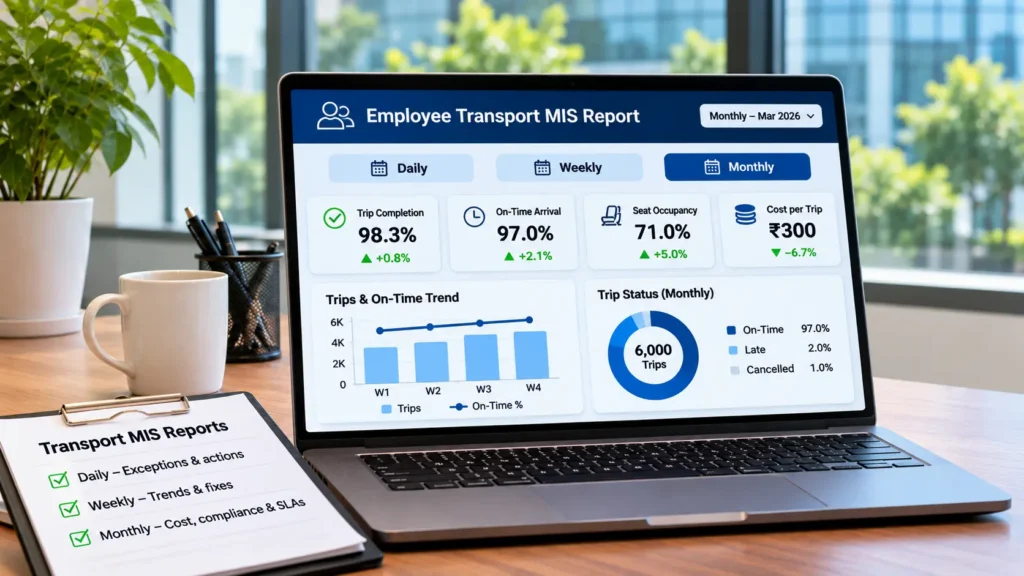
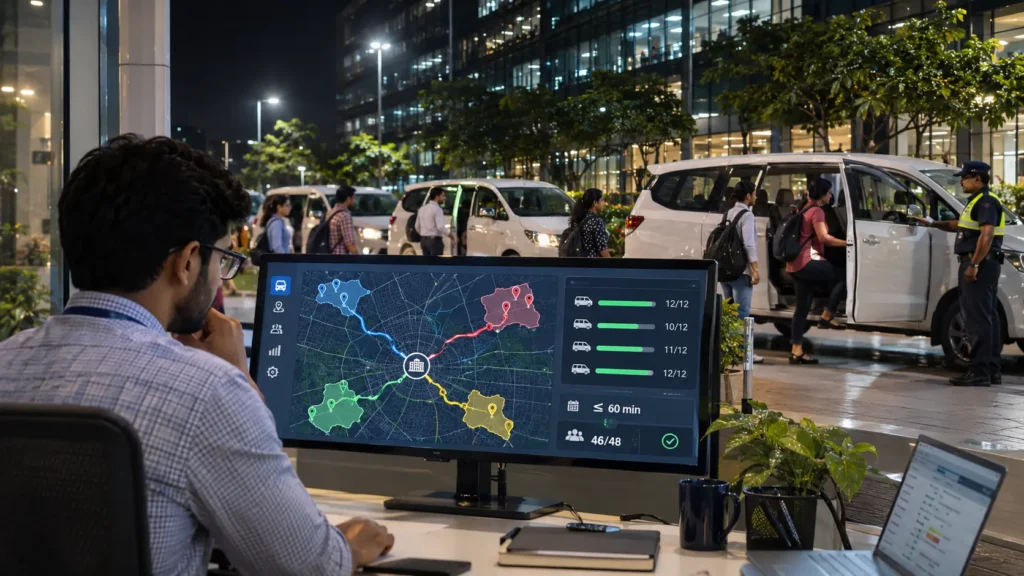
Two operating details matter most. A 24×7 command centre tracks live trips and responds to alerts, and reporting covers 150+ metrics with drill-down for monthly and quarterly reviews.
Routematic serves 400+ enterprises, including 125 GCCs, across 24 cities. It reports 100% driver and vehicle compliance, 97% on-time arrival, automated safe-drop confirmation on 98% of trips, and 12-18% cost savings. In another case study, AI forensics cut a BFSI client’s routing costs by about 12% in 30 days.
A practical rollout has three steps. First, list every site, shift, and vendor, so the baseline is visible. Second, move one shift or site onto the platform and compare on-time arrival, safe-drop confirmation, and billing closure with the old process. Third, extend the same standard city by city, because the rules stay identical while the vendors change.
To see how this works for multi-shift campuses, review Routematic TaaS.
FAQs
Do Tier-2 GCC sites need the same cab setup as metro sites?
Not always, because smaller sites often fit fixed routes better than door-to-door cabs. Routematic offers fixed route shuttles with seat reservations and waitlist management alongside dynamic shift cabs, so a GCC can mix both models under one platform.
How should a GCC handle last-minute roster changes?
A GCC should let a single point of contact or an admin submit and change rosters through a web or app interface until a set cut-off time. Ad hoc requests then flow through the same routing plan instead of phone calls.
Which reports should a GCC admin review every month?
Review on-time arrival, seat occupancy, route deviations, incident closure, compliance expiry, and billing variance. Routematic’s reporting covers more than 150 metrics, so teams can start with these six and add more as the program matures.
Can one platform cover cabs, shuttles, and executive travel?
Yes, Routematic’s GCC service combines dynamic shift transportation, fixed route shuttles, and corporate car rental for guests and executives. Parking management is also available through advance bookings.
What should a GCC check first when opening a new site?
Check vendor supply, route coverage, and compliance records before the first shift starts. A short pilot on one shift lets the team compare on-time arrival and safe-drop confirmation with existing sites before expanding.
Planning a new GCC site or adding shifts? Talk to Routematic to review your current commute operation.
About the author

Kavitha Ramachandragowda
Co-Founder & Executive Director, RouteMatic
As Co-Founder and Executive Director of RouteMatic, Kavitha Ramachandragowda is passionate about shaping the future of employee transportation through innovation and customer-centric solutions. She shares about workplace experience, women's safety, sustainability, enterprise mobility, and the leadership strategies that enable organizations to build smarter commuting programs.