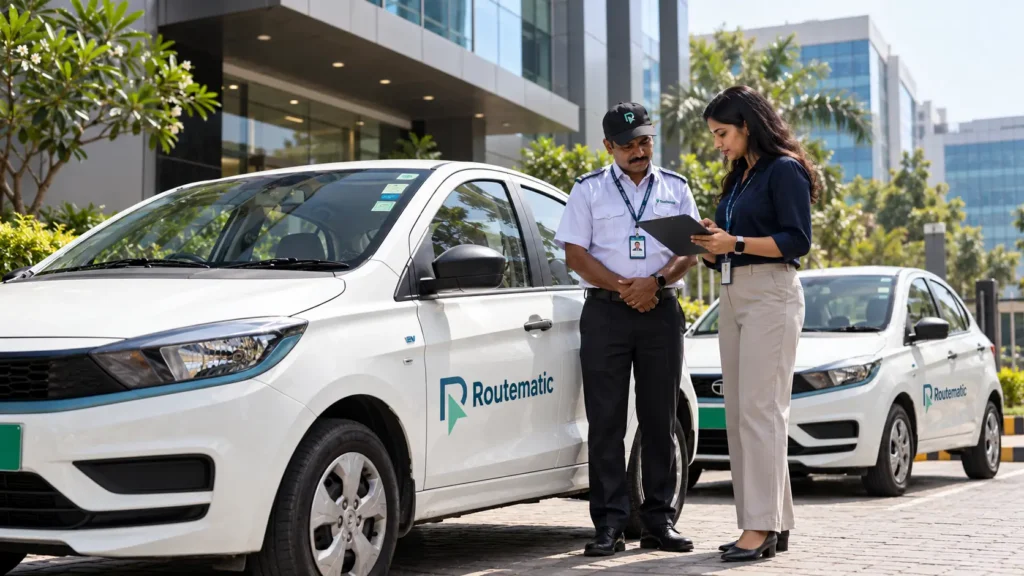
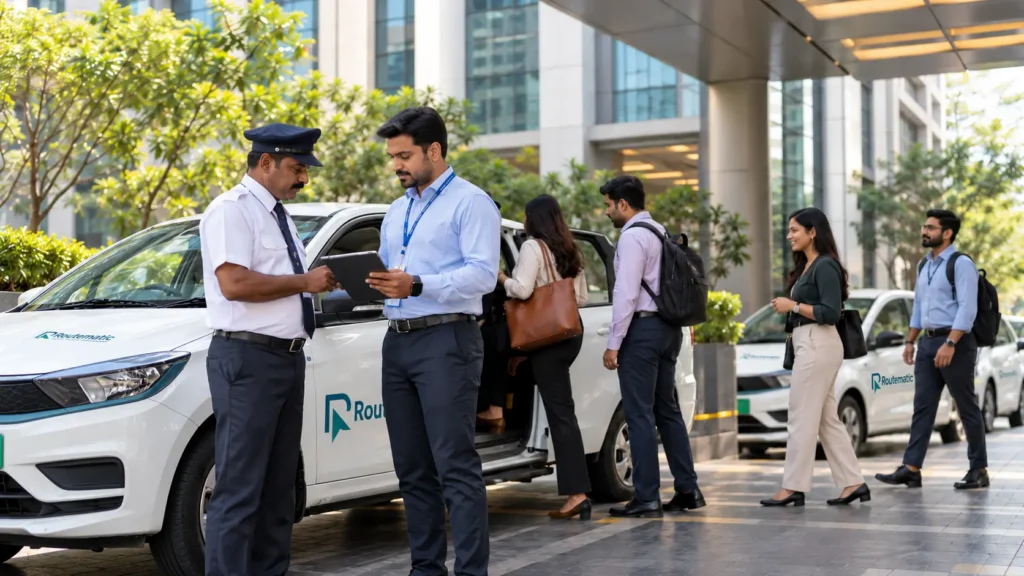
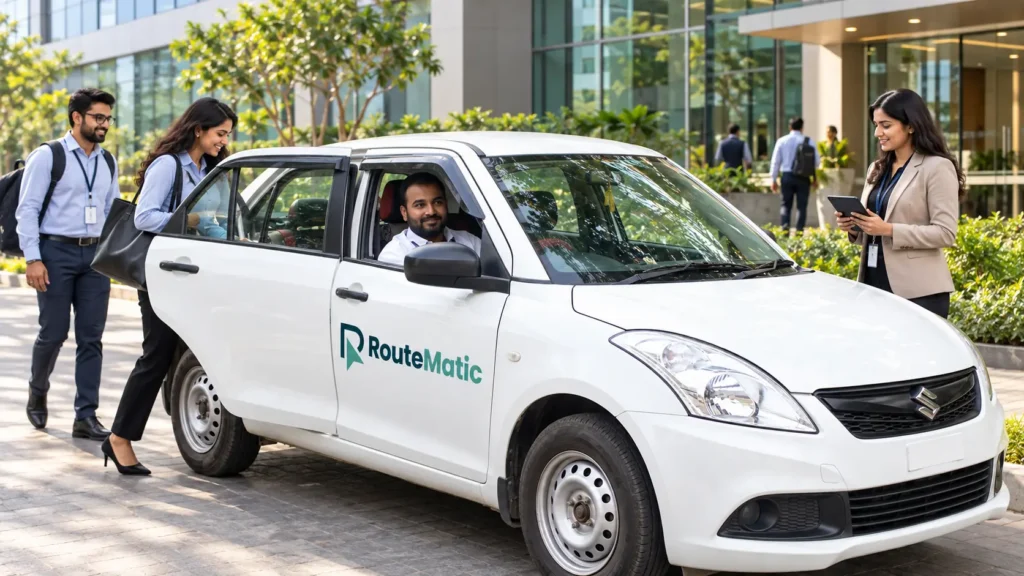
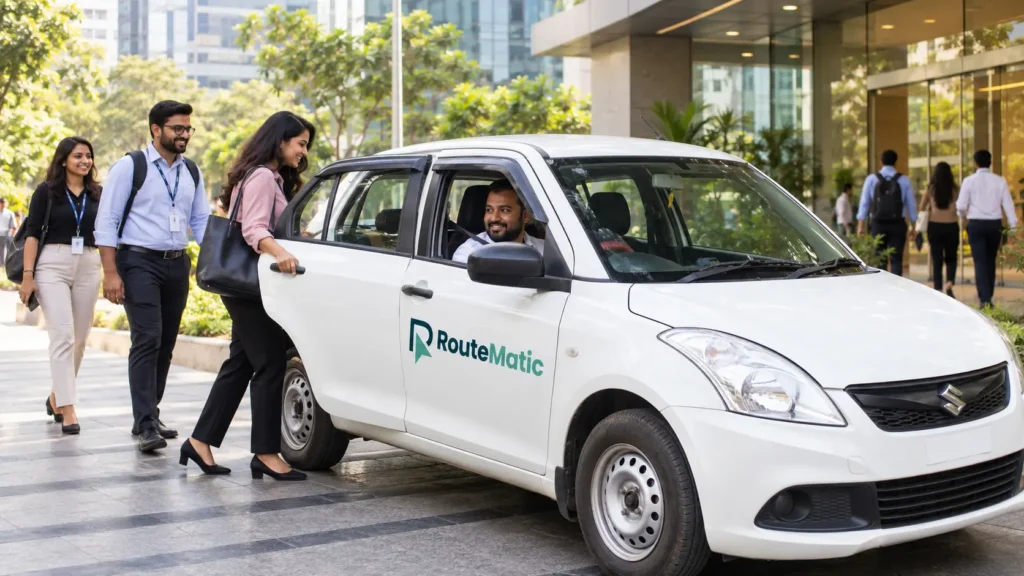
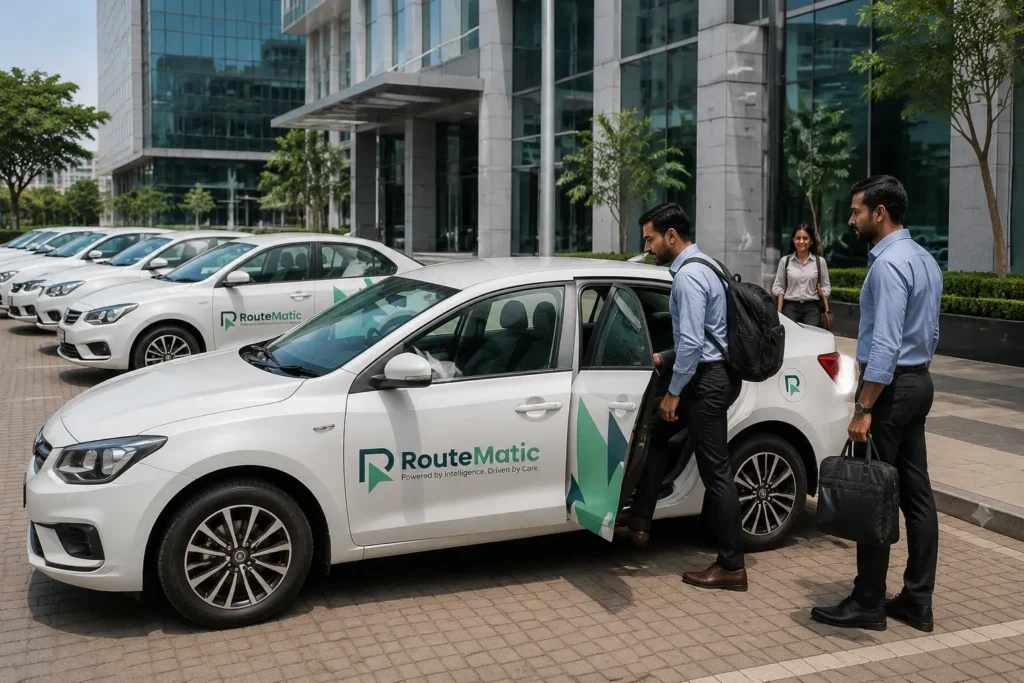
Your transport vendor sends a report every month. But the delay pattern shows up three shifts too late to fix. Right now, employee commute management at your company probably means phone calls, a shared sheet, and a WhatsApp group nobody saves. Every driver swap and route change lives in someone’s head, not in a system anyone else can see. Learning how to manage employee transport in a corporate company usually starts with closing that exact gap.
Employee commute management means running shift transport from one platform, not many vendors. It covers rostering, route planning, driver checks, live GPS tracking, and one bill for the whole fleet. RouteMatic’s webinar on the future of corporate mobility in India covers where this shift is heading next, for teams still deciding whether to consolidate now or later.

Key Takeaways
- Manual employee commute management breaks down at scale because vendor reports lag behind real delays. RouteMatic’s AI dispatch flags problems up to two hours before they happen.
- The OSH Code has been in force nationwide since November 21, 2025. It turns safe transport for night-shift women workers into a job you must record, not just a nice thing to offer.
- RouteMatic runs a fleet of more than 1,000 vehicles, including over 200 electric ones, per the company’s 2026 platform data. That gives enterprises a real-scale option next to fragmented vendor deals.
- Capco brought rostering, trip work, and delivery together across its Pune and Bangalore offices. All of it now runs on one RouteMatic platform.
- A centralized workforce commute management platform can hold on-time rides near 97 percent and work toward a 12 to 18 percent cut in transport cost, per RouteMatic’s own 2026 platform data.
What Breaks Down in Manual Employee Commute Management?
The breakdown happens at one point: the handoff between vendor systems and HR. A delay reaches drivers in Bengaluru’s IT corridor long after HR already knows about it, and by then the shift is late.
Picture a 2,000-employee tech company running three vendor contracts across day and night shifts. A driver calls in sick at 6 AM. The backup plan sits on a coordinator’s phone, not in a shared system. By the time the office learns a shuttle is short one vehicle, twenty employees are already waiting at a pickup point with no new arrival time.
Common failure points include:
- No single place to check driver and vehicle status across vendors
- Bills matched by hand against paper trip logs each month
- No trail for compliance trips, including women’s night-shift rides
Bengaluru’s Global Capability Center workforce spends 50 minutes getting to work, one way, on average. That figure comes from a 2025 report covered by Deccan Herald.
What Does the OSH Code Change About an Employer’s Commute Duty?
The OSH Code turns a duty most employers already accept into one they must record. Since November 21, 2025, transport for night-shift women workers needs a signed consent form, a checked driver, and a logged trip.
A coordinator running vendor cabs off a paper roster has no record of which driver picked up which worker at 11 PM last Tuesday. An inspector who asks for that trail gets a shrug instead of a report. A platform that logs every trip, driver, and consent form on its own already has that trail on file. That log is the backbone of a documented employee commute management policy.
A documented commute duty typically needs:
- A signed consent form for every night-shift assignment
- A checked driver and vehicle record tied to each trip
- Live tracking with a trail you can pull up on request
The OSH Code took effect nationwide that same day, per the Ministry of Labour and Employment’s official gazette notice.
How Does an AI-Driven Platform Close These Gaps?
An AI-driven platform closes that visibility gap by catching trouble before it reaches the pickup point. RouteMatic’s dispatch system flags delays up to two hours ahead, using past GPS data and live traffic instead of a guess.
Say a route runs 15 minutes behind on a Tuesday. The system moves nearby cars to cover the gap before the first rider even notices a wait. Admins see the change on one screen instead of fielding calls from a stranded pickup point. Riders get a new pickup time on their phone instead of standing at a nodal point guessing.
| Task | Manual coordination | AI-driven platform |
| Route delay | Surfaces after riders complain | Flagged up to two hours ahead |
| Billing | Matched by hand against paper logs | Built automatically from the dashboard |
| Compliance record | Scattered across vendor files | Logged per trip, no extra steps |
The dispatch layer is built for shift-based enterprise transport, not point-to-point rides. That is why its delay forecast still holds across a route with many stops. Enterprises weighing this shift can see the full picture on RouteMatic’s employee transport management software page.
Enterprises using automated dispatch report transport cost cuts of 12 to 18 percent. That figure comes from RouteMatic’s own platform data.
RouteMatic: Employee Commute Management Built for Enterprise Scale
Capco needed rostering, trip management, and delivery handled as one process, not three disconnected steps, across its Pune and Bangalore offices. In Capco’s own words: “RouteMatic’s technology-enabled fleet services have been able to deliver exceptional end to end employee experience, from rostering to trip management and fulfillment for Capco across Pune and Bangalore locations.”
The same platform runs over 1,000 vehicles, including more than 200 electric ones (per RouteMatic’s 2026 fleet data), with AI dispatch that catches delays before they reach a pickup point. For enterprises still running vendors by phone, that is the shift from fixing problems to catching them first.
The real cost of manual employee commute management is not the vendor bill. It is the blind spot between when something goes wrong and when you find out. A platform that predicts trouble and logs every compliance trip closes that blind spot. It does this before a delay turns into a late shift or an audit question nobody can answer. The real question is not whether your current setup works.
It is whether it would hold up if an inspector, or a worker’s family, asked for the trip record from last Tuesday night. As commute patterns keep shifting with hybrid schedules, that record only gets harder to keep by hand.
See Employee Commute Management in Action
A vendor call tells you what already went wrong. A platform tells you before it happens. See how RouteMatic’s automated employee transportation service handles rostering, tracking, and compliance in one place. Then ask for a walkthrough using your own shift data, not a generic demo.
Frequently Asked Questions
What Is Commute Management?
Commute management is the planning, routing, tracking, and safety oversight of worker transport between home and work. For companies running shifts, it covers driver checks, live GPS tracking, trip billing, and one shared dashboard instead of separate vendor logins each week.
What Should a Company Check Before Choosing an Employee Commute Management Platform?
A company should check three things: whether the platform predicts delays or only reports them, whether it logs OSH Code compliance records automatically, and whether it runs on the vendor’s own fleet or resells someone else’s cars. RouteMatic covers all three from one dashboard.
What Is the Employee Commute Platform?
An employee commute platform is software that brings rostering, routing, GPS tracking, and billing together in place of sheets and many vendor systems. Some platforms cover only part of that list, and that is usually where the gaps start.
How Do You Manage Commuting?
Managing commuting at the enterprise level means setting a transport policy, checking drivers, and tracking trips live. It also means matching bills against real rides. Companies with more than a few hundred workers usually need software to do this consistently across shifts and sites.
When Should a Company Move From Vendor Cabs to a Dedicated Commute Platform?
Most companies feel the shift once they cross a few hundred employees on rotating shifts, when phone-based coordination starts missing pickups. Some hold off longer to avoid switching costs. That gap between the two decisions often gets settled only after a compliance audit forces the question.
About the author

Sriram Kannan
Chief Executive Officer, RouteMatic
As CEO of RouteMatic, Sriram Kannan is driving the future of enterprise mobility through technology and innovation. He shares key knowledge about AI, digital transformation, workplace mobility, and the evolving role of intelligent transportation in helping organizations improve operational efficiency, employee experience, and sustainable growth.