When it comes to managing employee transportation, some organisations may view it as a logistics aspect; however, this is not the case. For enterprises operating across multiple cities, employee mobility directly affects cost control, compliance, and operational efficiency.
Here, corporate mobility solutions can be a game-changer, as these platforms are designed to bring visibility, automation, and accountability to employee transportation, helping companies reduce unnecessary spend while improving service quality.
We will discuss exactly how corporate mobility platforms can reduce overall employee transportation costs.
Understanding Cost Leakages in Traditional Transport Systems
Before analysing how corporate mobility solutions reduce costs, it is important to understand where organisations lose money in traditional setups. At times, enterprises and mid & large organisations can end up relying on different vendors to support employee mobility,
This creates a fragmented ecosystem with limited control and poor visibility. Common inefficiencies that enterprises find include:
- Overbilling due to a lack of audit trails
- Ghost trips and duplicate billing
- Low vehicle occupancy with empty seat kms
- Static routes that do not adjust to real demand
- Manual roster planning leads to inefficiencies
- Inconsistent compliance across cities
These inefficiencies are exactly what enterprise mobility solution providers in India aim to eliminate.
If these inefficiencies are managed with structured shuttle programs, it can reduce employee transportation costs by up to 25–35% while improving punctuality and workforce efficiency.
These inefficiencies are exactly what mid & large organisations mobility solution providers in India aim to eliminate.
Role of AI and Automation in Cost Optimisation
One of the biggest advantages of modern corporate mobility solutions is AI-led automation. Cost optimisation is no longer dependent on just manual decisions or basic pooling. Enterprises are now primarily focusing on:
- Demand forecasting based on employee travel patterns
- Dynamic routing that adjusts in real time
- Automated seat allocation to maximise occupancy
- Intelligent clustering of routes to reduce distance travelled
This approach makes sure that every vehicle is utilised efficiently. Higher occupancy directly translates to lower cost per employee.
Enterprise mobility solutions companies that combine AI with operational control deliver measurable outcomes. RouteMatic, for instance, operates on a hybrid model that integrates technology with owned-fleet operations.
This ensures that optimisation is not theoretical but implemented on the ground.
Enhancing Governance and Compliance to Mitigate Risk
Financial loss is not just about the monthly invoice; it is also about the hidden costs that are incurred due to non-compliance and safety incidents. In India, the regulatory landscape with respect to employee transport is strict, especially for night shifts and female employees.
A single safety lapse can lead to massive legal liabilities and irreparable reputational damage. Enterprise mobility solutions companies provide a governance layer that manual vendors cannot match.
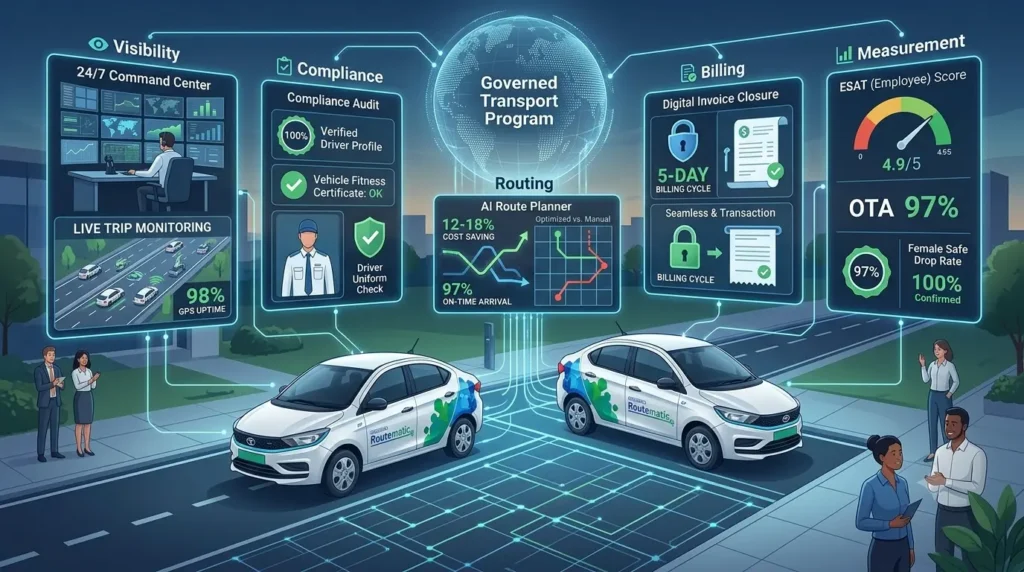
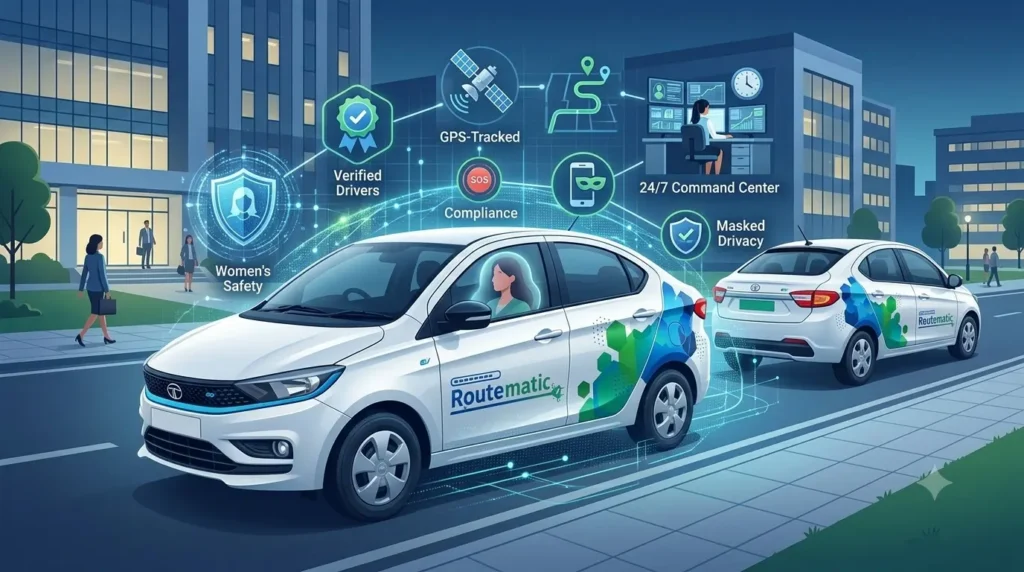
By automating female safe drop confirmations and maintaining 100% digital audit trails for driver and vehicle compliance, these platforms insulate the organisation from risk.
- Standardised Compliance: Every vehicle and driver undergoes a rigorous verification process before being onboarded into the system.
- Real-time Monitoring: A 24/7 command centre monitors every trip, flagging any route deviation or unscheduled stop immediately.
- Automated Audit Trails: Every trip generates a digital footprint, making the organisation “audit-ready” at all times.
Improved Vehicle Utilisation and Route Efficiency
Low vehicle utilisation is one of the biggest cost drivers in employee transportation. Many organisations operate vehicles that run partially empty due to poor planning. Corporate mobility solutions address this through:
- Occupancy optimisation algorithms
- Route consolidation
- Smart pooling based on real-time demand
- Continuous monitoring of utilisation metrics
This will ensure that fewer vehicles are required to meet the same demand, lower fuel consumption and operating expenses, and a better environmental impact.
Centralised Control and Billing Accuracy
One of the biggest financial challenges in employee transport is the lack of transparency in billing. Without proper systems in place, organisations often tend to struggle when it comes to validating invoices and detecting discrepancies, especially when multiple vendors are involved.
Corporate mobility solutions solve this by introducing centralised control and automated billing systems that create a clear financial audit trail.
It helps by:
- Real-time trip tracking with GPS validation
- Digital audit trails for every ride
- Automated billing validation based on actual trip data
- Elimination of manual invoice reconciliation
- Standardised pricing models across locations
Unlike traditional vendor setups, enterprise mobility solutions companies provide a single source of truth for all transport data, which strengthens financial governance.
Multi-City Scalability and Standardisation
As organisations expand across cities, managing employee transport becomes increasingly complex. Different vendors, varying standards, and inconsistent processes lead to inefficiencies.
Corporate commute solutions bring standardisation across locations through:
- Centralised command centre operations
- Uniform service levels across cities
- Scalable technology infrastructure
- Integrated fleet management
This scalability is a key advantage of working with enterprise mobility solution providers in India that offer both technology and operational control.
Why Hybrid TaaS Models Deliver Better Cost Efficiency?
Not all enterprise mobility solutions companies operate with the same level of control. Many provide only software or act as intermediaries between enterprises and vendors. The hybrid Transport-as-a-Service model provides a more structured approach as it successfully combines:
- AI-driven technology platforms
- Owned or tightly managed fleet
- Trained and verified drivers
- 24/7 command centre monitoring
For enterprises that are on the lookout for reliable corporate commute solutions, choosing a provider with both technology and operational depth is essential for long-term efficiency.
Sustainability and the Future of Corporate Mobility
As ESG (Environmental, Social, and Governance) goals become a priority for boards of directors, transportation spend is being viewed through the lens of carbon footprints. Traditional petrol and diesel fleets account for a significant share of a company’s Scope 3 emissions.
Forward-thinking mobility platforms are integrating Electric Vehicles (EVs) into their core offering. In Fact, leading corporate mobility providers like RouteMatic are enhancing their EV fleet capabilities, using electric vehicles to optimise employee transportation costs and support sustainable mobility initiatives.
However, sustainability is not just about the engine type; it is about efficiency. By reducing the total number of trips through better routing, companies naturally reduce their CO2 output.
- Quantified ESG Metrics: Modern platforms offer digital dashboards that calculate the tons of CO2 saved through EV usage as well as trip optimisation.
- Reduced Congestion: Efficient pooling leads to fewer vehicles on the road, thereby reducing urban congestion.
- Employee Satisfaction: High-quality, reliable, and sustainable transport options lead to an Employee Satisfaction (ESAT) score of up to 4.9/5, which aids in talent retention, another significant long-term cost saving.
Conclusion
Employee transportation has evolved into a critical function that directly affects costs, compliance, and the employee experience. Organisations can no longer risk managing it through fragmented systems and manual processes.
Corporate commute solutions give a more structured, data-driven approach to reducing transportation costs. By improving utilisation, eliminating billing leaks, ensuring compliance, and enabling real-time visibility, these platforms deliver measurable, sustainable savings.
As organisations grow, the ability to scale transport across multiple cities while maintaining 100% compliance becomes a competitive advantage. The future of corporate mobility lies in data-driven decisions that aim to protect both the bottom line as well as the workforce’s well-being.
Frequently Asked Questions
How does a mobility platform differ from a local transport vendor?
A mobility platform integrates AI routing, real-time tracking, and automated billing, providing transparency and efficiency that manual vendors lack. It moves transport from a “service-only” model to a “data-driven” model.
Is it difficult to transition from our current vendor to a mobility platform?
While change management is a common concern, professional providers handle the transition end-to-end to prevent operational disruption, often running parallel systems during the initial phase.
How do corporate mobility solutions enhance female employee safety during night shift transportation?
The system uses automated female safe drop confirmations (via OTP or app) and 24/7 command centre monitoring. If a drop is not confirmed, the system triggers a manual call protocol.
Is switching to a mobility platform worth the effort?
Yes, if your current system lacks visibility and control, switching to corporate mobility solutions can significantly improve efficiency and reduce costs.