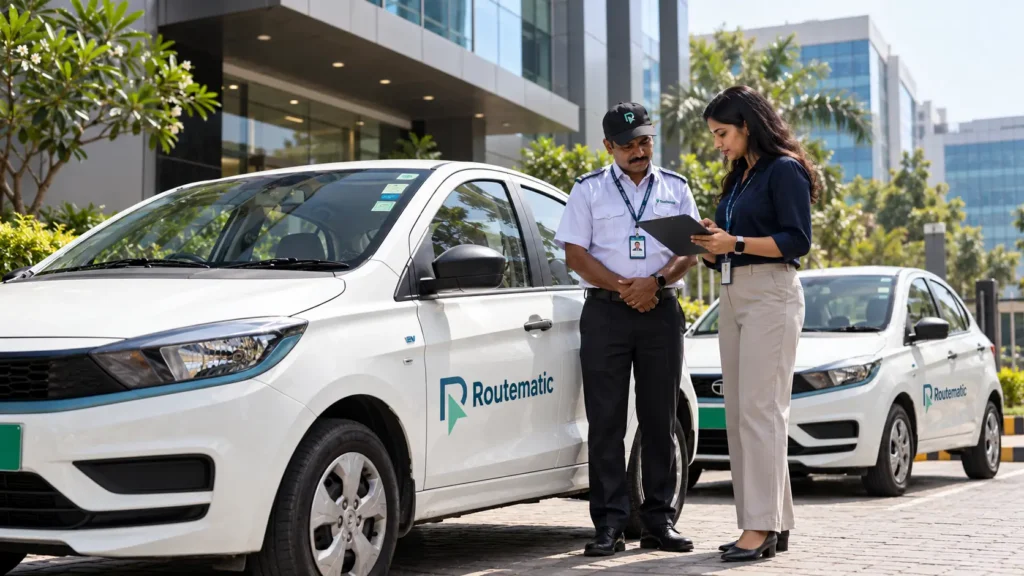
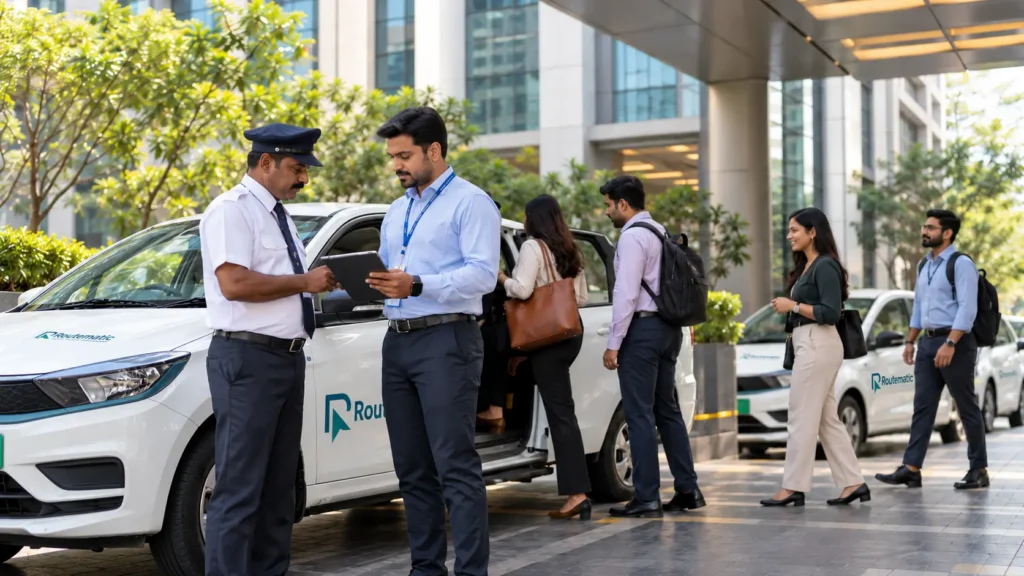
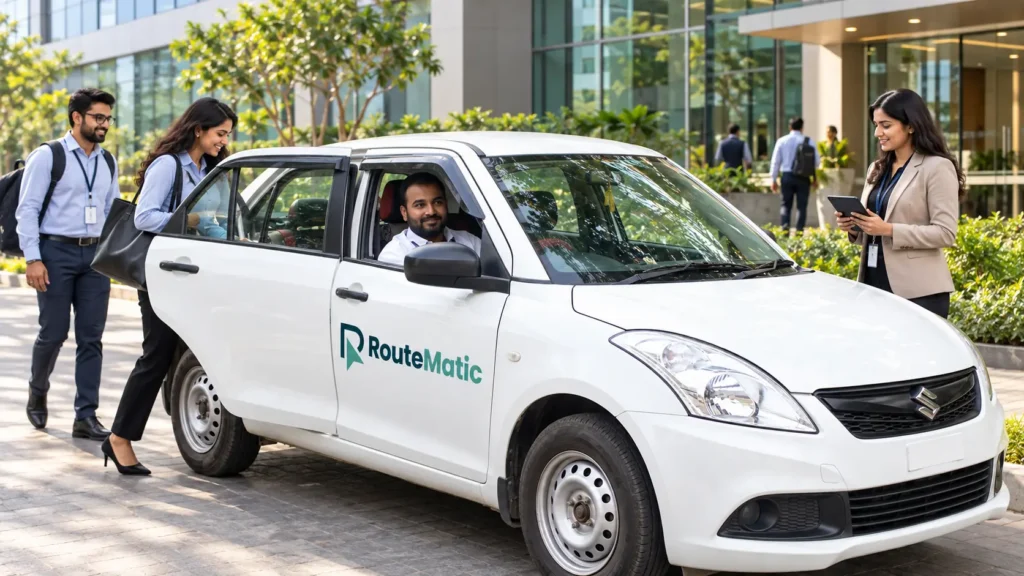
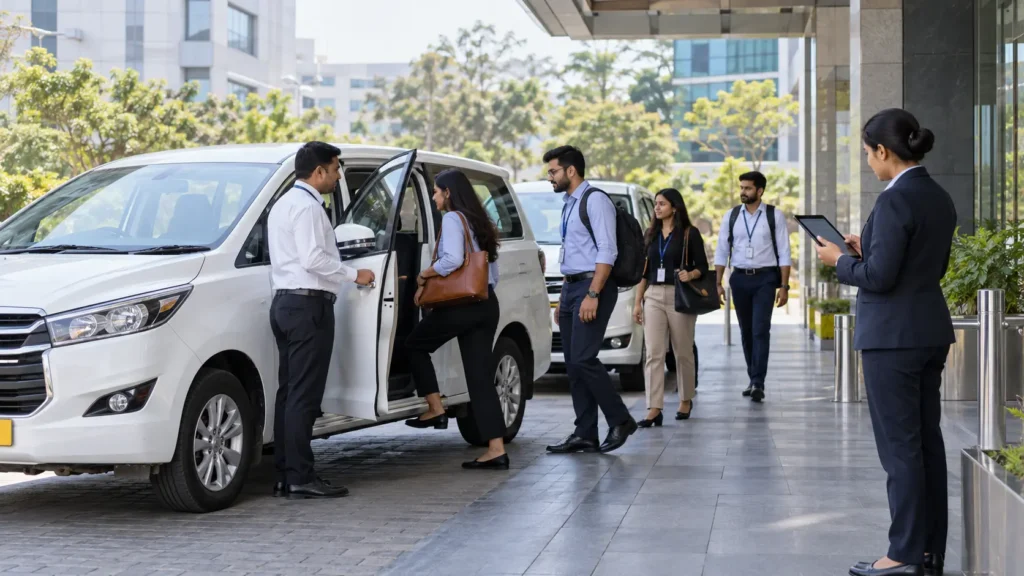
Most companies do not have an employee transportation strategy. They have an employee transportation habit. Vehicles get booked, routes get repeated, invoices get paid, and nobody asks whether the whole arrangement still serves the business.
In a country where over 2,100 Global Capability Centres now employ nearly 2.36 million professionals, and where technology employees in Bengaluru spend an average of 50 minutes travelling roughly 15 kilometres one way to the office, that habit is expensive.
A strategy changes the question from “how do we get people to the office tomorrow” to “how should commuting work for this organisation over the next three years”. This blog breaks down what an employee transportation strategy should include, and how to build one that holds up as your workforce grows.
TL;DR
- Modern workplace commuting is evolving from a personal responsibility into a company-managed mobility experience focused on safety, efficiency, and flexibility.
- Smart transport solutions help reduce travel stress, improve employee productivity, and optimise daily office commutes.
- Technology-driven mobility enables real-time tracking, better routing, cost savings, and sustainable travel choices.
- The future of corporate commuting combines employee convenience, operational efficiency, and greener transportation.
What Is an Employee Transportation Strategy?
An employee transportation strategy is a documented, board-level framework that defines how an organisation moves its people: the service standards it commits to, the operating model it uses, the technology it runs on, the budget it allocates, and the safety and sustainability outcomes it targets. It sits above daily operations and gives every routing, vendor, and fleet decision a reference point.
Without one, transport decisions get made reactively by whoever is handling escalations that week. With one, the commute becomes part of your employee value proposition, your cost structure, and your ESG story. If the underlying concepts are new to your team, our explainer on what corporate mobility means is a useful starting point before going deeper.
So what exactly should the document contain? Six components, at minimum.
The Six Components Every Strategy Must Include
1. Demand Mapping
Start by understanding where your employees live, which shifts they work, and how office attendance changes throughout the week. Hybrid work has made commute demand less predictable, making accurate demand mapping essential for efficient route planning.
According to the CBRE 2024 India Office Occupier Survey, around 90% of organisations now expect employees to work from the office at least three days a week. As attendance varies by day and team, transport demand also changes significantly. Companies that assume the same level of demand every day often end up with underutilised vehicles on some days and capacity shortages on others.
A strategy that assumes uniform daily demand will overprovision on quiet days and fail on peak days. We have written separately about aligning commute programmes with hybrid work mobility strategy, and demand mapping is the foundation of it.
2. Service Level Definitions
Decide, in writing, what good looks like: maximum one-way travel time, on-time arrival percentage, minimum vehicle occupancy, cab waiting windows, and grievance resolution time. These service levels become the yardstick for every vendor and every platform you evaluate.
3. Operating Model
Choose between owned fleet, outsourced vendors, or a platform-managed hybrid. Most Indian enterprises now favour a technology platform controlling execution partners, because it combines accountability with asset-light economics. A structured employee transportation service gives you enterprise-grade control without fleet ownership on your books.
4. Technology and Data Architecture
The strategy must specify the digital backbone: automated rostering, AI-based route optimisation, live tracking, employee apps, and billing that reconciles against actual trips. An AI-powered employee transportation strategy is not a buzzword; it is the difference between routes designed by algorithms that learn from every trip and routes designed by memory.
5. Safety and Compliance Framework
Define driver verification standards, night shift protocols, escort and safe drop rules for women employees, SOS response procedures, and the audit trail you will maintain for state compliance requirements. Safety belongs in the strategy document, not in an annexure.
6. Budget and Measurement
Fix the cost per employee per month you are targeting, the review cadence, and the metrics leadership will see. What gets measured monthly gets managed; what gets reviewed annually gets ignored.
The Two Strategic Trends Shaping Corporate Transportation
Modern corporate transportation is no longer just about moving employees from one place to another. Businesses are increasingly focusing on technology and sustainability to improve efficiency, reduce costs, and prepare for future transportation needs. Two trends stand out:
1. Artificial Intelligence Is Making Transport Smarter
Artificial intelligence is transforming how companies plan and manage employee transportation. AI-powered systems can optimise routes, group employees based on location and shifts, predict daily transport demand, and automatically adjust vehicle allocation as schedules change. This helps businesses improve vehicle utilisation, reduce travel time, lower operating costs, and minimise manual planning. Routematic’s live webinar on how AI is reshaping every layer of employee mobility breaks down how this forecasting and allocation model is actually built, layer by layer.

2. Sustainability Is Becoming a Business Requirement
Sustainability is now a key part of corporate transportation planning. According to the India Brand Equity Foundation (IBEF), India recorded more than 2.3 million electric vehicle sales in 2025, while the country’s public charging network expanded to over 29,000 charging stations. As more organisations work towards their ESG goals, integrating electric vehicles into employee transport fleets can reduce long-term costs and lower carbon emissions. For a deeper look at the business benefits and implementation strategies, read our sustainable transport report.
Assess the Maturity of Your Corporate Transportation Programme
Not all corporate transportation systems operate at the same level. The table below helps you assess where your organisation stands today and identifies the key improvements needed to build a more efficient, scalable, and future-ready transport programme.
| Area | Reactive | Managed | Strategic |
| Route Planning | Fixed, manually planned routes | Software-assisted route planning | AI-optimised, self-learning routes |
| Demand Planning | No demand forecasting | Weekly roster-based planning | Predictive planning based on hybrid work patterns |
| Employee Safety | Complaint-driven response | GPS tracking and monitoring | Standardised safety protocols with safe drop confirmation |
| Fleet Management | Dependent on vendor availability | Standardised fleet | Phased EV adoption with defined utilisation targets |
| Cost Management | Manual invoice verification | Periodic cost reviews | Automated trip-level reconciliation and cost analytics |
| Governance & Reporting | Ad hoc reviews | Quarterly performance reviews | Monthly dashboards and leadership reporting |
Building the Strategy: A Five Step Sequence
Building a successful corporate transportation strategy requires a structured approach. Follow these five steps to get started:
- Gather twelve months of data. Trip logs, costs, complaints, occupancy, and employee home locations.
- Survey employees. Commute pain is a retention issue; ask about travel time, safety perception, and preferences before writing anything.
- Draft service levels and the operating model. Get finance, HR, and admin to sign the same document.
- Select the technology platform. Evaluate against your service levels, then fit execution partners to the platform, never the reverse.
- Set a sustainability glide path. Fix EV percentage targets by year, and model the economics using our EV fleet management ROI framework so targets are grounded in cost, carbon, and employee experience together.
Conclusion
An employee transportation strategy turns the commute from a cost you tolerate into a capability you manage. Map demand honestly, commit to service levels, choose a platform-led operating model, and build AI and sustainability in from day one rather than bolting them on later. Organisations that do this consistently spend less, retain better, and report cleaner ESG numbers, and the right technology partner makes each component measurable from the first month.
Frequently Asked Questions
What should an employee transportation strategy include?
Six things: demand mapping, defined service levels, an operating model, a technology and data architecture, a safety and compliance framework, and a budget with measurable targets. Anything less is an operations plan, not a strategy.
How is a corporate transportation strategy different from daily transport management?
Strategy sets direction and standards over a multi-year horizon; management executes trips daily within those standards. Companies that skip strategy end up with management by escalation.
Why should AI be part of the strategy?
Because routing and deployment are mathematical optimisation problems. AI systems continuously improve occupancy, travel times, and cost per trip in ways manual planning cannot match at scale.
Is a sustainable employee transportation strategy financially viable in India?
Increasingly, yes. Falling GST on electric vehicles, expanding charging infrastructure, and lower running costs per kilometre have brought EV commute economics close to parity on high-utilisation corporate routes.
How often should the strategy be reviewed?
Review metrics monthly and the strategy itself annually, or immediately after major changes such as a new office, a shift pattern change, or significant headcount growth.
About the author

Sandeep Padhi
Chief Operating Officer, RouteMatic
As COO of RouteMatic, Sandeep Padhi brings extensive expertise in transport operations, fleet management, and enterprise mobility. He shares practical insights on scaling transportation programs, operational excellence, compliance, driver ecosystems, and building reliable mobility solutions for modern enterprises.