Your transport vendor sends this month’s invoice. The numbers don’t match what your team tracked on the ground. This is how most employee transportation planning breaks down, somewhere between the spreadsheet and the street. A structured plan closes that gap before it becomes an audit finding. Here’s how automated billing closed that exact gap for one client.
Employee transportation planning covers six connected pieces: mapping commute demand, designing routes, choosing the right vehicle and technology mix, building in safety and compliance checks, controlling cost, and monitoring performance after rollout. Skip any one piece, and the gap shows up later as a safety incident, a billing dispute, or a route nobody actually uses.
Key Takeaways
- A complete employee transportation planning process covers six areas: demand mapping, route design, technology, safety, cost control, and performance monitoring.
- Enterprises that skip a baseline commute survey usually rebuild their routes within the first year. Real pickup patterns end up different from what they assumed.
- A billing audit for one of RouteMatic’s enterprise IT consulting clients caught escort trips being double-charged, cutting those costs in half within a single billing cycle.
- RouteMatic builds night-shift and women-only trip monitoring into every plan by default, a response to Ola Mobility Institute’s 2019 finding that most women in India don’t feel safe on public transport.
- Corporate transportation planning succeeds or fails on whether performance gets tracked monthly, not set up once and left alone.
What Does an Employee Transportation Plan Need to Cover?
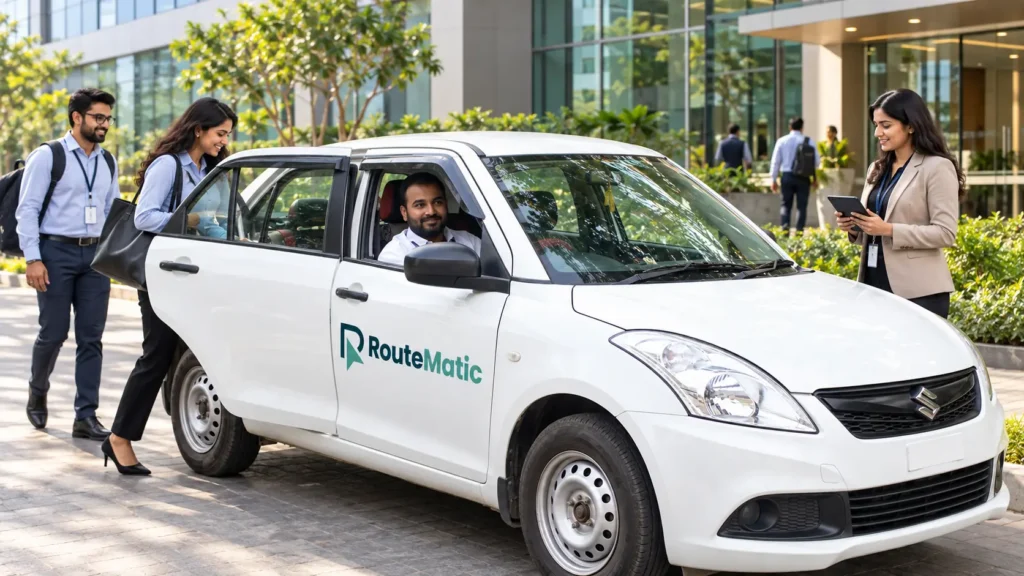
RouteMatic starts every plan with a commute survey that covers home locations, shift times, and current travel modes for each employee who needs a ride. That baseline groups riders into zones before a single route is drawn, since routing without zone data usually results in half-empty vehicles within months. Good employee mobility planning treats this survey as step one, not an afterthought.
Take a large enterprise running multiple shifts in one city. A commute survey often finds night-shift staff clustered in the same two or three localities. Nobody had grouped these pickups before. Fixed routes replace a dozen scattered trips a night with two or three scheduled runs.
| Planning input | What it determines |
| Home locality or ZIP | Route zones and pickup clusters |
| Shift start and end time | Vehicle scheduling and driver rostering |
| Headcount per zone | Vehicle size, from sedan to bus |
| Current commute mode | Where resistance to switching is likely |
The corporate employee transportation service market was valued at approximately USD 38.46 billion in 2025. It is projected to reach USD 56.58 billion by 2030, according to The Business Research Company.
How Do You Build Safety and Cost Control Into the Plan?
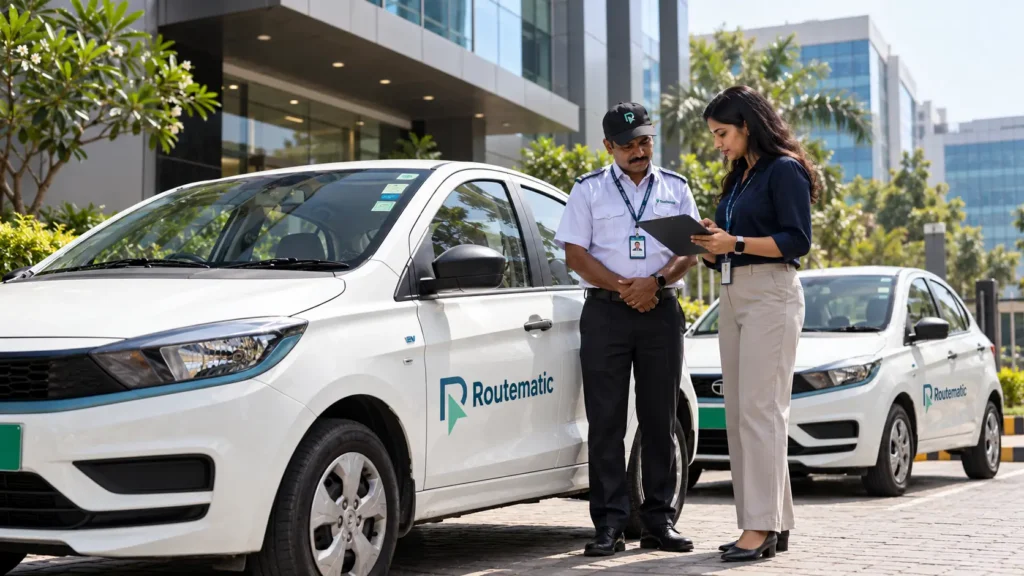
RouteMatic treats safety and cost as a single planning step, not two, since the same trip data drives both outcomes simultaneously. It checks driver and vehicle compliance before every trip is assigned, pulling that data straight from the GPS logs already running on each vehicle. Only fully compliant vehicles ever get dispatched. RouteMatic’s safety and compliance guide covers this in more depth, and the masterclass on building an audit-ready transport system walks through what that compliance record needs to look like under the Motor Vehicles Act.

RouteMatic’s IT consulting client had a billing problem hiding in plain sight. Escort trips were being charged twice under their previous vendor. Catching that in the trip-level data cut the double-charging problem in half within one billing cycle.
- Driver verification and documentation checks are run before onboarding and on a fixed schedule after
- GPS tracking and panic-button access on every vehicle, not just ones flagged as high-risk
- Automated flags for night-shift and women-only trips that need extra monitoring
- Digital billing is tied to trip-level data so that invoices can be checked against actual GPS logs
Only 9% of women in India say they feel safe using public transport, according to the Ola Mobility Institute’s 2019 survey of nearly 10,000 women across 11 cities.
How Do You Monitor Performance After the Plan Goes Live?
RouteMatic tracks plan performance through monthly reviews of on-time arrivals, cost per trip, vehicle occupancy, and safety incidents, rather than a one-time setup at rollout. Skip that cadence, and a plan that looked solid at launch starts drifting within weeks of the first shift change or office move. That drift is the most common reason corporate mobility planning fails quietly instead of all at once.
Picture a GCC that expands from one shift to three within a year. The original routes were built around a single shift window. Pickups start getting missed within weeks. Nobody redrew the zones.
| Metric to track | Why it matters |
| On-time arrival rate | Flags route or scheduling breakdowns early |
| Cost per trip | Catches billing drift before it compounds |
| Vehicle occupancy | Shows where routes need consolidating |
| Safety incident count | Confirms compliance checks are actually working |
Monthly reviews, not annual ones, catch a drifting plan before it turns into a full rebuild.
RouteMatic: Turning a Transportation Plan Into a Measurable Operation
Thermofisher runs its employee commute through RouteMatic’s technology-integrated fleet. “Thermofisher has a strong emphasis on Safety and Compliance. RouteMatic’s technology integrated fleet helps us drive Safety and Compliance. Real-time feeds help us to address the queries immediately enhancing employee satisfaction. We would recommend RouteMatic for Corporate Employee Transport,” says the Manager, Facilities, South East India. On the cost side, that same escort-trip billing fix delivered a 40% overall cost reduction for an IT consulting client once trip-level data replaced manual reconciliation. RouteMatic holds ISO 27001:2022 certification for its handling of trip and billing data.
What Actually Changes Once the Plan Is in Place
The biggest shift isn’t the routes themselves. It’s that transport stops being a monthly surprise and starts being something your team can forecast. Once demand mapping, safety checks, and cost tracking run in tandem, you can forecast rather than react. The real question becomes how fast you can adjust when headcount or shifts change. RouteMatic’s day-to-day operations checklist picks up right where this planning stage ends.
Get Your Employee Transportation Plan Reviewed
A plan built on assumptions rather than a real commute survey tends to require rework within the first year. RouteMatic checks your fleet and technology setup against actual shift and headcount data, not a generic template. That way, the gaps show up before they cost you. Talk to RouteMatic about reviewing your current plan.
Frequently Asked Questions
What are employee transportation services?
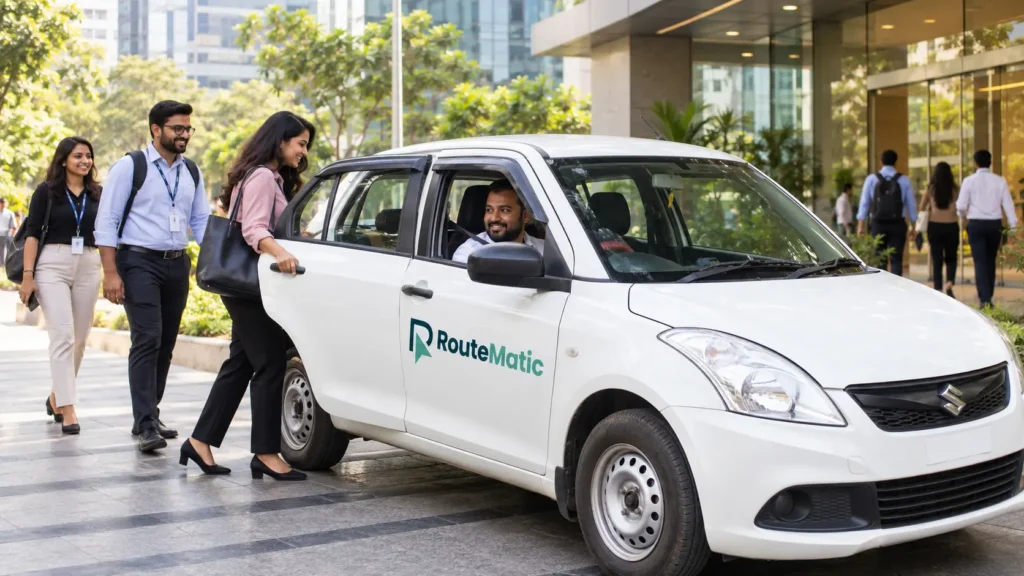
Employee transportation services cover the routes, vehicles, drivers, and technology a company uses to move staff between home and work. RouteMatic runs this as a hybrid model: an owned fleet paired with route optimization, real-time tracking, and a 24/7 command center.
What are the steps in employee transportation planning?
Planning starts with a commute survey, then zone-based route design, vehicle and technology selection, safety and compliance setup, cost modeling, and ongoing performance monitoring. Skipping the survey step is the most common reason routes need to be rebuilt within the first year.
What is the 4-step model used in transportation planning?
The classic 4-step model comes from urban transport planning, not corporate commute programs. It covers trip generation, distribution, mode choice, and route assignment. Enterprise transport teams borrow this logic but swap census data for employee shift rosters and home locations, which changes how each step actually gets run.
What types of employee transportation does a plan need to account for?
A plan typically covers fixed-route shuttles for high-density zones, on-demand shift cabs for scattered pickups, parking and access management, and corporate rentals for airport or multi-day travel. Most enterprises run at least two of these side by side, not just one.
How do you know if an employee transportation plan is working?
Track on-time arrival rate, cost per trip, vehicle occupancy, and safety incident count monthly, not just at renewal time. A plan that looked solid at rollout can still drift once a new shift pattern or office location gets added without anyone updating the routes.
About the author

Kavitha Ramachandragowda
Co-Founder & Executive Director, RouteMatic
As Co-Founder and Executive Director of RouteMatic, Kavitha Ramachandragowda is passionate about shaping the future of employee transportation through innovation and customer-centric solutions. She shares about workplace experience, women's safety, sustainability, enterprise mobility, and the leadership strategies that enable organizations to build smarter commuting programs.