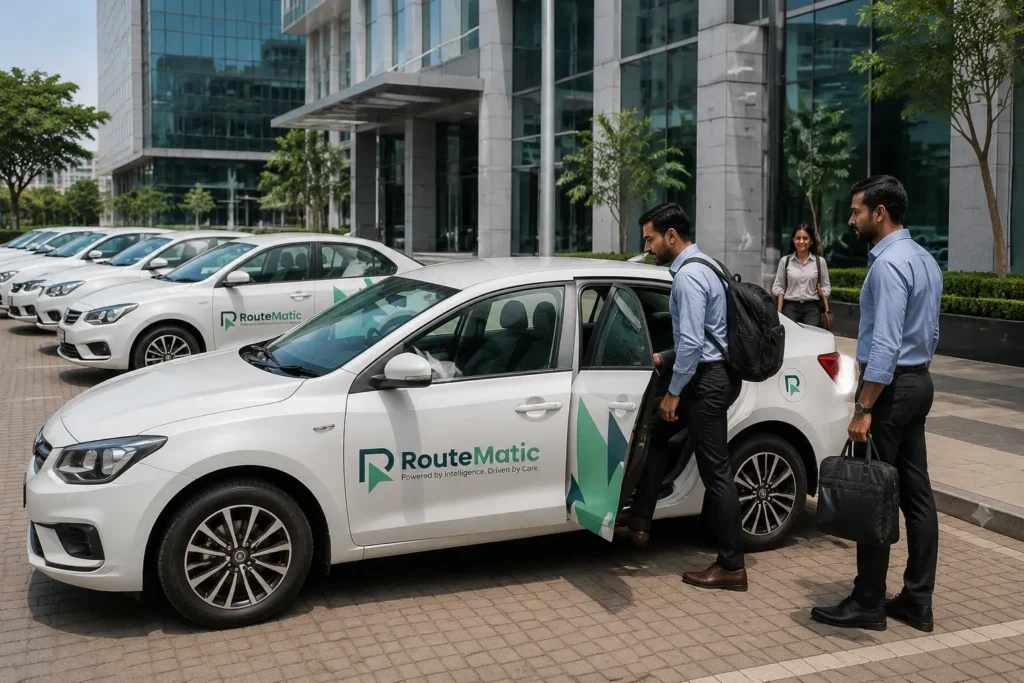
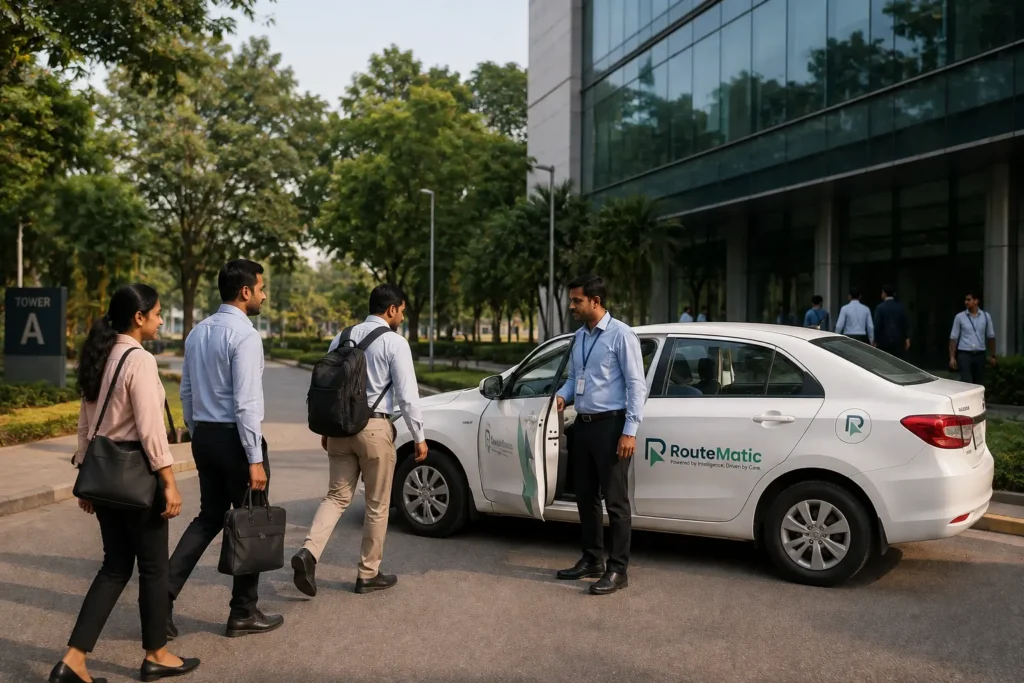
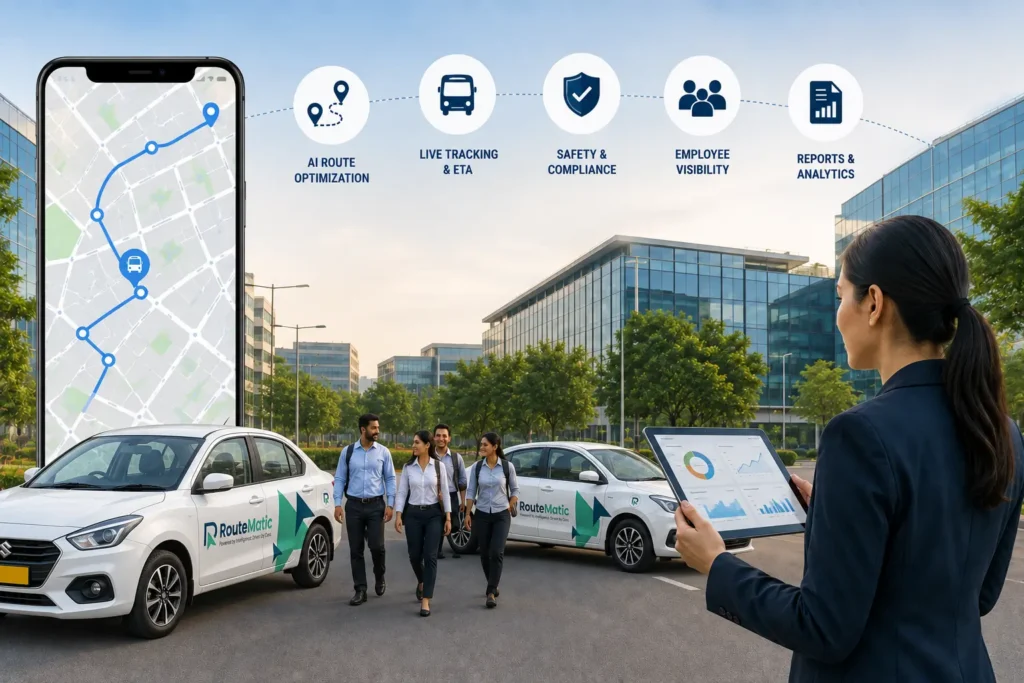
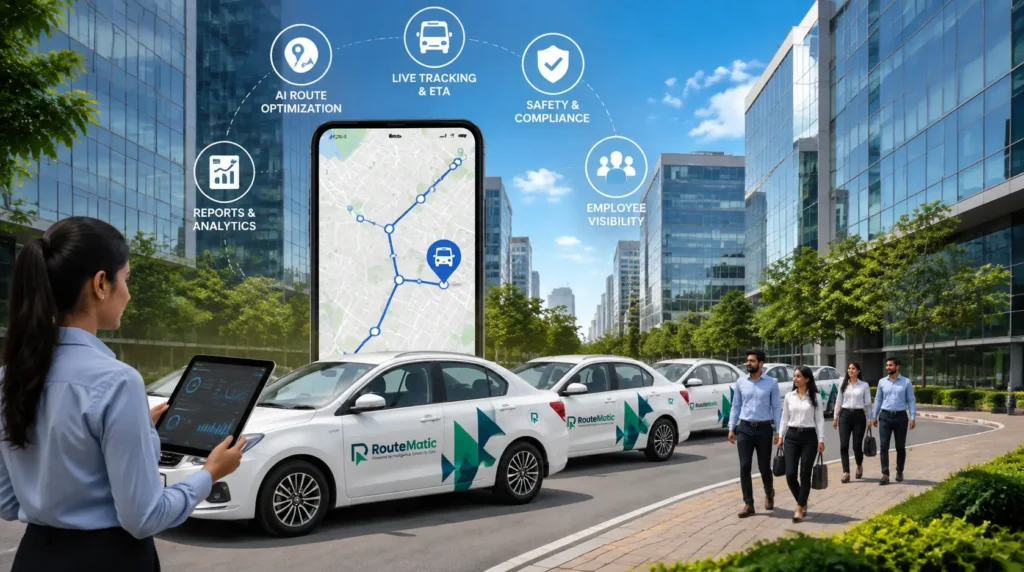
Employee transportation operations are becoming increasingly complex for large enterprises in India. Managing multiple routes, shifts, vehicles, and vendors manually often results in higher costs and lower operational efficiency.
AI-powered Employee Transportation Management Systems (TMS) help organisations optimise routes, automate planning, and improve vehicle utilisation through data-driven decision-making. This aligns with India’s broader focus on transportation efficiency, with initiatives such as the National Logistics Policy aiming to reduce logistics costs from around 14% to 8% of GDP.
In this article, we explore the key roles AI plays in employee transportation management and the business benefits it delivers for Indian enterprises.
TL;DR
- Corporate transportation management helps enterprises move beyond manual cab operations with structured, data-driven commute solutions.
- Modern systems improve routing, safety, billing accuracy, and employee experience while reducing operational costs.
- AI-powered platforms enable real-time visibility, better fleet utilisation, compliance tracking, and sustainable mobility.
- A successful transport strategy combines technology, operational control, and continuous optimisation for scalable growth.
Top 6 Roles of AI in Employee Transportation Management
AI is improving every stage of employee transport operations, from route planning and vehicle allocation to billing, safety, and compliance. Here are the six most important ways AI is helping enterprises manage transportation more efficiently and reduce operational challenges.
Here are the top 6 ways AI improves employee transportation management for enterprises:
1. Dynamic Route Optimisation
Fixed routes are a common problem. They were designed for one set of conditions. But employee locations change. Traffic patterns shift. Shift timings vary. A route that worked six months ago may now be running vehicles half-empty on a longer path than necessary.
AI looks at live traffic data, employee pickup locations, shift timings, and vehicle capacity together. It builds the most efficient route for each shift, not the same route every time. When an employee cancels at the last minute, the system automatically adjusts the route. No manual rerouting needed. In our experience, this kind of dynamic planning reduces total vehicle kilometres travelled and significantly cuts per-trip costs, which is why our AI-driven vehicle deployment case study shows that EV utilisation improved to 78% for one of our clients in the IT sector.
2. Demand Forecasting and Vehicle Allocation
How many vehicles does a company actually need for tomorrow morning’s shift? Most transport managers estimate based on experience or historical averages. Both are imprecise. Overstaffing wastes money. Understaffing creates delays and employee complaints.
AI analyses historical trip data, shift schedules, and seasonal patterns to forecast demand accurately. It tells the system how many vehicles to deploy, which routes to use, and when. This means fewer empty vehicles and fewer last-minute additions. It also reduces the pressure on transport managers who are currently making these calls manually, often under time pressure and with incomplete information. Our approach to demand forecasting is built into our corporate transportation service and is one of the primary reasons enterprises see measurable cost reduction within the first quarter of deployment.
3. Automated Billing and Fraud Detection
Billing leakage is a major problem in employee transport. Vendors bill for trips that were cancelled. Distances are rounded up. Duplicate entries go unnoticed because manual reconciliation is slow and incomplete.
AI solves this by connecting trip data directly to billing. Every pickup, every drop, every kilometre is automatically captured and matched to the invoice. If a vendor bills for a trip that GPS data shows did not happen, the system flags it. In one enterprise case, our automated billing system uncovered over ₹12 crore in hidden transport costs, including savings of ₹8.28 crore from accurate trip-level pricing. This is documented in our automated billing case study. Billing disputes also close faster because both sides work from the same verified data.
4. Real-Time Monitoring and Incident Response
A vehicle that goes off-route. A driver who is running late. An employee who did not board at the expected time. In a manual system, these events are discovered after they have already caused a problem.
AI enables continuous monitoring of every active trip. It compares the actual vehicle position against the planned route at all times. When a deviation is detected, the system immediately alerts the transport team. For night shift operations and women’s commutes, this real-time layer is critical. Safe drop confirmation, which verifies that an employee has reached home safely at the end of a late shift, is an example of how AI-powered monitoring translates directly into employee safety outcomes. Our employee transport solutions for night shifts detail how this works in practice for enterprises managing late-shift workforces.
5. Vendor Performance Scoring
Most enterprises manage transport through multiple vendors. Each vendor follows different processes and delivers different service quality. Without a common measurement framework, it is impossible to make fair comparisons or hold vendors accountable.
AI builds a performance score for every vendor based on objective data. On-time arrival rate. Route adherence. Vehicle condition compliance. Driver verification status. Incident history. These scores update in real time as trips are completed. Transport managers can see at a glance which vendors are performing and which are not, without waiting for a monthly review cycle. This kind of structured vendor accountability is at the heart of how we help enterprises move from fragmented vendor management to total transport control.
6. ESG Reporting and Scope 3 Emissions Tracking
Under SEBI’s Business Responsibility and Sustainability Reporting framework, listed Indian companies must disclose Scope 3 emissions, which include employee commuting. This is a new compliance requirement that most transport operations are not yet equipped to meet.
AI enables this by capturing trip-level emissions data. Every journey is logged with fuel type, distance, vehicle occupancy, and calculated carbon output. When an enterprise moves from diesel vehicles to CNG or electric vehicles, the system shows the before-and-after emissions comparison automatically. This data is audit-ready without any manual compilation. It supports both regulatory reporting and internal ESG targets in one integrated system. Our guide on why sustainable transport is the future of employee commute covers how Indian enterprises are using transport data to meet their sustainability commitments.
Why Indian Enterprises Are Adopting AI-Based Transport Management
As employee transport operations become more complex, enterprises are moving towards AI-powered systems to improve efficiency, reduce costs, and gain better operational control. AI is helping companies manage transport in a more scalable, data-driven, and reliable way.
- Rising fuel prices and increasing transport costs are pushing companies to optimise routes and reduce unnecessary vehicle usage.
- Hybrid work models and changing shift patterns require more flexible transport planning than traditional systems can handle.
- Enterprises are focusing more on employee safety, especially during night shifts and late-hour commutes.
- Managing multiple transport vendors manually creates operational gaps, billing disputes, and inconsistent service quality.
- ESG and BRSR reporting requirements are increasing the need for accurate tracking of emissions and transport data.
The Bottom Line
AI is no longer a future technology in transportation management. Indian enterprises are already using AI-powered systems to reduce transport costs, improve employee safety, automate billing, and strengthen ESG reporting with real-time operational data.
The biggest advantage of AI is that it helps enterprises move from reactive transport management to proactive decision-making. Instead of solving problems after they happen, transport teams can identify risks early, optimise operations continuously, and manage every trip with better visibility and control.
As employee transport operations become more complex, manual processes and spreadsheet-based planning are no longer sustainable at an enterprise scale. AI-powered transportation management systems help organisations improve efficiency, reduce operational gaps, and build a smarter, more reliable employee commute experience.
Frequently Asked Questions
What is the role of AI in transportation management systems?
AI helps automate route planning, demand forecasting, billing, trip monitoring, vendor management, and emissions tracking. It improves operational efficiency, reduces manual work, and helps enterprises manage employee transport at a much larger scale.
How does AI reduce employee transport costs for Indian enterprises?
AI reduces costs by optimising routes, improving vehicle utilisation, reducing empty trips, and automating billing verification. It also helps enterprises make faster operational decisions using real-time data and accurate transport demand forecasting.
How does AI help with BRSR compliance in employee transport?
AI tracks trip-level emissions data, including fuel usage, travel distance, and vehicle occupancy. This helps enterprises generate accurate Scope 3 emissions reports and maintain audit-ready sustainability data required under BRSR compliance guidelines.
What is the difference between a traditional TMS and an AI-powered TMS?
Traditional TMS platforms require significant manual intervention, whereas AI-powered TMS solutions automate planning, monitoring, and optimisation to improve transportation outcomes. Schedule a demo to see it in action.
About the author

Sandeep Padhi
Chief Operating Officer, RouteMatic
As COO of RouteMatic, Sandeep Padhi brings extensive expertise in transport operations, fleet management, and enterprise mobility. He shares practical insights on scaling transportation programs, operational excellence, compliance, driver ecosystems, and building reliable mobility solutions for modern enterprises.