Choosing the right commute model is a commercial decision with direct impact on finance, HR, and employee trust. An enterprise-grade office cab program delivers predictable costs, audited safety, and clean invoices. Ad hoc ride-hailing offers convenience but introduces surge exposure, cancellation risk, and fragmented billing.
This comparison helps stakeholders assess total cost, reliability, safety, and reconciliation rigour, with a clear path to implement at scale using modern Mobility Solutions. RouteMatic can be considered where unified planning, routing, tracking, and billing are required.
Cost per seat and surge exposure
An office cab model is designed for pooled efficiency. Routes cluster riders by locality and shift windows to lift seat fill without hurting ETAs. That reduces dead kilometres and stabilises cost per seat. Contracts set inclusions and exclusions up front, limiting mid-month surprises.
By contrast, ride-hailing exposes programs to peak-hour surge, cancellation fees, and long detours that inflate the cost per ride. When finance teams compare monthly spend, the repeatability of office cab pricing, plus pooling and route discipline, typically delivers a lower and more predictable cost per employee.
Reliability that operations can plan around
Shift operations require dependable ETAs and dispatch certainty. Office cabs operate with fixed rosters, cutoffs that enable pooling, and back-to-back trip stitching to keep vehicles productive between peaks. Exceptions are visible on a control-tower dashboard and escalated in real time. Ride-hailing depends on driver availability and app incentives, which fluctuate by hour and locality.
Late cancellations and reassignments extend wait times and disrupt shift adherence. For office cabs in Bangalore and other high-traffic corridors, pre-positioning vehicles via demand heatmaps and nearest-vehicle logic keeps on-time performance steady across the week.
Safety and compliance by design
Safety is strongest when it is embedded in workflows. Office cab programs enforce verified drivers, vehicle document checks, geofenced routes, and women’s safe drop with call-back confirmation. SOS readiness and incident playbooks create a repeatable, auditable response. Ride-hailing platforms have safety features, but enterprise enforcement is limited, and incident evidence resides outside company systems.
Compliance teams prefer a model where every step generates evidence. This reduces investigation time, strengthens legal defensibility, and builds confidence among late and early shift riders.
Why pooled routing beats one-off rides?
Pooling creates value when implemented with discipline. Enforce pooling thresholds before dispatch and use no-show rebalancing to recover spare capacity. Office cab routing algorithms sequence stops to protect first pickups and stabilise ETAs for the entire route.
Ride-hailing generally prioritises single-rider convenience over pooled efficiency, which raises per-ride cost and shifts budget risk to the buyer. In Mobility Solutions, pooling is not guesswork. It is a daily, measurable control that buyers can monitor route by route.
Month-end reconciliation without the headaches
Finance leaders care about dispute volume and days to close. Office cab platforms use event-led billing. Each billed line maps to check-ins, OTPs, GPS traces, and safe-drop confirmations, enabling clean chargebacks and fewer disputes. A single ledger aligns planning data with payments.
Ride-hailing creates hundreds of scattered receipts with variable inclusions and inconsistent taxonomy. Reconciling that noise costs time and increases provisions. Clean, trip-evidenced invoices are a decisive advantage for office cab programs.
What to include in an enterprise RFP
- Cost controls: demand pooling thresholds, dead-kilometre targets, and corridor-level cost per seat reporting.
- Reliability measures: corridor and shift-wise ETA bands, breach thresholds, and time-bound escalations.
- Safety proof: driver verification rates, geofenced routing, SOS metrics, and women’s safe drop adherence.
- Evidence and billing: trip-level GPS, OTP, and check-in logs attached to every invoice line, with dispute categories and SLA-based resolution times.
- Governance: vendor scorecards, monthly business reviews, and a control tower that unifies operations, safety, and finance data.
Where RouteMatic fits best
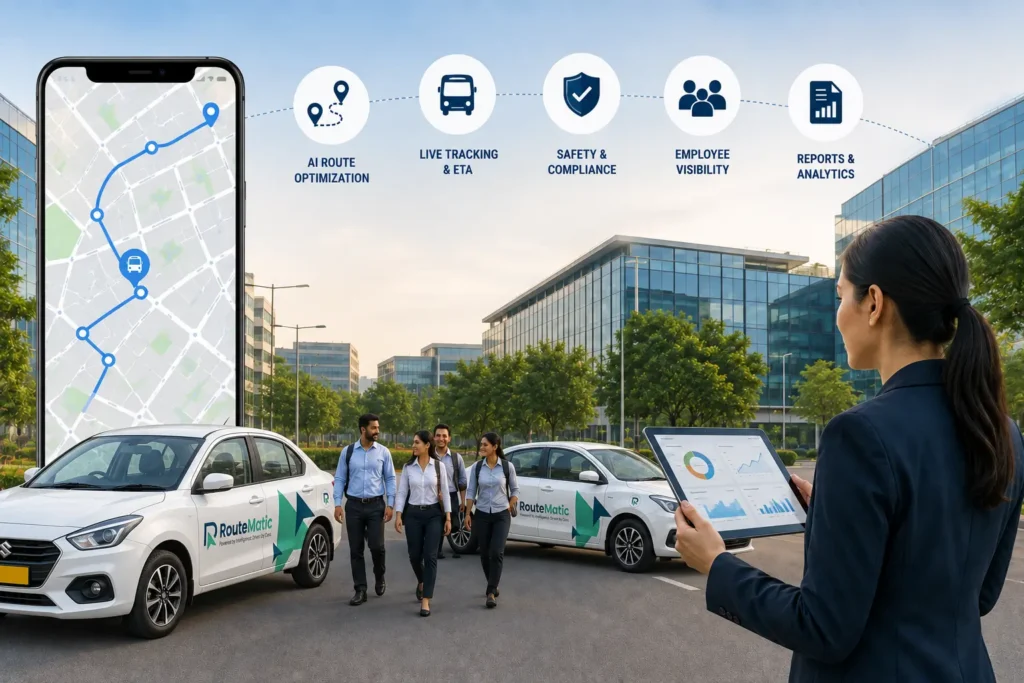
RouteMatic unifies rosters, AI-based routing, live tracking, and event-led billing in one platform. The system enforces pooling for lower cost per seat, pre-positions vehicles to reduce dead kilometres, and benchmarks on-time performance by corridor and time band. Safety is built in with verified drivers, geofenced corridors, SOS, and women’s safe drop, supported by call-back confirmation.
For finance, invoices are backed by trip evidence to shorten month-end closure and reduce disputes. For office cabs in Bangalore and other metros, this integrated approach keeps service reliable despite traffic variability.
How to run a 14-day proof of value
- Pilot at one large site with two peak shifts and mixed corridors.
- Track cost per seat, ETA variance, dead-kilometre ratio, no-show rebalancing, safety adherence, and dispute-free invoice rate.
- Conduct a mock month-end reconciliation using event-led evidence.
- Hold a joint review with operations, HR, and finance to approve scale-up.
Conclusion
For enterprises, the office cab model delivers the controls that matter to finance and HR. Pooled routing reduces cost per seat. Verified drivers and geofenced corridors raise safety assurance. Event-led billing simplifies reconciliation and cuts disputes.
Ride-hailing remains useful for ad hoc needs, but for predictable daily commutes, an enterprise office cab program supported by robust Mobility Solutions is the better operating system. With RouteMatic, organisations get a single, auditable flow from planning to payment, stronger compliance, and a commute employees can trust.