Let’s face it. When we talk about electric vehicles and clean transport, the spotlight usually falls on shiny new cars or last-mile delivery services. But there’s a quieter, more powerful driver of change hiding in plain sight: the daily office commute.
Yes, really.
While India works to reduce its position as the world’s third-largest greenhouse gas emitter, one major opportunity is hiding in something millions of employees do every single day go to work.
And it turns out, this predictable, high-volume movement might just be the green mobility opportunity we’ve all been overlooking.
Why Corporate Transport Crucial in India’s EV Shift?
India’s employee transportation market is set to reach $13.2 billion by 2030. That growth is fueled by the rapid rise of Global Capability Centers (GCCs), growing attention to employee well-being, and mounting ESG expectations.
The takeaway? Enterprises are uniquely positioned to lead the shift to cleaner commutes. They already have the scale, the systems, and the structure. What they need is a smart way forward.
What Does a Scalable Green Commute Look Like?
It’s not just about swapping diesel for electric. A real shift means rethinking how fleets are deployed, how routes are optimized, and how drivers are supported.
Here’s what that looks like in action:
How to Identify Ideal Locations for EV Fleet Deployment?
EV rollouts work best in dense urban hubs — think Bengaluru, Pune, Hyderabad — where routes are predictable, and infrastructure is evolving. Tailoring deployment to actual route complexity and charging availability is the difference between a pilot and a long-term win.
How to use AI to Optimize Smarter and Greener Fleet Management
Routing tech has come a long way. Today’s AI-led systems can:
- Match vehicles to shifts based on load and battery health
- Route EVs to charging stations automatically
- Cut idle time and boost utilization
That’s not just sustainable, it’s reliable, and that’s gold in enterprise transport.
Think Beyond the Vehicle: Support the Driver
Let’s talk about economics. EVs often come with higher upfront costs, and many drivers simply can’t absorb the EMI. That’s where new ownership models come in.
We’re seeing more companies own the vehicles themselves and directly employ drivers, easing the financial load while improving service quality and speeding up adoption.
Plan Ahead, Predictively
The smartest fleets don’t just react, they anticipate. With predictive dispatching, companies can:
- Maximize EV use where it delivers value
- Keep ICE vehicles only where they’re still necessary
- Balance cost, performance, and carbon goals: all in real-time
What are some Practical Stratgeies for the EV Shift to EVs
EV adoption isn’t an all-or-nothing move. The smartest strategies are incremental, data-led, and deeply practical.
That means building charging infra as you scale, training drivers, and continuously refining operations.
How Can Green Commutes Help Meet ESG Mandates?
Let’s be honest. ESG used to be something you talked about in annual reports. Today, it’s front and center, shaping how companies are valued, how talent chooses where to work, and how seriously you’re taken by partners and investors.
And here’s the kicker: a big chunk of a company’s emissions isn’t from factories or flights. It’s from everyday stuff like how employees get to work.
That’s Scope 3. Harder to track, but impossible to ignore.
Greening the daily commute gives companies a real, measurable way to move the ESG needle. It cuts emissions, boosts inclusivity, and sends a clear signal that sustainability isn’t just a buzzword; it’s baked into how you operate.
Smart commute strategies help you:
- Reduce Scope 3 emissions in a way that’s easy to measure and report
- Improve accessibility and reliability for employees
- Build a brand that walks the talk on climate
- Stay ahead of evolving ESG mandates
The office commute is more than a ride, it’s a reputational lever. Use it well.
Real Stories, Real Impact, Some Golden Lessons Learnt
Take Pune. In just six months, one global enterprise reduced Scope 3 emissions by 18% and cut costs by 25% simply by switching to an EV-enabled fleet with optimized routes and shared mobility.
The result? Cleaner commutes, better efficiency, and happier employees.
Proof that sustainable transport isn’t just possible, it’s better business.
Build on a Platform That Brings It All Together
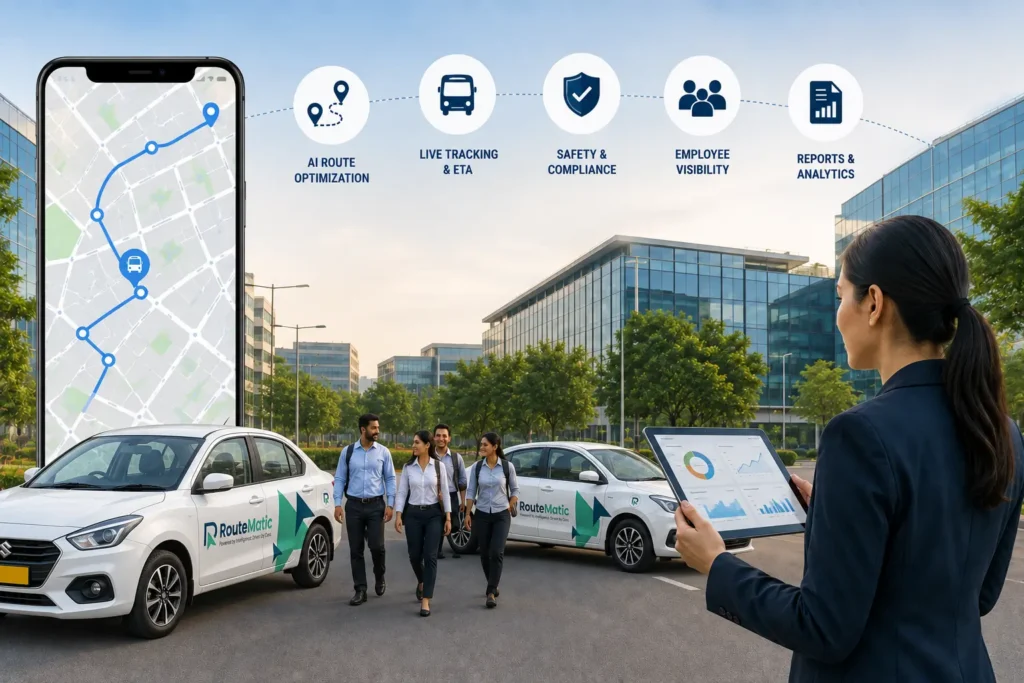
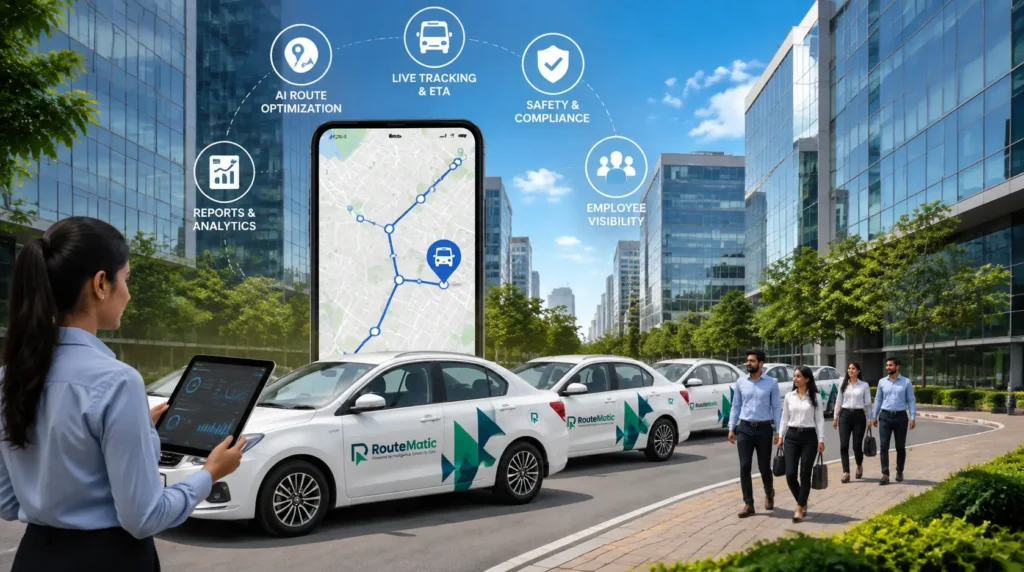
At the heart of any successful green mobility plan? A smart platform. One that helps enterprises:
- Optimize energy use and fleet utilization
- Enable ride sharing to lower emissions
- Deploy EVs in stages, based on data
- Track progress via real-time ESG dashboards
When operations, sustainability, and reporting live on one platform, it’s easier to connect every ride to a bigger goal.
Let me address some frequently asked questions:
The daily office commute, driven by corporate transport, presents a significant and strategic opportunity for India’s electric vehicle shift.
Companies can optimize by deploying EVs in dense urban hubs, utilizing AI for routing and fleet management, supporting drivers with new ownership models, and implementing predictive dispatching.
Green commutes help companies reduce Scope 3 emissions, improve employee accessibility, enhance brand reputation, and meet evolving ESG mandates.
India’s employee transportation market is projected to reach $13.2 billion by 2030.
The Commute Is a Climate Strategy. Let’s Treat It Like One
If India’s mobility shift depends on personal vehicle choices alone, we’ll be waiting a while.
Corporate transport has the scale, structure, and systems to lead not follow. And with rising expectations around sustainability, now’s the time to turn that daily commute into a powerful lever for change. The road to net-zero might just begin in the office parking lot.