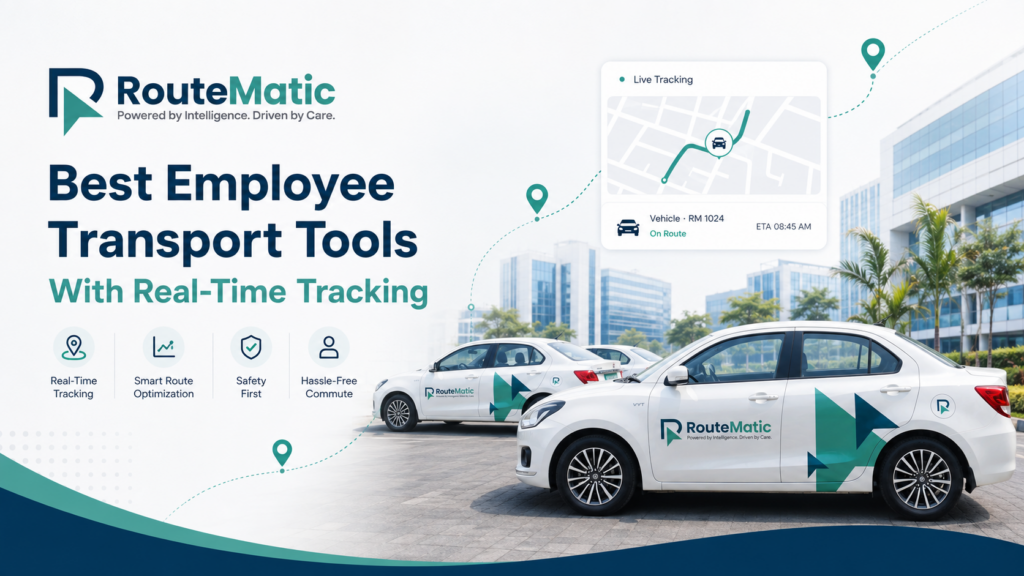
Under the Occupational Safety, Health and Working Conditions Code, 2020, which will be enforced from November 2025, employers are legally required to provide safe transport for women working between 7 PM and 6 AM. Beyond that legal baseline, a well-structured transport policy governs fleet standards, driver verification, billing accountability, safety protocols, and vendor management, all of which sit firmly in the employer’s lap, not the vendor’s.
Key Takeaways
- India’s OSH Code, effective from November 2025, requires employers to provide transportation for female night-shift employees.
- An employee transportation policy that relies on vendor self-reporting, manual rosters, and WhatsApp coordination is not a policy.
- Despite their invisibility in budgets, uncontrolled transport causes a steady drain on funds due to issues including overbilling, ghost journeys, and duplicate routes.
- Not only should route maps and pickup timings be included in India’s transport policy requirements, but driver verification, vehicle fitness, real-time trip monitoring, confirmation of the Female Safe Drop, and a recorded audit trail should also be included.
- Travel expenses can be reduced by 12-18%, and employee happiness can be measured when companies view travel as a governance role rather than a logistical one.
So, When did Your Company Last Actually Read its Transport Policy?
If you are managing employee commutes for a few hundred or a few thousand people, there is a decent chance your transport policy was written when the company was smaller, updated once or twice since, and now lives in a shared folder that nobody opens unless something goes wrong.
The new Occupational Safety, Health, and Working Conditions Code, 2020, has shifted the playing field considerably since it went into effect on November 21, 2025. You can’t just pass the buck to a third party when it comes to women’s night-shift transportation needs.
It is the responsibility of employers to ensure safe transportation arrangements, adequate security, and documented processes, as explicitly stated in the law. The approval of the female worker is now required before any night shift assignment, and proper safety, transportation, and security measures are now integrated into the statute, as stated simply in the Ministry of Labor’s own FAQ on the OSH Code.
What Most Corporate Transport Policies are Actually Missing
First, you should consider the scope of your present road policy. The transport coordinator should be contacted for more information regarding the schedule, routes, eligibility requirements, and pick-up and drop-off times. Most policies in Indian firms today take a shape similar to that.
What it usually does not cover is the part that creates actual liability.
No documented driver and vehicle compliance standards. Your policy probably says “verified drivers” somewhere. But does it specify what verification means, what background checks, license validation, and vehicle fitness certificates entail, and how frequently these are renewed? If a driver’s fitness certificate lapsed six months ago and something happens on a night shift, your policy will not protect you. It gave you a paper trail to the gap.
No Female Safe Drop protocol. This is the one that comes up most in audits and legal scrutiny. A documented, timestamped confirmation that a female employee was dropped safely at her residence is now an operational requirement in a structured employee transportation policy in India. A phone call from the driver to the coordinator does not count. Neither does a WhatsApp message. You need a digital record that can be produced in an audit.
No billing audit framework. Fragmented vendor models often result in “ghost trips,” in which a taxi is charged for a trip that never occurred. Your transportation expenses will gradually increase month after month due to route duplication across multiple suppliers and overbilling without digital verification. In the absence of automatic billing validation and a maximum billing closure timeline specified in your policy, you are effectively endorsing the vendor’s submission.
No escalation structure for incidents. What happens when a cab goes off-route at 1 AM? Who gets alerted, in what timeframe, and what is the response protocol? Most policies have a general “contact HR” line. That is not a response structure.
What the Law Actually Requires You to Have in Place
Let us be specific, because the OSH Code’s factsheet from the Press Information Bureau is clear: employers must make adequate arrangements for safety, facilities, and transportation when women work before 6 AM or beyond 7 PM. That phrase “adequate arrangements” has been further defined at the state level.
Less than 10% of the 9,935 women surveyed in 11 Indian cities by the Ola Mobility Institute felt secure using public transportation. Concerns about the safety of their commute prevented half of the respondents from taking advantage of an educational or employment opportunity. You put people’s lives in jeopardy and put yourself in legal jeopardy when your transportation policy doesn’t provide real safety infrastructure. You are deliberately taking steps to reduce the number of women working for you.
What Good Transport Policy Guidelines in India Look Like
Here is the real deal on each aspect of your company’s transport policy:
Eligibility and coverage. What is the procedure for employees working the night shift in particular, and who is eligible for transportation under what shift conditions? In this part, you should also explain what happens when a worker’s shift schedule or address changes.
Fleet and vehicle standards. The registration of commercial vehicles cannot be altered. Using one’s own vehicle for business purposes exposes one to legal risk right away. Air conditioning requirements, required GPS, night-shift CCTV, and the frequency of vehicle fitness certification are to be specified. These rules and regulations protect both employees and employers and govern India’s transportation policy.
Driver compliance. Drivers who violate conduct standards will be blacklisted, and there will be background checks, license validity checks, and alcohol checks prior to shifts. In addition to outlining how often this data is audited, the policy should state who holds this data.
Safety protocols. Setting up a live tracking system with alerts for when things go wrong, a panic or SOS button that employees can use while on the road, a way for female employees to check in with an escort, and a command center that is open 24/7 with real staff, not just a helpline that rings after hours.
Female Safe Drop. Instead of hiding this in a general safety provision, your policy should include a full section just for it. Explain how to handle unconfirmed drops that need to be escalated, and what digital, timestamped, and verifiable confirmation means.
Billing and vendor management. Set the maximum number of days for billing closure, the billing cycle, and the format for validating invoices. Outline the process for reviewing vendor performance, handling no-shows, and what counts as a billable travel. This provision of your policy is ineffective if your billing cycle exceeds 10 days and you are using a manual reconciliation process.
Why Transport Policy is a Financial Control Document, not Just an HR one
Here is a reframe worth taking back to your Finance team. Poor transport policy guidelines in India do not just create safety and compliance risk. They create direct financial leakage.
There were 4.73 lakh accidents and 1.70 lakh deaths in 2024, according to the Ministry of Road Transport and Highways. The real, quantitative risk of incident liability exists for business fleets that do not use vetted drivers, GPS tracking, or route monitoring. If you have a loose vendor arrangement, you may save money in the near term, but the legal, reputational, and operational costs of a single major incident will more than cover those costs.
Every day, poorly regulated transportation costs money, and that’s just one instance. Unbilled “ghost trips”: Due to poor route optimization, vehicle occupancy is low. Having three different vendors handle the same corridor results in route duplication.
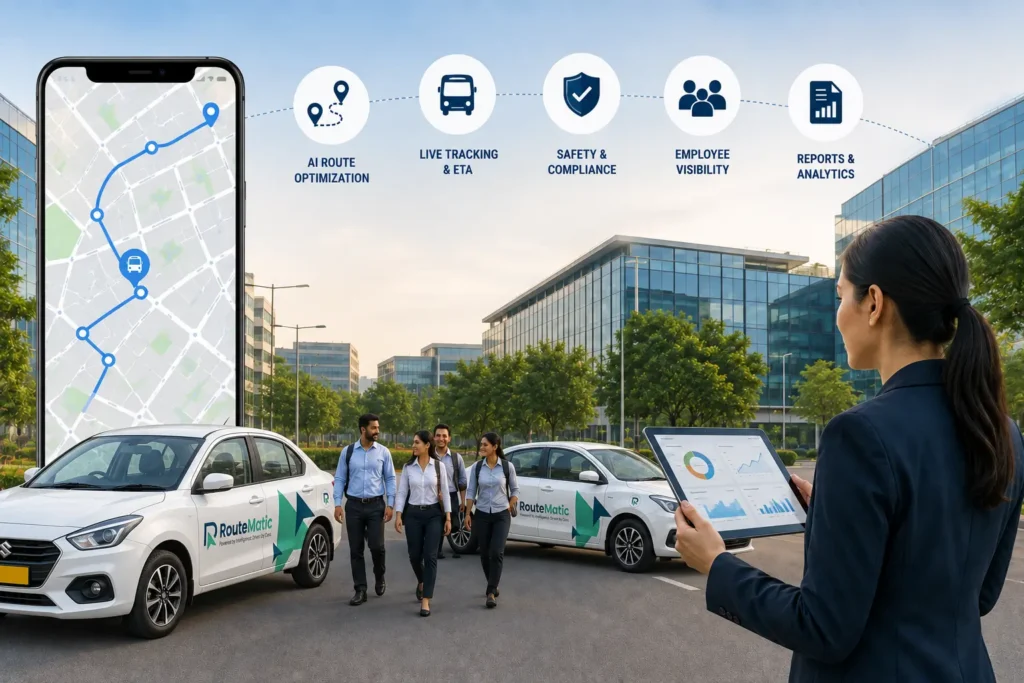
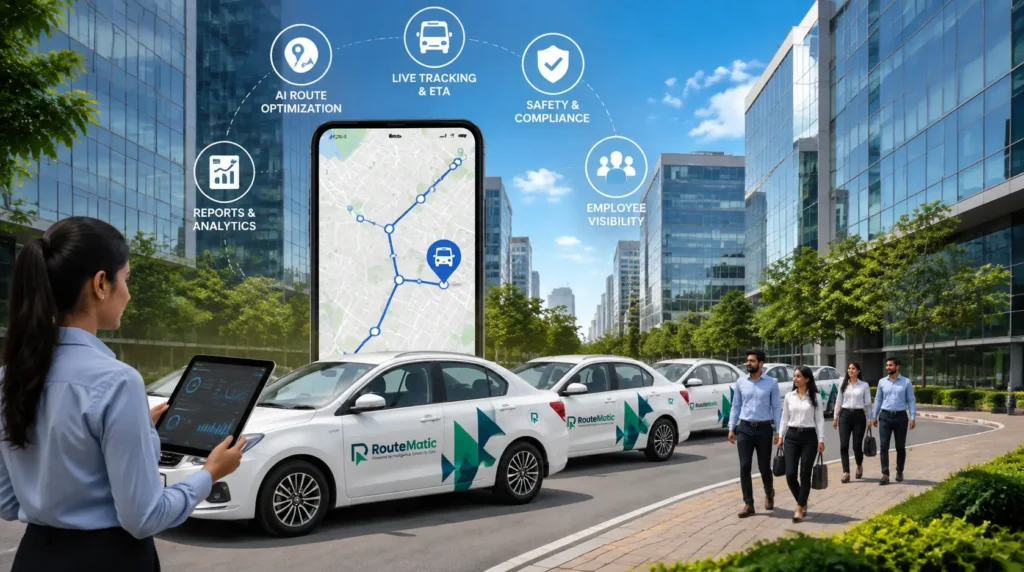
RouteMatic’s data across 400+ enterprise clients, including 125 GCCs and 38 Fortune 500 companies operating across 24 cities, shows that a structured, AI-driven corporate transportation service with automated routing, real-time monitoring, and digital billing consistently delivers 12–18% cost savings against unmanaged vendor models. No-show rates come down to 5%. Billing closes in under five days. Employee satisfaction sits at 4.9 out of 5.
FAQs
How does AI improve compliance in employee transport policy implementation?
Digital billing validation generates an audit-ready record of every trip, demand forecasts for vehicle deployment, automated Female Safe Drop confirmation, real-time route deviation notifications, and other tasks that human coordinators structurally cannot accomplish at scale are all handled by AI. At 2 in the morning, a WhatsApp coordinator in charge of 200 taxis cannot make a route change. A command center that is powered by AI can.
What financial leakages should a transport policy prevent?
Ghost trips, route duplication, poor vehicle occupancy, overbilling without digital validation, and manual billing cycles lasting more than 30 days without resolution. Finance will no longer have to worry about monthly reconciliations thanks to a well-written policy that defines billable trips, outlines the process for raising disputes, and sets a maximum timeline for billing closure.
How often should a corporate transport policy be reviewed?
At the very least, once a year, and right after any modification to regulations at the state level, any safety event, any major shift in personnel, or any new city expansion. Organizations with operations in more than one Indian state should keep tabs on state-level notifications issued in 2024 and 2025, given the rapidity with which labor codes will be enforced nationwide. Using RouteMatic’s Transport SuperApp, compliance and transport teams have access to a dashboard that displays activities in real time, enabling continuous monitoring with no human intervention required.
About the author

Arjun Bhojaraj Manipal
Chief Business Officer, RouteMatic
As Chief Business Officer at RouteMatic, Arjun Bhojaraj Manipal works closely with enterprises to solve complex mobility challenges through technology-led solutions. He shares perspectives on enterprise transportation, digital transformation, AI-powered mobility, customer success, and the trends shaping the future of workplace commuting.