Corporate mobility in India is no longer a simple operational task. As urbanisation accelerates and ESG commitments become central to enterprise strategy, the way organisations move their workforce has become a governance, financial, and sustainability issue. The choice of transport mode now affects cost structures, employee experience, regulatory compliance, and public ESG disclosures in equal measure.
India’s transport sector accounts for 14% of India’s CO2 emissions, with road transport responsible for 94% of all transport-related emissions, according to a 2024 analysis by the Observer Research Foundation. Under the Securities and Exchange Board of India’s Business Responsibility and Sustainability Reporting (BRSR) framework, listed companies are required to disclose Scope 3 emissions, including emissions from employee commuting. As a result, the transportation choices companies make directly impact their sustainability reporting.
In this article, we examine the primary corporate transport modes available to Indian enterprises today, the sustainability considerations associated with each, and how a technology-led approach to fleet management enables organisations to commute more efficiently and responsibly.
TL;DR
- Safety and compliance in employee transportation help businesses reduce risks, protect employees, and meet regulatory requirements.
- A compliant transport system focuses on verified drivers, vehicle checks, real-time tracking, documentation, and emergency response.
- Technology-driven solutions simplify compliance management through automated alerts, digital records, and monitoring.
- Strong transport practices improve employee trust, operational efficiency, and workplace safety across locations.
Modes of Corporate Mobility and Their Sustainability Impact
Each transport mode carries a different emissions profile, operational complexity, and suitability for different workforce sizes. The following section examines each mode in the context of Indian enterprise operations and the considerations enterprises should take when building a structured commuting programme.
1. Employee Shuttle Services
The employee shuttle is the most widely adopted corporate transport mode among large Indian enterprises, particularly in technology parks, manufacturing campuses, and BPO operations. When seat utilisation is optimised, a well-loaded shuttle generates far lower per-capita emissions than an equivalent number of individual cab trips.
Transitioning to electric shuttle fleets further strengthens this advantage. Tata Motors’ deployment of electric buses at its Pantnagar plant, charged entirely by a 16 MW solar facility, is expected to save approximately 1,100 tonnes of CO2 annually, according to Tata Motors’ own reporting on the initiative.
Key sustainability advantages include:
- High passenger density reduces per-capita emissions significantly compared to individual transport
- Electric shuttle fleets generate measurable Scope 3 emission reductions reportable under BRSR
- AI-based route optimisation reduces fuel consumption and vehicle kilometres per shift
2. Cab and Sedan Services
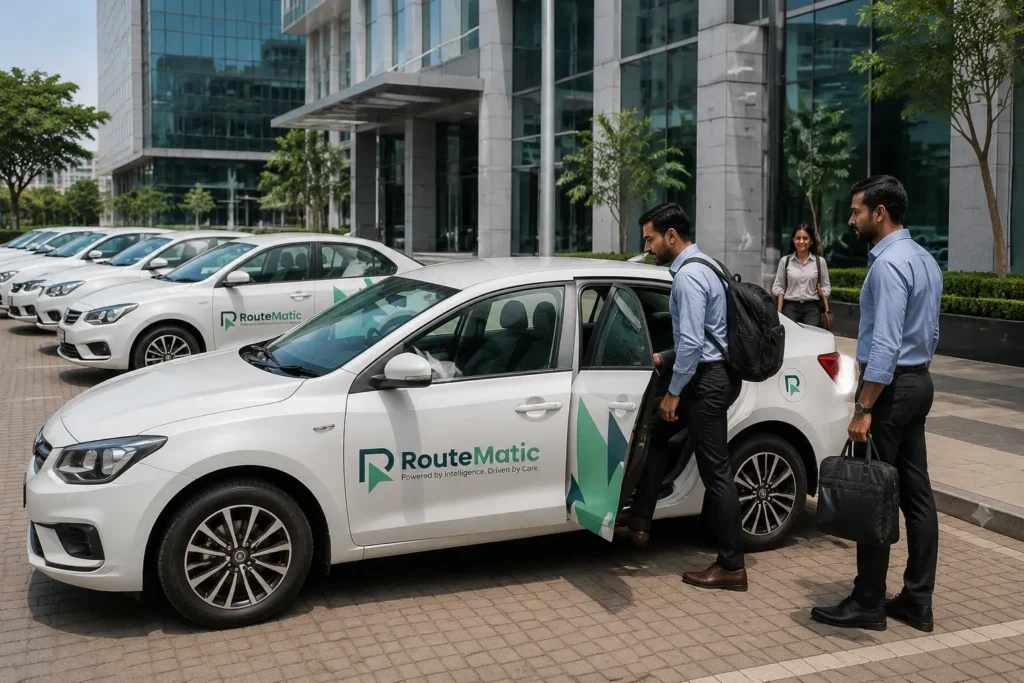
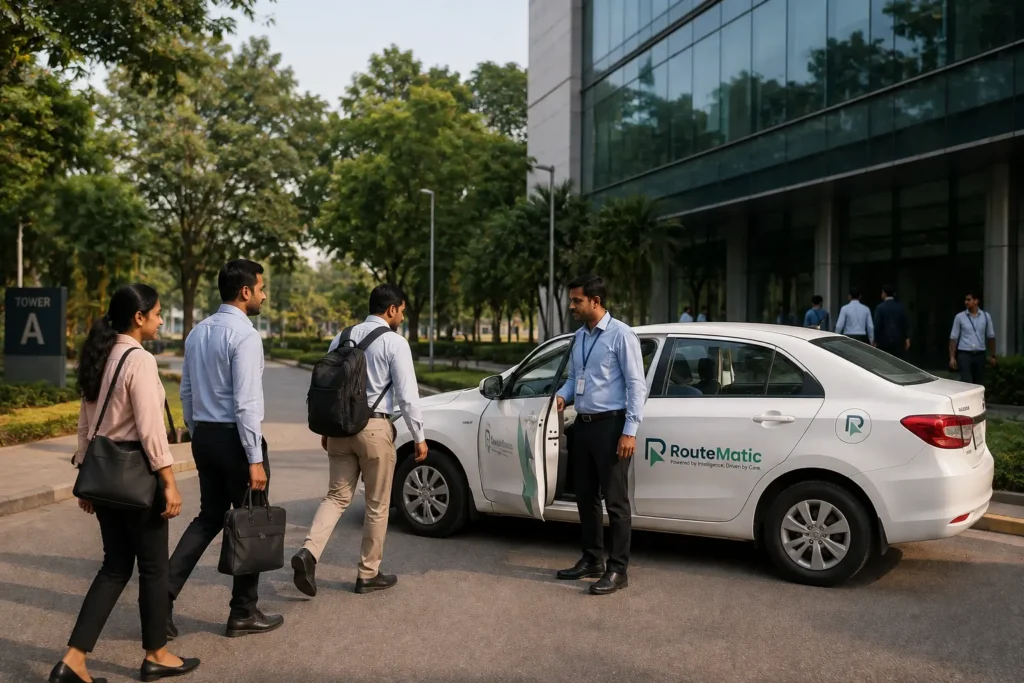
Point-to-point cab services remain essential for senior employees, night-shift workers, and locations where shuttle aggregation is not feasible. A 2019 Ola Mobility Institute survey found that 91% of women across 11 Indian cities felt public transport was extremely unsafe, making individual cab services with verified drivers and real-time tracking a non-negotiable requirement for night-shift female employees.
Several state regulations across Tamil Nadu, Karnataka, and Maharashtra mandate specific safety protocols, including escort requirements, for women on late shifts. Without a verified, GPS-tracked fleet, enterprises face significant safety and compliance exposure. Our safe drop and women’s commute safety systems are built around these exact requirements.
From a safety and sustainability standpoint:
- Transitioning from diesel to CNG or electric cabs reduces per-trip emissions without compromising service levels
- GPS-based trip-level billing eliminates revenue leakage and supports cost transparency
- Driver verification and safe drop confirmation are minimum standards for compliance and safety
3. Public Transport Integration and Last-Mile Connectivity
Public transport, including metro rail and city buses, represents the most resource-efficient mode of corporate mobility in urban India. The rapid expansion of metro networks across Bengaluru, Hyderabad, Delhi, Chennai, and Pune is creating new opportunities for enterprises to redesign their commute programmes to be metro-first. The practical limitation is the last-mile gap.
Enterprises that invest in structured feeder services to metro stations, rather than door-to-door cab coverage, are achieving meaningful reductions in fleet size, cost per trip, and overall emissions. Corporate mobility strategy insights discuss how hybrid commute models are being structured around public transit in Indian cities.
The environmental benefits of this model include:
- Metro integration dramatically reduces per-capita transport emissions for eligible employee cohorts
- Electric feeder vehicles bridge the last-mile connectivity gap sustainably
- Structured transit allowances combined with shuttle feeders reduce both cost and emissions
4. Carpooling and Shared Mobility
Replacing multiple individual cab trips with a single pooled vehicle carrying several employees reduces both vehicle kilometres travelled and per-trip cost proportionately. AI-driven route matching that optimises pickup sequences and vehicle fill rates further amplifies this efficiency. Despite its advantages, carpooling adoption in India has historically been limited by concerns about flexibility.
Structured pooling through a managed platform, where the matching algorithm, vehicle quality, and driver verification are controlled at the enterprise level, addresses most of these objections and delivers both cost savings and emissions reductions. Our analysis of how employee transport solutions cut costs consistently shows that pooling optimisation is among the highest-impact operational levers available.
This shared mobility approach supports sustainability through:
- Pooled vehicles reduce fleet size requirements and lower capital expenditure
- AI-matched carpooling minimises empty seat kilometres, the primary source of cost inefficiency
- Structured pooling data supports auditable Scope 3 emissions calculations for BRSR disclosures
5. Electric and CNG Vehicle Fleets
Road transport in India remains heavily dependent on fossil fuels, with petrol and diesel accounting for more than 80% of the transport sector’s energy consumption. Transitioning corporate fleets to EVs and CNG alternatives is therefore one of the highest-impact levers available for enterprises seeking to reduce transport emissions.
Government incentives under the FAME II and PM E-DRIVE schemes have reduced the cost differential for corporate fleet operators. For fixed-route shuttle operations with predictable daily distances, electric vehicles offer the clearest path to near-zero emissions at scale. EV fleet management and ROI analysis outlines how enterprises are calculating the financial and environmental case for fleet electrification.
The transition to cleaner fleets delivers:
- EV fleet integration directly reduces Scope 3 emissions with verifiable trip-level data
- Fixed-route shuttle operations are the most suitable use case for EV deployment
- CNG conversion is a practical intermediate step, where EV charging infrastructure is still developing
6. Non-Motorised and Active Transport
Non-motorised transport, including walking and cycling, accounts for more than 25% of passenger trips in Indian cities with populations over one million, according to NITI Aayog’s urban mobility analysis. For corporate campuses specifically, active transport supports within-campus movement and reduces dependency on motorised vehicles for short intra-campus distances.
Several large campuses in India have introduced cycle-sharing pools and pedestrian infrastructure as part of their sustainability and wellness programmes. While the emissions impact is modest relative to fleet electrification, active commuting contributes to the social dimension of ESG reporting under the BRSR framework’s employee health and safety disclosures.
Beyond emissions reduction, active mobility contributes through:
- Active mobility reduces intra-campus vehicle dependency for short distances
- Employer cycling infrastructure contributes to employee wellness reporting under BRSR
- Active commuting incentives paired with last-mile transit support strengthen overall commute programme quality
Corporate Transport Modes at a Glance
Different transport options offer different benefits in terms of cost, employee convenience, emissions reduction, and sustainability reporting. The table below provides a simple comparison of the most commonly used corporate mobility solutions and their relevance under ESG and BRSR reporting frameworks.
Conclusion
Selecting and managing corporate transport modes is no longer purely operational. For Indian enterprises managing large, distributed workforces, it has become a governance, financial, and compliance responsibility that spans ESG reporting, cost control, and employee safety simultaneously.
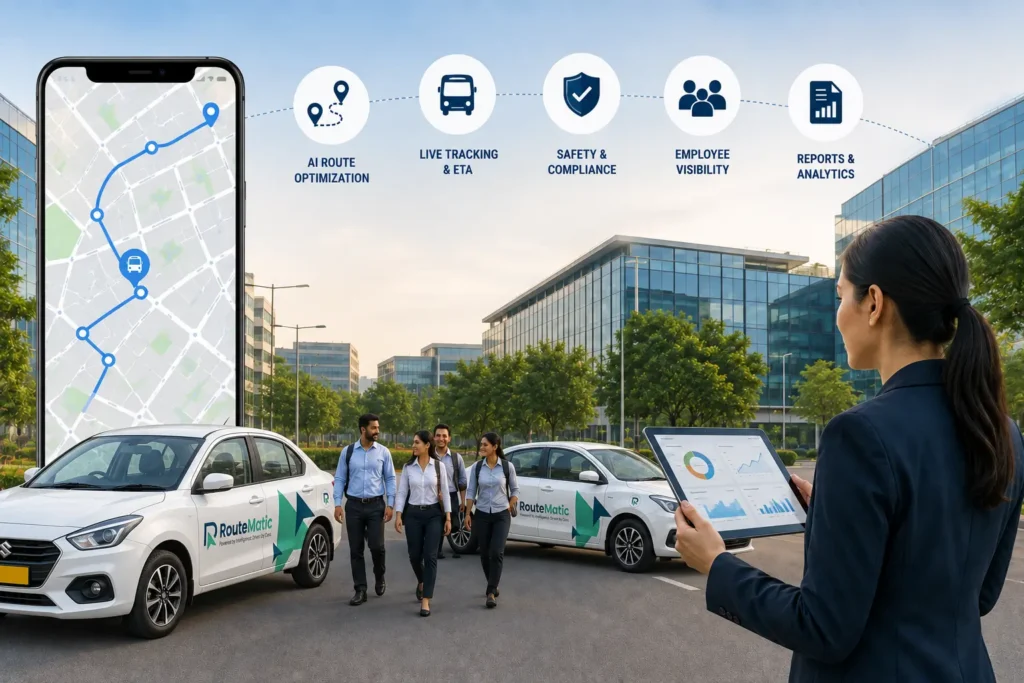
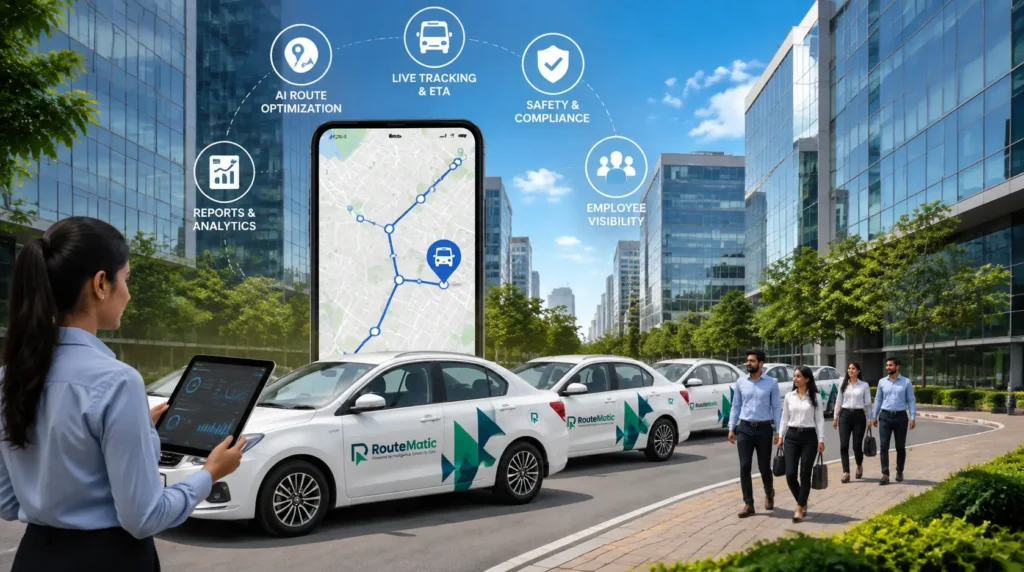
The most effective mobility strategies in 2026 combine multiple modes matched to different employee segments, shift requirements, and geographic contexts. Shuttle electrification for high-density routes, metro integration with managed last-mile connectivity, AI-optimised pooling for dispersed workforces, and compliant cab services for night shifts together form the architecture of a sustainable commuting programme. Technology is what makes this multi-modal approach operationally manageable. Without a centralised system for route optimisation, vendor management, real-time tracking, and emissions reporting, enterprises cannot achieve the visibility and accountability that structured corporate mobility now demands. Learn how our employee transport management software helps enterprises manage all transport modes from a single platform, with full operational control and ESG-ready reporting.
Frequently Asked Questions
What are the main modes of corporate mobility in India?
The main corporate transport modes in India include employee shuttles, cab services, public transport with feeder connectivity, carpooling, EV and CNG fleets, and active transport for short distances.
How does transport choice affect ESG reporting?
Under the Securities and Exchange Board of India’s BRSR framework, companies must report Scope 3 emissions, including employee commuting. Cleaner transport options like EVs, pooled rides, and public transport help reduce reported emissions.
What is the most sustainable corporate transport mode?
Public transport, especially metro rail, is the most sustainable option due to its low per-person emissions. Where public transport is limited, electric shuttle services are an effective alternative.
How can companies manage multiple transport modes efficiently?
Companies can manage multiple transport modes through a centralised transport management system that handles route planning, vendor coordination, tracking, billing, and emissions reporting in one platform.
About the author

Sandeep Padhi
Chief Operating Officer, RouteMatic
As COO of RouteMatic, Sandeep Padhi brings extensive expertise in transport operations, fleet management, and enterprise mobility. He shares practical insights on scaling transportation programs, operational excellence, compliance, driver ecosystems, and building reliable mobility solutions for modern enterprises.