Poor commute experience costs you more than you think. Delayed pickups, non-compliant drivers, overbilling, and zero real-time visibility add up fast, not just in money but in employee trust. Improving service quality in employee transportation is not a one-time fix. It is a governance decision that affects HR, Finance, and Operations at the same time.
Here is exactly how to do it.
Understanding corporate mobility as a governance function, not just a logistics task, is the first shift that changes real outcomes.
Key Takeaways
- Service quality in employee transportation depends on compliance, real-time visibility, and billing accuracy, not just fleet size
- Routematic’s operational data across 400+ enterprises shows AI-led routing cuts transport costs by 12 to 18%
- On-time arrival and drop rates are the most reliable indicators of corporate transport service improvement
- Fragmented vendor ecosystems are the single biggest cause of poor employee transport service quality
- Standardised driver and vehicle compliance protocols directly lower safety risk and audit exposure
- Measuring employee satisfaction scores alongside operational metrics gives the full picture of programme health
Why Your Employee Transport Programme Is Underperforming
Most companies do not have a bad transport vendor. They have a broken system.
When you rely on multiple vendors across cities with no central visibility, things fall apart quietly. A driver skips the uniform check. A vehicle misses its maintenance date. A billing dispute drags into its third week. Nobody flags it because no single system is watching.
That is the real reason employee transport service quality drops. Not bad intent. Broken structure.
India’s employee transportation service market is projected to grow at a CAGR of 8.2% between 2024 and 2030, according to ResearchAndMarkets: more trips, more vendors, more exposure if your governance layer is weak.
Step 1: Get Real-Time Visibility Into Every Trip
You cannot fix what you cannot see.
Most transport operations still run on morning reports and end-of-day summaries. By the time a problem surfaces in a report, the employee has already had a bad experience. You need live trip monitoring across your entire fleet, every shift, not just on paper.
Real-time visibility means:
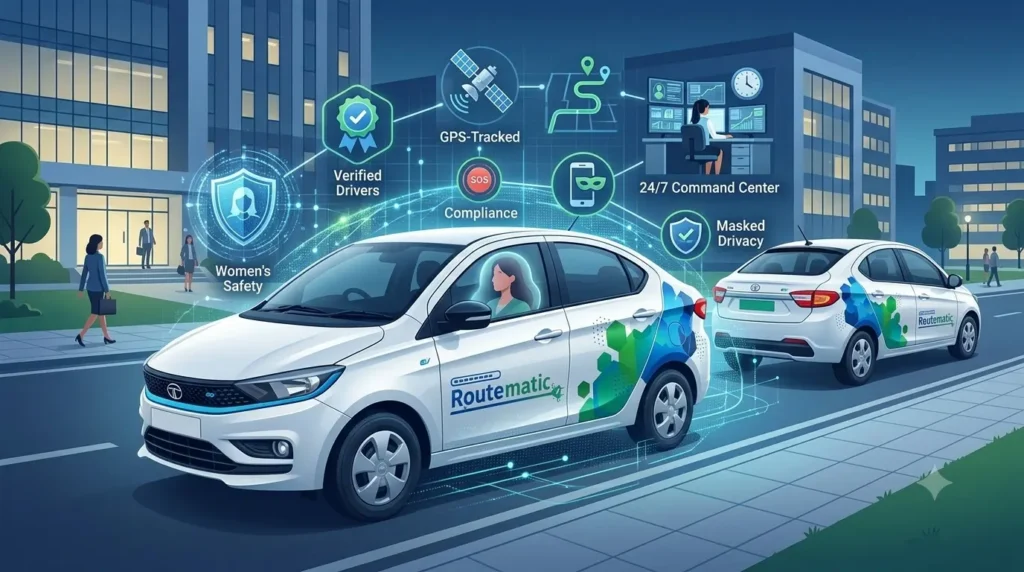
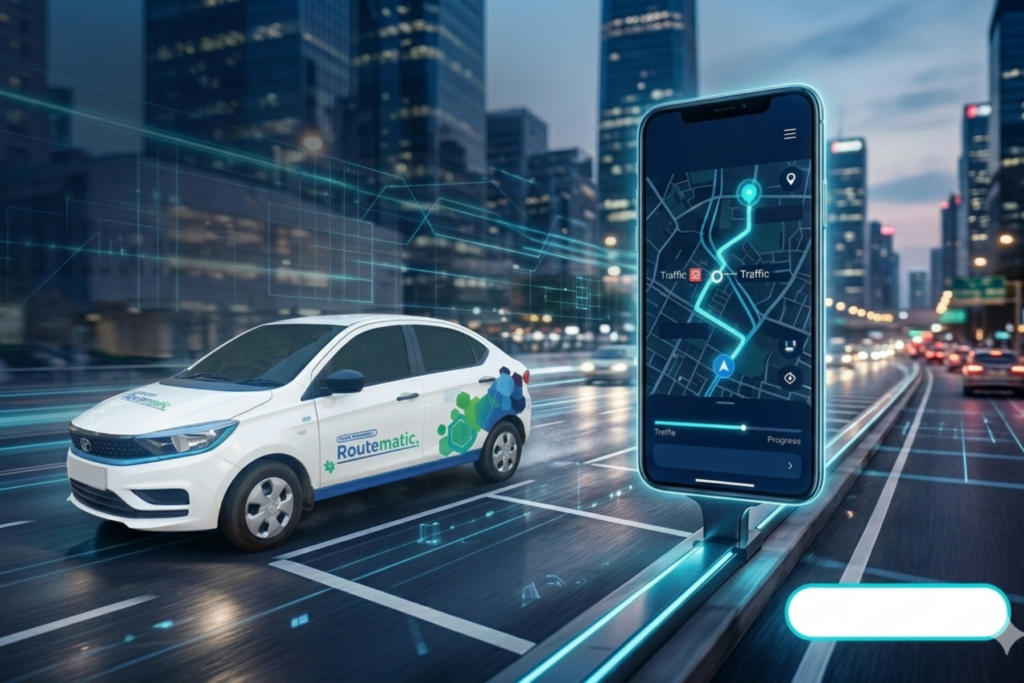
- Live GPS tracking on every vehicle across every shift
- Automated alerts for route deviations and delays
- A 24/7 command centre that intervenes before complaints reach HR
- Digital trip logs that build an audit trail automatically
When you have this in place, escalation overload drops sharply. Your team stops firefighting and starts managing.
Routematic monitors 75,000 daily trips across 24 cities from a single 24/7 command centre. That kind of live oversight is what separates a managed programme from a managed vendor.
Step 2: Standardise Driver and Vehicle Compliance
A compliant driver is not optional. For enterprises that run night shifts or transport women employees, compliance is a legal and reputational requirement.
Yet most vendor-led programmes have no standardised check process. Driver documents expire unnoticed. Vehicle fitness certificates lapse. Background verifications occur once and are not repeated. Sound familiar?
Corporate transport service improvement starts by locking down this layer first:
- 100% verified driver documentation before any trip assignment
- Scheduled vehicle inspections with digital sign-off
- Uniform and behaviour standards are enforced every day, not just during client visits
- Automated female safe drop confirmation after every night shift trip
According to Nasscom, the Indian IT-BPM industry employs over 4.5 million people, a workforce scale that makes standardised night-shift safety compliance non-negotiable for any enterprise transport programme.
Routematic achieves 100% driver and vehicle compliance and a 98% automated female safe drop confirmation rate across its owned fleet. Numbers like those are only possible with a standardised system behind them.
Step 3: Replace Manual Routing With AI-Led Planning
Manual routing is not cost optimisation. It is guesswork at scale.
When a transport admin manually assigns vehicles and routes, the decisions are based on yesterday’s data. Demand changes. Shift timings shift. Pickup points move. A static route plan accounts for none of that.
AI-led planning solves this directly:
- Forecasts demand based on actual employee travel patterns
- Clusters routes dynamically to cut empty seat kilometres
- Adjusts vehicle allocation in real time based on no-shows or last-minute additions
- Maximises vehicle occupancy so fewer vehicles cover more employees
Higher occupancy means lower per-ride costs. Better-planned routes mean employees arrive on time. And on-time arrival is the most basic, most visible measure of improving service quality in employee transportation.
Routematic’s AI routing has helped enterprises cut transport costs by 12 to 18% while holding a 97% on-time arrival rate. Want to know how that translates to your fleet size? That is worth a conversation.
For a detailed breakdown of what a structured programme looks like operationally, the guide on how corporate mobility platforms reduce employee transportation costs provides the numbers in detail.
Step 4: Fix the Billing Before It Becomes a Crisis
Billing leakage is silent and consistent.
Ghost trips, duplicate billing, and route duplication rarely show up as a single large error. They accumulate quietly across hundreds of trips every month. By the time Finance flags it, months of overcharging have already passed with no digital record to challenge it.
Improving employee transport service quality means closing this loop completely:
- GPS-verified trip data that automatically validates every invoice
- Digital records for every trip, every kilometre, every stoppage
- Billing closure within five days of the cycle end, not weeks later
- A clear audit trail that Finance and Compliance can access without chasing the vendor
Routematic closes billing within five days using automated trip validation. No manual reconciliation. No disputes dragging into the following month.
Before choosing a platform to manage this, reviewing a practical checklist to choose the right transportation management system will help you ask the right questions upfront.
Step 5: Measure What Actually Matters
Most programmes track cost and complaints. That is not enough.
Genuine corporate transport service improvement requires tracking the metrics that reveal the full picture:
| Metric | What It Tells You | Benchmark |
| On-Time Arrival (OTA) | Whether employees reach work on time | 97% |
| Employee Satisfaction Score (ESAT) | How employees actually feel about the commute | 4.9/5 |
| No-Show Rate | Missed pickups and planning failures | Below 5% |
| Female Safe Drop Rate | Night-shift safety compliance | 100% confirmed |
| Billing Closure Time | Financial governance health | Under 5 days |
All five benchmarks above are based on Routematic’s live operational data across 400+ enterprises in India.
When you track these together, you stop managing a vendor and start managing a programme.
Three Myths About Employee Transport Quality
“Better technology alone will fix our transport quality.” Technology without operational accountability changes nothing. A GPS tracker on a non-compliant vehicle is still a non-compliant vehicle. Real service quality in employee transportation needs both systems and the people behind them. Routematic’s enterprise data shows that compliance gaps persist even in tech-enabled fleets when there is no command centre accountability layer to back them up.
“Pooling vehicles is the same as cost optimisation.” Basic pooling puts more people in a cab. AI-led occupancy optimisation reduces the number of vehicles needed while maintaining on-time performance. Those are completely different outcomes with very different cost impacts.
“Employee transport is just an admin function.” It is a governance, risk, and financial control function. HR owns the safety liability. Finance owns the spend. Compliance owns the audit exposure. All three are affected every single day by how well your transport programme runs.
Quick Reference: Drivers of Corporate Transport Service Improvement
| Area | Common Problem | Fix |
| Visibility | No live trip data | 24/7 command centre with GPS monitoring |
| Compliance | Expired driver documents | Automated compliance checks before every trip |
| Routing | Static manual routes | AI-led demand forecasting and dynamic allocation |
| Billing | Ghost trips and overbilling | GPS-validated automated billing within 5 days |
| Measurement | Cost-only tracking | ESAT, OTA, no-show, and safe drop metrics |
The One Change That Moves Everything
Service quality in employee transportation does not improve because you switch vendors. It improves when a fragmented, invisible system is replaced by one with accountability built into every layer.
Real-time oversight, compliant fleets, AI routing, accurate billing, and the right metrics working together. Get all five right, and your transport programme stops being a liability and becomes a measurable business advantage.
See what a fully managed, audit-ready transport programme looks like in practice by exploring Routematic TaaS and requesting a demo tailored to your fleet size and city footprint.
What does your biggest transport headache look like right now?
Frequently Asked Questions
What is service quality in employee transportation?
Service quality in employee transportation refers to how reliably, safely, and efficiently your programme moves employees between their homes and offices. It covers on-time performance, driver compliance, vehicle standards, billing accuracy, and employee satisfaction. When all of these work together consistently, your programme qualifies as genuinely high quality.
How do you measure employee transport service quality?
Track five metrics: on-time arrival rate, employee satisfaction score, no-show rate, female safe drop confirmation, and billing closure time. These give you a complete picture covering operational performance, safety compliance, and financial governance. Cost alone tells you almost nothing about actual service quality in employee transportation.
Why does corporate transport service improvement require more than just new software?
Software gives you data. Improvement requires action on that data. Without a trained operations team, a live command centre, and standardised fleet controls, the data sits unused in a dashboard. Enterprises that see real corporate transport service improvements combine technology with full operational accountability.
What causes poor employee transport service quality in large enterprises?
Vendor fragmentation is the most common cause. When multiple vendors run routes across several cities with no central oversight, compliance gaps and billing errors are almost guaranteed. Consolidating into a single managed programme with a single audit trail fixes the root problem, not just the symptoms.
How long does it take to see improvement after upgrading your transport programme?
Most enterprises see measurable improvements in on-time rates and billing accuracy within 30 to 60 days of moving to a managed programme. Employee satisfaction scores typically improve over 60 to 90 days as consistency builds. Clear SLAs from day one give you a baseline to measure against.