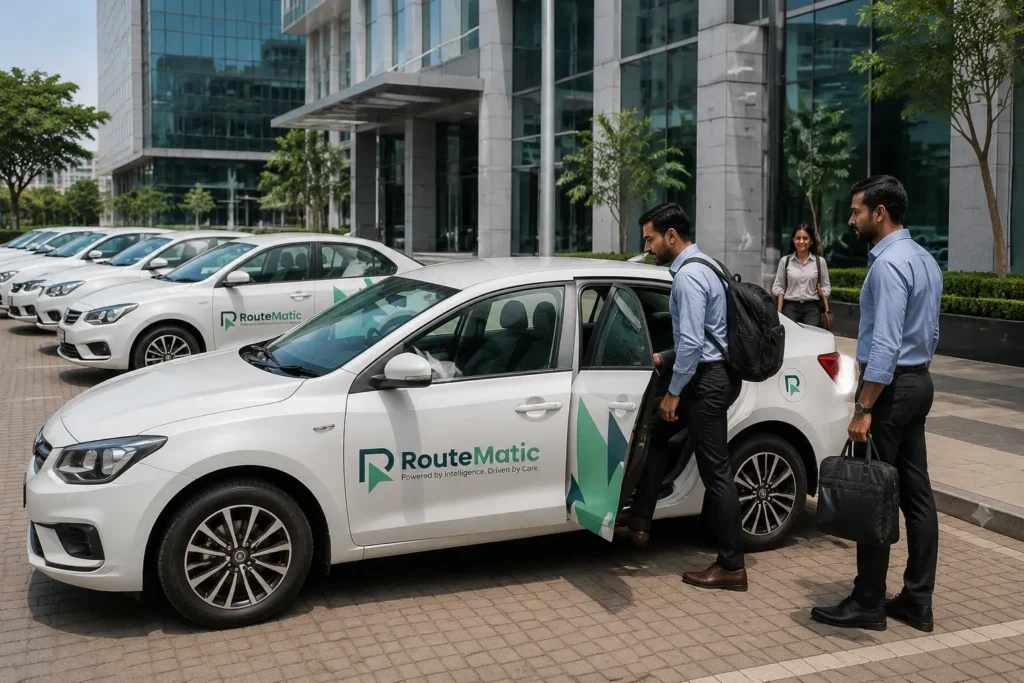
A good employee transport checklist covers six areas: demand and route planning, fleet and vehicle standards, driver compliance, safety protocols (especially for women and night shifts), real-time monitoring and audit trails, and billing accountability. The point is not to tick boxes. It is to turn employee transport from a fragmented, vendor-dependent operation into a governed system where safety, cost, and compliance are all controlled and provable.
Key Takeaways
- A complete employee transport checklist covers six areas: demand and route planning, fleet and vehicle standards, driver compliance, safety and women’s safety, monitoring and audit trails, and billing accountability.
- Fleet and driver standards are non-negotiable: commercial registration, current fitness certificates, active GPS, background-verified drivers, and pre-shift alcohol checks. India recorded 1.70 lakh road fatalities in 2024, which is why these cannot be optional.
- Women’s safety is now a legal checklist item, not a feature. India’s OSH Code, in force from 21 November 2025, requires employers to provide documented safe transport for women working between 7 PM and 6 AM.
- Safe-drop confirmation should be automated and timestamped, not a driver’s verbal say-so. Fewer than 10% of Indian urban women feel safe on public transport, per the Ola Mobility Institute.
- Billing accountability closes the quiet leaks: automated validation, a defined closure timeline, and a digital trace per trip. Structured operations deliver 12 to 18% cost savings by closing this gap.
Why Do You Need a Transport Checklist in the First Place?
Most employee transport operations are not run from a plan. They grew. You started with a few cabs, added vendors as headcount climbed, patched gaps with WhatsApp groups, and now you have a sprawling operation that nobody fully oversees.
That works until it does not. Usually, the wake-up call is an audit observation, a safety incident, or a finance team asking why transport spend keeps climbing. By then, you are fixing things under pressure.
A checklist to manage employee transportation flips that. Instead of reacting, you build the operation around a structure that holds up to scrutiny before scrutiny arrives. And the stakes are real. The Ministry of Road Transport and Highways recorded 4.73 lakh road accidents and 1.70 lakh fatalities in 2024 on a provisional basis. For any fleet moving employees daily, safety is not a soft concern. It is the core of the operation.
The market is moving this way, too. The global corporate employee transportation market is estimated at around USD 40 billion in 2025, and the organized, technology-led segment is steadily gaining share from informal vendors. Companies are professionalizing transport because the old way is no longer defensible.
What Should Your Demand and Route Planning Cover?
Start here, because everything downstream depends on getting demand right. If you do not know who needs transport, when, and from where, the rest of the operation runs inefficiently.
Your employee transport planning checklist for this stage:
- Map actual demand by shift, location, and day, not by assumption. Rosters change. Hybrid work makes the demand uneven.
- Use zone-based routing to cluster pickups and reduce empty-seat miles.
- Build in demand forecasting so vehicle deployment matches real boarding patterns rather than worst-case guesses.
- Account for shift timings specifically, including night shifts and rotational patterns.
- Define how address changes and ad hoc requests are handled without disrupting the route plan.
This is where manual systems quietly bleed money. Static routing and roster-by-spreadsheet lead to low vehicle occupancy and duplicated routes. AI-led routing and occupancy optimization are what actually move the cost needle, not basic pooling. This single stage is usually the difference between a transport operation that runs at 60% occupancy and one that runs efficiently.
What Are the Non-Negotiable Fleet and Driver Standards?
This section of your corporate transport management checklist is where compliance lives or dies. Get specific here, because vague standards are the same as no standards.
Fleet and vehicle checklist:
| Item | What to verify |
| Commercial registration | Vehicle registered commercially, not a personal car used for hire |
| Fitness certificate | Current and renewed on schedule, not lapsed |
| GPS tracking | Installed and active on every vehicle |
| CCTV | Fitted for night-shift vehicles per state rules |
| Vehicle condition | Clean, maintained, and air conditioning functional |
Driver checklist:
- Background verification completed and on file
- Valid commercial driving licence
- Pre-shift alcohol checks
- Defined conduct standards, including uniform and behavior
- A blacklist mechanism for drivers who breach standards
Technology alone does not enforce any of this. A dashboard can show you a driver’s name, but it cannot guarantee that the driver was background-verified or that the vehicle passed a fitness check this quarter.
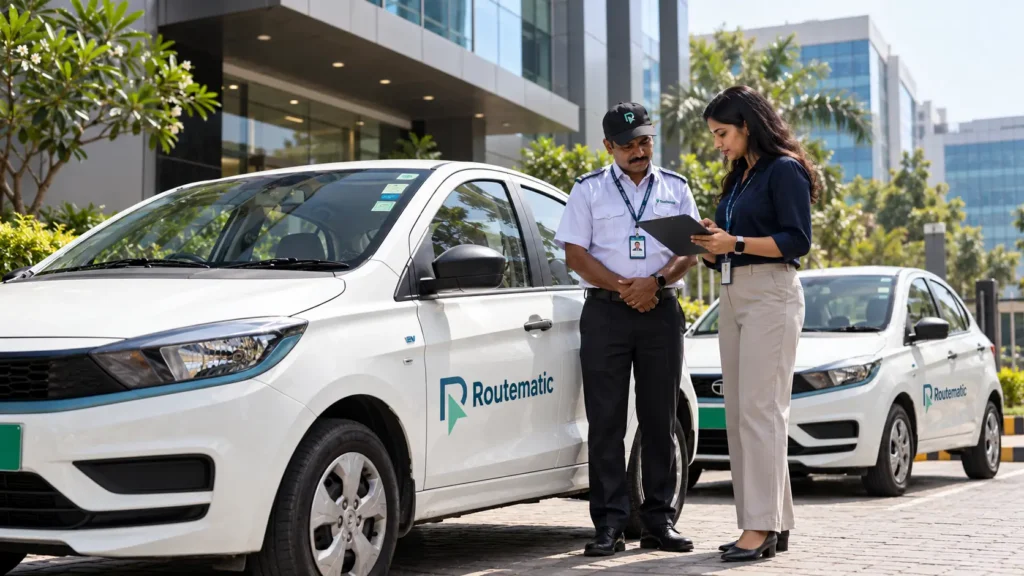
That enforcement requires operational accountability, which is exactly why owned-fleet models hold an edge over SaaS-only platforms that simply surface data over third-party vendors. Routematic runs 100% driver and vehicle compliance across its operations precisely because it controls the fleet rather than coordinating other people’s.
How Do You Handle Safety and Women’s Safety Compliance?
This deserves its own section because it carries the heaviest legal weight and is where unmanaged operations are most exposed.
Since 21 November 2025, India’s Occupational Safety, Health and Working Conditions Code legally requires employers to provide safe transport for women working between 7 PM and 6 AM.
The Ministry of Labor’s own OSH Code FAQ confirms that adequate safety, transport, and security arrangements are now built into the statute, and that the woman worker’s consent is required before any night shift.
The reason this matters beyond compliance: the Ola Mobility Institute’s survey of 9,935 women across 11 Indian cities found fewer than 10% felt safe traveling on public transport. If your transport does not solve for this, you lose women from your workforce.
Your safety checklist:
- Live trip tracking with route-deviation alerts
- An in-trip SOS or panic function that routes to a staffed command center
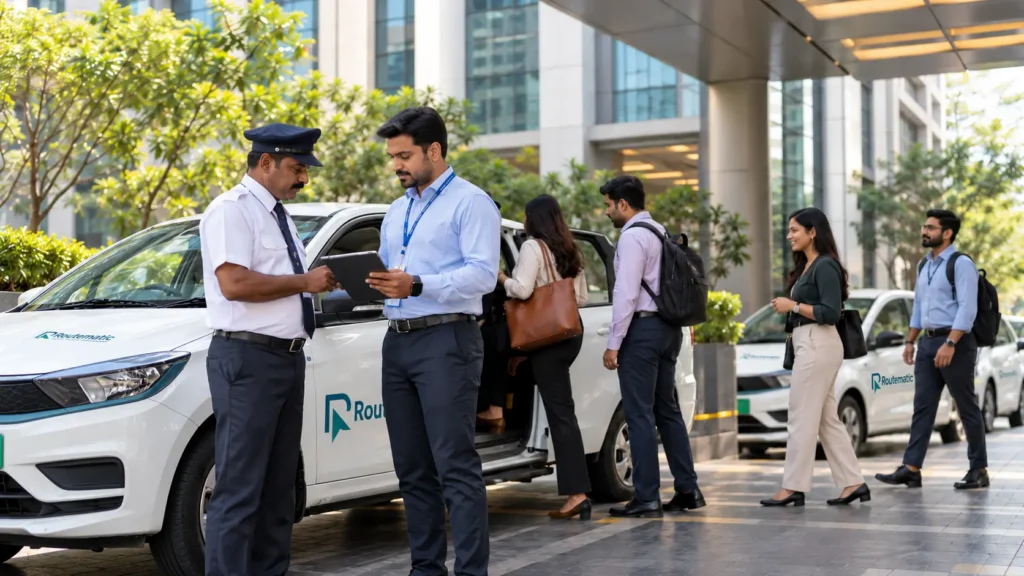
- A documented, timestamped Female Safe Drop confirmation, not a driver’s verbal say-so
- A 24/7 command center that actually answers at 2 AM
- Masked personal data so drivers do not hold employees’ contact details
On safe drop specifically, the standard worth holding any provider to is automated confirmation. Routematic automates Female Safe Drop confirmation on 98% of trips, with a manual follow-up call on the remaining 2%. Ask any vendor you evaluate for their equivalent number.
What About Monitoring, Audit Trails, and Billing?
This is the stage that finance and compliance teams care about most, and the one that fragmented operations handle worst.
Monitoring and audit checklist:
- Real-time visibility of every vehicle and trip
- A queryable audit trail: pick any trip from six weeks ago and pull the full record, route, driver, GPS log, and billing entry, on demand
- Closed-incident logs for any SOS or safety event
- Compliance certificate tracking with expiry alerts
Billing checklist:
- Automated billing validation against actual trips
- A defined maximum billing-closure timeline
- Clear rules on what counts as a billable trip and how no-shows are treated
- A digital trace for every charge
Billing is where the quiet money leaks. Ghost trips, route duplication, and overbilling without a digital trace inflate spend month over month. If retrieving last month’s trip-level billing data requires a vendor email and a three-day wait, you do not have an audit trail. You have a hope. This is a large part of why structured operations deliver 12 to 18% cost savings: the leakage simply gets closed. Routematic closes billing in under five days with a full digital trace behind every entry.
FAQs
How often should we review and update our transport checklist?
Review it at least annually, and immediately after any state-level regulatory change, a safety incident, a major headcount shift, or a new city launch. Given how quickly labor codes rolled out across Indian states through 2024 and 2025, multi-state operators should track state notifications on a rolling basis rather than waiting for an annual cycle.
Can a small company manage this checklist manually without software?
For a single location with a handful of vehicles, possibly. It breaks fast at scale. Once you are coordinating hundreds of employees across shifts and cities, a manual system cannot catch a ghost trip, flag an expired fitness certificate, or reroute a vehicle at 11 PM without a long phone chain that leaves no documentation. Most transport heads discover this after an audit, not before.
Who in the organization should own the transport checklist?
Transport or facility operations usually own execution, but the checklist should be visible to HR (safety and retention), Finance (billing and cost), and Compliance (audit and legal exposure). Treating transport as a purely administrative function is the root cause of the mistake. It is a governance layer that touches three departments, so single-team ownership without cross-functional sign-off tends to leave gaps.
What is the single most common gap you see in transport operations?
The audit trail. Companies often have decent day-to-day operations but cannot reconstruct a specific trip from weeks ago on demand, including its driver, route, GPS log, and billing entry. That gap remains invisible until an auditor or an incident investigation requests exactly that record, and by then, it is too late to build retroactively.
If your current operation cannot pass this checklist line by line, that is the gap worth closing before your next audit. Talk to Routematic to see how a governed, owned-fleet model holds up against every point above, with the compliance, safety, and billing accountability built in rather than bolted on.
About the author

Sandeep Padhi
Chief Operating Officer, RouteMatic
As COO of RouteMatic, Sandeep Padhi brings extensive expertise in transport operations, fleet management, and enterprise mobility. He shares practical insights on scaling transportation programs, operational excellence, compliance, driver ecosystems, and building reliable mobility solutions for modern enterprises.